Right, as discussed, let's get down to some proper planning. Or, perversely, for this post, un-proper planning. Let me explain.
Your clients will mostly likely be fully fledged marketeers. They'll have gone through higher education doing a marketing and marketing related degree and build their work around what they learned. Not only is much of what they have been taught out of date, is is fundamentally wrong, built on principles of economics and business that assume that all people make rational decisions and respond to incentives in a rational way.
This is, of course, untrue. We know know, through psychology, anthropology and Behaviorial Economics that people make decisions irrationally, intuitively and emotionally.
Still, they can be useful when thinking about the category alone, but they're useless when thinking about the brand, a valuable asset that, if managed well, should be less about the category and more about life. Successful, long lived brands occupy a role in people's and certainly don't play to category rules, they redefine them.
But there is no point ignoring the process and rules clients live by, rather, it pays to understand them and find a way to work with them.
To be honest, that's not really different to working with an agency proprietary process. Most agencies go about things the same way, they just sell it different. So if you have to work around TBWA's Disruption, MC Saatchi's One Word Equity or McCann's Brand Footprint (the most sensible and usable in my book) you'll be doing good thinking and post rationalising it to fit with with the process that's been sold in. It's not that different to working with traditional marketing processes and rules.
We've all got experience, since everyone's pretended to be interested in someone else's stuff to make them like us and trust us, it's called dating.
So we're going to take a look at some tried and trusted marketing models, how they work, why they're flawed and what to do about it.
So firstly, step forward The Ansoff Matrix.
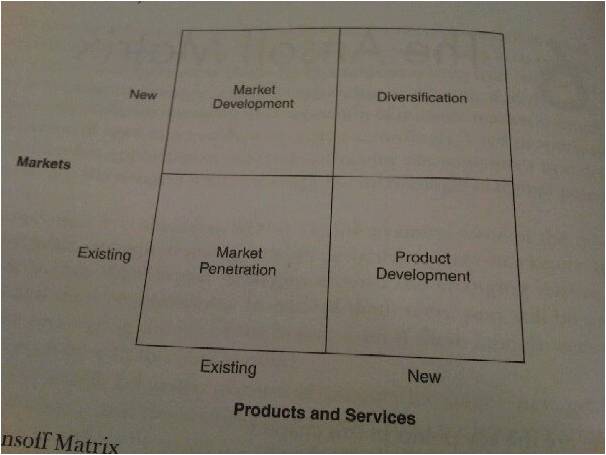
It's supposed to help develop thinking for how best to plot a strategy for growth through analysing the market.
It's main focus is on the rational benefits of your product and service and largely ignores the emotional and cultural aspect of the brand.
If it's used carefully, it can keep a brand healthy by encouraging collective brains to constantly think about opportunities for development in the immediate category your in, but it doesn't account for the value that brands add, and can ignore the business you're really in.
For example, it could be argued that Nike's real value is in personal growth, Apple might say it makes you more creative rather than helps you do computer type things.
Basically, it it gives you four options for growth by matching up existing and new products and services with markets that exist and possible new ones.
If you go to the bottom left, that's nearest, safe and warm area of comfort;Penetration. Now why on earth this is the case I don't know, but here, penetration doesn't mean going after a new type of customer, it means it means selling more to the type you have AND getting more of the same.
Now this is already a problem to me – that's actually two very different strategies, increasing frequency us very different to recruiting new ones, the same type or not.
Anyway, building loyalty is bloody hard and to be honest, without the brand magic that transcends the category, it is very, very rare to have more loyalty than anyone else.
Sainsbury's Try Something New Today is a good example of doing this well, and that tapped into a deeper need that was a part of culture – resolving the tension between growing popularity of cooking and the skills, time and budgets of real people with real jobs.
Now go to the top right and you have market development. Bascially, getting new customers to buy the product without changing it. Through new target segments, like Apple targeting more entrenched PC users
Or geography – like Morrisons going down south and taking the marketing 'upmarket'
Or just finding new channels to market – recently God knows how many retailers have gone online. But also, mobile companies have opened their own branded stores.
This is all good of course, but just focusing on product or service benefit throws up all sorts of problems. You need to look at the brand, how people feel about it and what it stands for (if anything). In many cases, it's too entrenched to stretch to new people or new places. HSBC launched packaged it's telephone banking service as First Direct because the potential customers rejected big bad financial behemoths.
John Lewis is brilliantly middle class, but would struggle to gain shoppers outside of the emotional heartland it's built.
Morrisons nearly came a cropper when it moved down South, it's Northern, common sense heritage just didn't wash. It was only when they used their fresh offering to communicate quality that things picked up.
Some brands can stretch, some cannot. Much of that depends on how they've built their relationship with people, if it's a big, human, cutural truth, that can stretch – Nike can use it's 'anyone can be an athlete no matter what their gender, background or race' to become relevant to all sorts of people for example. From being a brand for men to empowering women for example, but then again, their failure with skate parks made them buy Converse.
Coke can't target the health conscious with much credibility so bought Innocent.
So, yes, this get to the heart of why Ansoff's just isn't realistic, it doesn't measure brand value and doesn't take into account how elastic it is. Sometimes it can be made to work for new people, some times it can't. You can't thinki about decent market development strategy without it.
Now, lets move onto product developmentm making new products for existing customers. These rely on existing brand strength. Of course, they have functional benefits, but coming back to Nike, some people think the key point they were succesful was the Nike Air launch. It wasn't. The technology was available for ten years before that, with no success. What made the relaunch successful was getting the brand right.
Think UK supermarkets selling insurance, or immenently selling mortgages- it's only the trust people have in the brand that lets them do this. How on earth can Virgin sell cable TV and transatlantic flights? The brand provides the glue.
You can't have a sensible conversation about this without intangible brand stuff to come in. Again, how and where can we stretch – if it all.
The most difficult is complete diversification. New product to new customers. Straight away, you need to ask, what credibility do we have?
One way is partnership. Team up with someone with experience and credibility in that category – Guiness agreeing to Guiness flavoured Marmite for example, or Sony Ericson. But in both cases, it was as much about brand fit as product fit. Both Guiness and Marmite are distinct products that you either love or hate for example.
Yep, the brand muscles it's way into the conversation again. Now, if you want to attempt doig this without partnership, you really do need to be a brand built on values and a point of view rather than product attributes and even emotional ones wrapped around them. Virgin can do it, but even Nike can't go into, say fashion without looking stupid, it may be a cultural brand but it's built on sport.
So there you go, a whistle stop tour of the Ansoff Matrix. It's useful, it's a way of thinking about growth, but it's too wedded to the category and product benefit.
So if someone in a marketing department you're in, or work for, starts using this model as a basis the business strategy you've been briefed on, or wants to use it to frame some workshop exercises, be ready.
Don't reject it, praise it, talk about how useful it is to channel thinking about the immediate category and challenges for targeting, product innovation and distribution. But then proceed to work from your areas of expertise, your credibility – the real relationship the brand has in people's lives, its reas srouce of authority and it's role in culture. Be the champion of brand behaviour to augment the hard thinking the client is doing, or has done.
In other words, add value and channel what's good about this model into something even better.
Hope this helps.
 NORTHERN PLANNER
Leave a comment