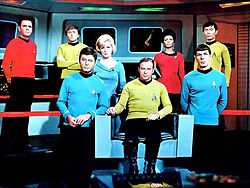
I wouldn't be the first to propose the notion those most market research about what people say they want or will do is pretty useless. It doesn't matter if that's NPD, creative development research or whatever. Research based on watching customers, observing them in their own environment, living with them can expose all sorts of opportunities. Expecting them to tell us what they want will not. Because they can't. We're all useless at predicting what we'll do,want or feel like because our frame of reference is how things are right now, or how they were. Look at Star Trek from the 60's and how archaic it looks, because it's based on how people looked and behaved in the 1960's.
Not to mention, we post rationalise what we've done anyway. Our memories work to make us feel about the past, for example believing we weren't that happy in a relationship when we get dumped – or believing we made a choice from careful consideration rather than gut instinct. Men have been proven to change their minds about how they felt in a sad situation – believing they were less emotional than they were because culture teaches us that 'men don't cry'.
So customers are pretty bad at creating the future for companies. And much of market research is about mentally removing risk for marketing folk. It's a placebo. It's snake oil.
Brands are accepted as future building tools though. But the idea of a brand doesn't always help that much either.
Companies spend a massive amount on 'brands' because they're seen as massively valuable when it comes to the bottom line. They have a point since for some of the biggest organisations, a significant proportion of the market capitalisation value (if they sold up) lies in the name, the reputation and the symbols in people's heads. If Coca Cola's entire production line blew up, they could still sell the company for billions on the name, the blood red colour and the instantly recognisable font next to the swooshy ribbon thing. Of course, maybe they would need to hold onto the secret recipe. Yep, brands can be seen as an 'asset' along with real estate, infrastructure or the R&D team.
But the people that own these brands are besieged by those who are, in many ways, nothing more than charlatans. Brand consultants, internal 'brand health directors' and the agency, design and, these days even digital partners who like to think of themselves as brand guardians.
It seems that every single one has their own version of how brands work, and, lets be honest, change it week in week out. From brand triangles, wheels, and onions to more exotic species like 'blueprints', 'disruptive brand idea', 'brand health pyramids' and even molecules.
Every week, if you follow the trade press (and hopefully you don't bother too much) there's a sparkling new methodology, tool or weird chart unleashed on the marketing universe, with all the furrowed brow gravitas of the discovery of the Higgs Boson or the key to cold fusion.
Brand people tend to have their own unique, all conquering recipe that will prevent, cure and eradicate all sorts of commercial problems.
Now only a fool would say 'the brand' is not a good idea, it's just that most have forgotten what that idea actually was. The way that mos claim they work and tend to use them is, at best, doesn't work and, at worst, causes more problems than the ones they're solving.
They stop us solving genuine problems
Most brand models have the brand as an end in itself. You move people from being 'unaware' through to considers to, God forbid, evangelists. Huge budgets are spent on brand objectives, 'awareness' 'consideration' and so on, without addressing real business issues. Decent advertising builds brands, especially stuff that makes people talk.If it uses relatively consistent symbols, themes and tone, it builds up long term recognition and distinctiveness. But this is an consistent outcome of all advertising (and I use advertising in it's broadest sense – DM, telly, digital, social etc) not the ROLE of advertising.
We're all here to use creativity and communications to solve business issues, mosty around how to grow sales. Thinking just in terms of brand issues gets in the way. I love this Chrysler stuff, love it. But I'm sure the brief for this wasn't 'we need a new relevant brand idea' but more like, 'People are put off buying our luxury cars because they don't want to be seen as ostentatious in times like these'. And it's not based on some ethereal brand idea, it's based on a truth – the cars are made in Detroit. This based on solving a very real business issue, not brand scores.
This was created to solve solve the issue that fashion has straight hair wasn't the fashion must have it once was and we needed to demonstrate the product could do a lot more.
Not solving brand problems, solving commercial problems in a way that continued to build the brand.
Claims on how brands work are exaggerated and in many ways, plain wrong anyway
The efforts of many organisations into measuring brand scores often come at the expense of delivering sales – assuming that if we get the brand scores right, sales will follow. Yet I've worked on more than one brand where the brand health scores are through the roof but sales are declining. In one case becaue penetratio in the one price bracket the brand was in has maxed out and was under attack from competitors. Leading to the search for product innovation.
Another argument is that if we get strong emotional loyalty, the more loyal and frequent their buying behaviour will be.
But both are not really true. In this book we discover that brand image etc tends to happen AFTER the actual purchase, how people's score brands alters from months to month anyway and loyalty in any category are pretty constant. And around half of sales come from people who don't very much ergo don't think about brands very much.
Just on the brand thing therefore, assuming no one is interested is by far the most sensible approach but still – solving brand problems rarely solves business problems. Solving business problems does!
Brands about your history, not your future
This is the source of biggest blockage to business building ideas. All that brand essence, values stuff is designed to be immovable. Unlike the rest of culture, brand are designed to stand the test of time. When in reality, people, markets, culture and economies are always changing and moving on.
At the very least, that requires re-evaluating the brand to new contexts and challenges. For example, I think Levis' Go Forth work moved from being a slightly sexualised symbol of youth rebellion through what you wear – very much part of you are what you wear – an irrelevant hangover from th 1980's and 1990's to a fizzing catalyst for the young to come together around and actually CHANGE stuff apart from just looking like they did.
The most stupid thing anyone can say is, 'That's not on brand' when they means it doesn't get a brand onion tick.
So, yes, brands are useful. They're useful to people because they help them not think about stuff. They're useful to organisations because they do add to things like market capitalisations rates, they do enable a measure of coherence. But they do not solve busines problems on their own. Building brands is an outcome, not the goal.


 NORTHERN PLANNER
Leave a comment