One of the problems with planners is their love of powerpoint. Scratch that, it's a problem with agency folk.

Endless stressing over the precise words that go into chart after chart, when, actually, a great presentation swings on people listening to what you're saying, not reading over-written charts.
For what it's worth, here's how I go about making presentation (when allowed to)….
Work on the three to five key points you want to make, rich hooks to hang your thinking on, stuff that's memorable. Make slides for them, mostly as great headlines and great visuals.
Then fill in the gaps.
But try and fill them with your personal script rather than more slides.
Or use props.
Create a new slide only when necessary, and never to help you remember your lines…rehearse, learn your script, so you're able to leave room for conversations and letting your audience in.
Anyway.
What's even worse in agency land is the way even simple meetings have to accompanied by powerpoint too.
When a conversation should do.When a conversation is much more useful than talking at each other. Presentations tend to sell, you don't sell in a relationship, you talk a bit and listen more.
A useful alternative to the powerpoint madness is the humble flipchart.
For a planner, there's nothing quite like jumping up, marker pen in hand, and drawing something to illustrate your point – looking as spontaneous as possible.
So people will continue to want you in the room for those sudden flashes of insight and interesting, graspable flashes of wisdom.
And flipcharts are interactive, or should be.
Interactive stuff was not invented when digital was. Making images jump up in keynote is not interactive, it's just polish.
Of course, spontaneity is hard.
So plan it.
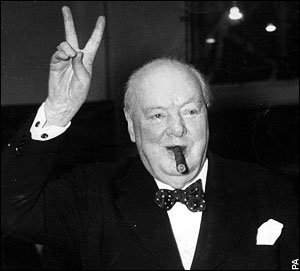
Once when someone asked Churchill one of the great orators of all times, what he was doing, he replied, "Preparing my impromptu remarks".
Work out what you want out of a meeting, what you feel you want to say, what you want people to take out of it, and plan your killer points beforehand.
And prepare some killer flipchart points too.
In fact, prepare an arsenal just in case.
For example………here's how you might talk about the fact that markets get more competitive the more they grow.
Iit doesn't matter if you're in a growing market or a mature one, a discussion about long term strategy eventually comes down to communications innovation or product innovation.
If you're talking to the average complacent marketing exec, you'll need to wake them up to the need for ads and stuff to be interesting and make folks feel stuff, rather than simply generating the right take-out.
Or remind them how un-special their product/service is in the face of the competition.
Or the fact that one day, it won't be.
So get up and draw them this….
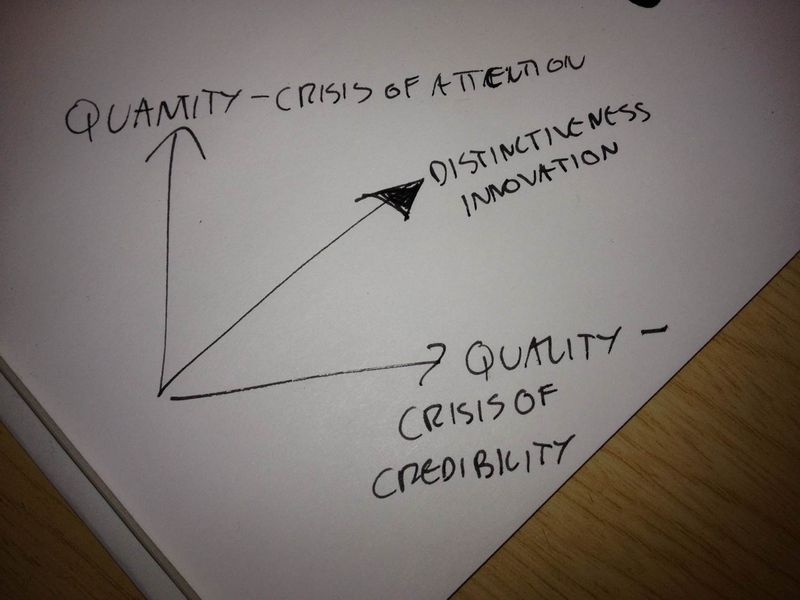
If you're lucky enough to be in a new market, you have the luxury of creating communications that should stand out because you're delivering 'new news'. But over time, other players always come in and it gets harder to stand out, especially when everyone in a category says the same stuff.
So the best advice you can give to a new brand is to appeal to the heart instead of the head and try and build 'fame' with stand-out ideas that make people talk. The more you 'own' that category, but even more, you're seen as a brand people care about in general, the harder it is for another brand to come in and steal share.
Coming back to all that Ehrenberg Bass work, you need to make as many people familiar with you as possible to build and sustain growth. The more people have heard of you and know what you're about, the more likely the brand is likely to survive over time.
Innocent did this at launch. It's no accident that there are few smoothie brands you're heard of also. And making people care defended them against own label copies. Yes, they've reduced price recently, in the face of a more thrifty culture, yes they do promotions more, but the price cut is less deep than it might have been.
(yes this ad is product attribute but wrapped in oodles of quirky, memorable tone of voice)
And when you're in a mature market, you're in the 'crisis of attention'. Lots of brand banging on about themselves, connecting emotionally rationally, the whole lot. Stand out communications become a must.
Because of the need for salience and distinctive memory structures.
Honda is a good example of this. In one of the most crowded (and samey) markets of all, they did car ads that no one had seen before. Which went a long way to building massive business value.
Now this is all well and good, but as much as many would love communications to the only solution to sustained growth, it just isn't.
Because when more and more brands enter the market, you end up with a crisis of quality. Your product just isn't special anymore. Yes, you can continue to build brand value, but that will only get you so far.
If you haven't read Why Most Things Fail by Paul Ormerod, you jolly well should.
He rigorously shows that KNOWING the future and predicting what will happen in any complex system involving people – an economy, a market or even the dynamics of a local supermarket price war – is doomed to failure. There are just too many variables.
The only route to continued success, survival even, is continuous innovation.
Ahead of the curve.
Writing the future, not waiting for it.
In other words, doing nothing guarantees nothing but failure.
Look at the way Apple's star is on the wane. They have a long way to fall of course, but they haven't lost share because of lack of distinctiveness of brand value.
They're run out of innovation. While Samsung have launched a credible alternative with the the Galaxy. While others have successfully launched mid-priced mini-tablets.
While they've started to rely on incremental improvements rather than great leaps.
Look at Yahoo, or Microsoft. Both got caught out by doing nothing about social before it was too late.
First Direct were a barnstorming success when they were first to market with telephone banking, but didn't innovate with online banking and now with phones and social, franky, they're behind the curve.
Yep, eventually, you have to innovate in the actual business of what you do, not just what you tell people about it.
That's where planning really gets interesting, when you're able to help innovate the business, even advise that RATHER than comms.
Helping clients n new markets see that today's game changer is tomorrow's has-been, and helping them build the innovation pipeline and make the business case for it.
Or helping clients in mature markets see that perhaps the problem isn't 'brand' or 'advertising' it's that the product just isn't special enough to justify the price position – or they're in a market that's doomed to fail.
Imagine if someone had told HMV they needed to build an MP3 offering before Apple launched Itunes?
Now, look at all all that waffle from one, badly drawn little diagram. Imagine talking a client through this stuff as you draw it up.
Hope it helps.

 NORTHERN PLANNER
Leave a comment