(Excuse the typing I've broken my wrist)
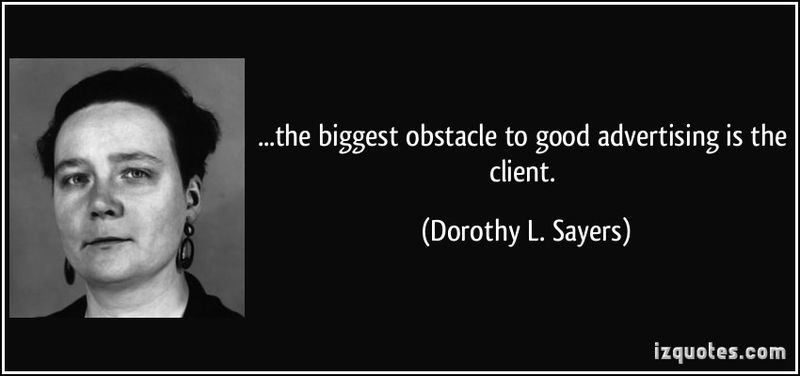
I hate this quote, really hate it. I loathe the way it shifts responsibility away from agency folk.
I hate the disrespect, you know, "Clients just don't get it, if only they would let me do what I wanted we would be so much more successful".
Yes, you know advertising, but they know their business, they know the board that signs stuff off. There is a reason people work in most types of agencies, they haven't the personality or skills to do a real job. Respect the people that do.
We're supposed to produce compelling work, that supposedly doesn't need a clear selling message. If you can't make your client sell compelling, you're in the wrong job.
Now I've been fortunate to have some lovely clients in my time. Some really good relationships.
Good enough to have me sat on their side while they were pitched to.
Even good enough with another client to sit with them while they talked colleagues through the process they'd just gone through in hiring another agency.
I suspect much of that is down to the fact I love the job, therefore love working on their stuff. Genuine enthusiasm gets you a long way, even more so when you're senior.
I also think it's because I'm very honest, trust me, I'm a useless liar.
It's not the looks, charm or talent mark my words.
I also got to hear Sara Leach of Coca Cola talking through the client perspective recently.
Distilling much of this, here's some stuff to think about.
1. When you're presenting, especially in pitches, just like advertising should leave some space for the consumer, leave some space for the client. In major presentations, clients are faced with well honed arguments, great theatre, charm, wit and the sheer force of slide after slide of crafted persuasion. It can be quite intimidating, especially if you can't get a word in. Find a way to draw them into a conversation. Because when we feel fear, or uncomfortable it's fight or flight. You don't want that.
2. In reviews of work, I usually find a way to give feedback last, or not even give it. Because I need to entertain an idea a bit before I decide what my view is. With clients, agencies push for immediate feedback on the work they have just shared, right at the point they are struggling to process what their opinion is. Push them to share and they'll share something they might not mean and then stick to it. And the default reaction is to add some builds, builds that turn into issues that kill your entire project. Don't push for immediate feedback unless they really want to give it.
3. Listen to feedback. Clients do want to be challenged, but they don't want to be ignored. Try and discern what is up for debate and what is not. You MUST actually listen to feedback and show you've taken it on board. In between tissue meetings and final presentation, the number one loser of pitches or work getting rejected, is that agencies haven't listened to clear feedback- or even worse, they've ignored it.
4. Be likeable. My favourite client ever once told me,"You can be great at strategy, wonderful at execution, you can be the cheapest, but if we don't like you, forget it". Of course, some agencies ARE successful with the whole arrogance thing, but being cool and mistakenly thinking you work at CDP and it's 1976 only gets you so far. Some agencies get hired for being totally brilliant, but I know of one hot agency where the client hated their guts and kept with them as long as they delivered the goods. But as soon as they cocked up-and you always do- they were toast. No one perfect, good will and trust gets you past the moment you make a pigs ear of it.
5. Keep things clear. There is more jargon than ever. Clients can't be arsed to de-code your work, and they usually have to present it on, make it easy for them.
6. Stop working so hard. Done is better than perfect. Good clients pay you to be on time. They also pay you for what you think. Spend a little less crafting the powerpoint and more time getting a tight argument – in fact, a little imperfection is good, is gives clients the chance to correct you and feel they are playing a part.
7. Clients are human too. There are wankers who enjoy making you work weekends, but most are uncomfortable working with pale faced ghosts who look exhausted. See point 4.
8. Get the bloody set up over as soon as you can. They're sitting there waiting to see the ads, the plan, or whatever the main output is supposed to be. Get out of the bloody way. Most strategy bits of decks tend to be about looking clever, rather than helping. And be brave, show them the ads first, show them the proposition, then tell them how you got there. Surprise the poor bastards instead of showing basically the same deck over and over again. It's boring, and bored clients fire you.
9. Their hours are shorter than yours. But don't mistake that for an easy life. It's a cultural thing that they leave on time, but that puts them under pressure to cram more into the day – and only 10% of what they do is advertising and brand stuff. They don't get to lounge around and have the banter that we do, it's serious and intense. And their offices are usually grim, grey affairs with no decent tea or coffee. So no wonder they like their agencies to be fun. But also, respect their time, give them plenty of notice if you need stuff approving, their days are choc full in ways we are less used to.
10. Would they like to spend a couple of hours on a train with you? Boil it all down, especially for planning folk and they want smart intelligent folks they could have a chat with. The smart and intelligent bit is about being interesting, especially if you're shy and introverted like me, read lots of stuff, know a little about a lot of things. As for the having a chat bit, find out what they care about and know something about it, even better, just listen! Ask questions, lots of them and you'll find out what you might have in common. So, if you found yourself on a train with a client, what would you both do? Have an easy, natural chat, know each other well enough to even read in silence? Or would you pretend not to notice each other. If it's the last, you're fucked (see point 4)
 NORTHERN PLANNER
Leave a comment