• Thanks to the wonders of Typepad allowing you time when posts are published, by the time you read this I will be on a train bound for London. I’m off to see Prince this weekend.

    Prince

    This little man is the Marmite of music, you love him and hate him. I happen to think Prince is brilliant.

    Rewind back to the Brit Awards 1996. Prince walks off the stage to thunderous applause, after finishing a blistering set, a little smile on his face. He’d killed them again..after all these years, teh daft name change, the duff albums, he still had it in him to just blow them away.

    It was exactly the same expression I’ve seen every time I’ve seen him live. On stage there is quite simply no one to touch him. From the moment he comes out to the final encore, he has you and he won’t let you go until he’s given you a good seeing to. And he plays guitar at least as well as anyone else out there.

    On record of course, he’s been a different proposition recently, mostly average, sometimes good, now and again with flashes of the old genius, which makes him even more frustrating.

    Maybe someone can only be that brillaint for so long, like Bowie’s run that started with Ziggy Stardust and ended with Scary Monsters. And mark my words, he was that good. He may have used a lot of infuences, but for a awhile there was nothing like Prince. He was a mass of contradictions; painfully shy off stage while charismatic enough to blow an audience away on it, deeply religious yet one of the perviest singers ever, neither black nor white, androgenous….these tensions peppered a string of albums that started with For You and ended with Lovesexy. Prince’s music had a dirtiness, a danger that few others could touch. And the wild experimentation meant that his albums sounded like nothing else.

    It’s not for everyone, and for some it’s hard to get past the image, but that’s a real shame. He was breathtaking.

    For_you

    He was still really good until the horific name change saga, but less focused with some terrible experiments with rappers, and the music became too polished, safe even.

    What’s really scary is the songs most people won’t have heard. Lots of people will mention Purple Rain, but Sign ‘o’ the Times sounded like it came from another planet. You can really here the claustophic urgency of a man working alone in a studio. And much of his best stuff wasn’t released…songs like Crystal ball and Crucial. Incedible creativity that most will never hear.

    It’s a sad comment in the way he lost it that Bog George from the Black Album is funny comment on gangsta rap, yet 5 years later he was trying to copy the very thing he’d mocked.

    But tomorrow night, it will be Prince live. And you just know that by the end of the night he will have that smirk again. He’ll have blown us away yet again.
  • Stumble

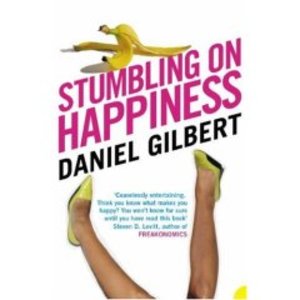
    Stumbling Happiness by Daniel Gilbert is not a self-help book, despite Mrs NP’s attempts to wind me up. It’s a treasure trove of insights into how humans behave. It’s littered with little truths that explain how we behave like we do…..but the heart of the book is about how we’re useless at predicting how we’ll feel about something in the future.

    When we try and picture the unknown, we simply cannot avoid doing it from our own frame of reference. I had the misfortune to work in call centre once, and whenever I have to talk to talk to some poor sod reading from a script now, I always picture them in the building I worked in, despite the fact their office will be different.

    It’s just like that predicting the future, we fill in the gaps with what we know now………and nine times out of ten, we don’t know were doing it.

    That’s why you need to be wary of any research asking people how they will feel about something, or what they might do. This filling in from our current frame of reference means that it’s likely we’ll say one thing now and do something different later.

    There are other bits I think are worth sharing another time. At least it’s a break from all the science nonsense.

  • More science geekery, but last bit for a while I promise. This is maybe the weirdest post I’ve ever written, but so be it.

    When you go down as small as atoms, they are all basically the same…….which seems a bit odd since everything we observe in the universe that exists at our size is so wildly varied. It’s all made of the same kind of stuff, how can it look so different?

    A possible explanation they’re throwing around is the idea of the universe acting like some sort of supercomputer, outputting a version of the universe we all see, while not really being the REALITY of it.

    Helpentercompressed

    Don’t make that face, it’s not that far fetched when you think about it. An electronic computer combines a simple code to create 3 dimensional looking images. Think of atoms as bits of code that all look simple until you pull back and get chemical structure, and then pull even further back and get cats, dogs, stars and people.

    When you think of things like this, everything we see is precisely that – shimmering information, no more permanent or real than the picture you see on your PC screen. It’s not real, it’s made of thousands of pixels, and the pixels themselves are made of simple code, imagine the world as a three dimensional computer screen and you get the picture, as it were.

    BUT a computer’s information is manipulated by a physical architecture, usually stored in a computer chip. Some information theorists believe the world is like that…the information has no meaning without someone to READ IT, and it needs a system to process it.

    From our point of view, subatomic stuff is like putting a magnifying glass to a computer screen and looking at the pixels. But we have to understand the processing architecture BEHIND those pixels to make sense of how the universe works.

    Anyway, we’re all made of stars, the atoms in us are billions of years old, and billions of years later these borrowed atoms will still exist, but we won’t. If we’re fleeting patterns in this long term information, in what sense are we real?

    Computers use 2 types of information, that’s it. The entire universe is built from standard particles……and these atoms are mostly empty space. So what’s really more important, the real solid stuff that isn’t (mostly) there, or the information it conveys? Like Lego.

    The bricks are standard, but imagine you’ve built a cathedral model for them, but the next day all human culture is wiped from th earth, but the cathedral remains. In what sense is it anything more than a pile of bricks without us to process the information it imparts as a ‘cathedral’?

    Legodeathstar2

    When you think like that, on what level does the universe exist without beings like us to observe it? To give it meaning? And that not so daft either.

    Electrons are really important, it’s these little things that give us electricity when they flow. But we don’t really know what are, and when we try to observe them, it alters what they will do. How does it know you’re looking? Quite seriously, if you fire an electron at a wall with two holes in it and don’t observe it, the results show it went through BOTH. Yet when it’s observed, it goes through one or the other.

    If we do test on an electron to see if it behaves like a wave – it does. But if we do another to see if it behaves like a particle, guess what? You got it, particle it is.

    Are we making these things happen by watching them? Is what we see nothing more than information created by sub-atomic code? Hold on! I’ve see a film about that!

    Matrix

  • Sampling goes to the heart of good quantitative research. The research agency will be responsible, but you need to be able to judge appropriate proposals.

    It matters. There’s no point doing it unless it’s with the audience you think you want to affect.

    Sampling is a trade off between making the sample is big enough to give confidence in the findings and not being too expensive. It needs to be big enough to give a reliable reflection of what you’re audience as a whole thinks, but size is nothing without recruiting a REPRESENTATIVE sample.

    As a rule of thumb:

    Samples of less than 100 should be treated with caution.

    Samples of 500 are robust enough to leave out any margin for error.

    Remember, if you want to sub-sample, like maybe looking at two life stages within a sample, the 100 rule still applies.

    Of course, you can get scientific  and look at ‘sample error’. This is a calculation that lets you know that if you repeated the survey, the likelihood of the same answer is xx. Bigger samples always means smaller error.

    It depends on the scale of the answer too though. Like if 95% of your sample say they like chocolate, that’s pretty clear cut. But what if 50% of people say that?

    Ask the research agency. It matters. Here’s an example:

    Spontaneous brand awareness = 20%

    Sample size                           = 400

    Sample error                         = 4.3%

    So the real answer                 = 20% plus or minus 4.3%

    Since quant is about proof, make sure your proof is reliable!!

  • Right, back to that ‘to do list’.

    How do you decide between quant research or qual? Some of that will be governed by the type of client you have, or the agency you work in for that matter.

    But in the end, it will depend on the the information you want.

    Quant is:

    Measurment

    Logig, deductive

    Hard facts

    Literal

    How much questions

    How many questions

    Qual is:

    Understanding

    Initiative

    Feelings, emotions

    Descriptive

    Interpretive

    Why questions

    In what way questions.

    Put another way, quant research is for when you know what question to ask, you know what you want to prove, and NEED to prove it.

    Qual is for probing, and it’s cheaperm not to mention much quicker. If you need to explore and gain new understanding, that’s what qual’s for.

  • This story from the New Scientist (gist only I’m afraid, they charge for the whole thing) turns the received wisdom about the importance of breakfast on its head.

    ‘Eat a good breakfast it’s the most important meal of the day’, they say. Well sometimes it’s worse than going hungry, at least for mental performance. While a low GI breakfast works to help boost memory performance, its not so good for tasks that require a very quick reaction, so if you want to return a tennis serve, or win a game of snap, it may be better to do without.

    Coco_pops_monkeyx150

    Makes sense really, you can imagine evolution making hungry animals more alert so they can catch dinner……..

    And if your stressed, be careful, breakfast may make you feel worse!

    I wonder what Tony the Tiger would say.

  • There haven’t been any recipes for awhile so heres a belter of a curry. Half an hour, and I swear it’s better than a take-away.

    You need:

    Tin chopped tomatoes

    1 large onion. finely chopped

    1 finely chopped clove of garlic

    1 teaspoon turmeric

    1 teaspoon chilli flakes (more if you like it hot)…you can chop up a fresh chilli which is better though, it goes in at the same time as the onion. If you like it hot, keep the seeds in.

    2 teaspoons of garam masala

    Handful of freshly chopped coriander

    Massive handful of fresh spinach (optional)

    Get 2 tablespoons of olive oil hot in pan, over the hob. Put in the onion and cook unto it goes brown around the edges, this should take about ten minutes.

    While it’s cooking, whiz the tomatoes in a blender – don’t ask me why this works, it just does!

    When the onion is cooked, throw in the garlic and stir for a couple of seconds, then  put in the tomato with the spices and half the coriander. Turn the heat up and stir really well until it all goes glossy.

    You’ll have a very thick sauce. At this point, if you want meat with it, throw whatever it is in and stir fry for four minutes…..or prawns for that matter. Then add any vegetables you fancy and stir for another minute.

    Then top up the mix with enough water to nearly cover the vegetables, meat, whatever. Be conservative with this, you don’t want is going too thin. To add depth to the flavour, you may want to add stock instead of water..vegetable chicken, whatever suits.

    Bring it to the boil and simmer uncovered for 20 minutes. Then throw in the rest of the coriander and the spinach, stir really well, when the spinach wilts you’re done.

    You can serve this with rice (must do cooking rice at some point) but it’s great stuffed into pittas too.

    If you’re feeling racy, roasting a punnet of fresh tomatoes and whizzing (replacing the tin) them is amazing, as is coconut milk at the end.

    By the way Fee and Chris love the tomato soup recipe. There’s a bonus baked beans recipe in the comments, which they loved. Visual evidence is here.

  • Gareth’s doing the next project, so expect something brilliant. Have a look at his better ways of working stuff, it’s top.

    Paul and Rob want to do it again, and so do I at some point. Since Rob did it more recently than Paul, maybe Paul shoulf go next followed by Rob. After that, I’ll have another go, unless anyone else wants to step in.

    Everyone happy with that?

  • While were on the subject of evolution, here’s some stuff on a galactic level that will really bake your noodle. Just look at this picture first. At first glance it’s stars, but it ISN’T. Those smears of light are galaxies, so far away we’re seeing them as they were billions of years ago. The distance between them is unimaginable. Makes you feel small no?

    Deao_field

    We’re very lucky to be here. If the universe was only slightly different, not only would life be impossible, so would be a stable universe for us to live in. There are only four forces in the universe that matter; gravity, electromagnetism and the strong and weak nuclear forces. If they were slightly stronger or weaker, the universe would be a big mess. Like if gravity was a weaker, suns would die out too quickly to sustain planets……or even create the dense matter we’re all made of.

    Sounds like someone designed it that way doesn’t it? The instant the universe came into being these four laws came into play. But they didn’t have to, they could have been different. The odds on it being like it is are too big to take in. So the survey suggests we got a helping hand?

    Maybe not. We wouldn’t be here is the universe was different, we wouldn’t be around to marvel at how unlucky we were! Since we here, it’s easy to marvel at what looks like divine interventio… but it seems that universes are created all the time. We just happen to be in one like thisWe’re just one of them.… If you could see all the universes out there, it may change your view.

    Maybe it’s a bit like believing the love of your life is perfectly designed for you, some mystical soulmate, the ONLY person out there because you’ve met them, and not the other potential loves of your life.

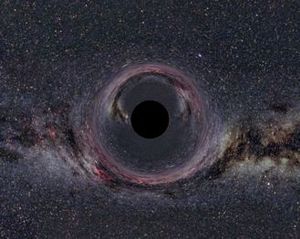
    So what has this got to do with evolution? Well, the universe came from a pinprick of infinitely condensed matter, and rapidly expanded in the Big Bang. But these pinpricks are not that uncommon, they’re called Black Holes……what’s left when massive stars die and implode on themselves. The unimanigable gravity crushed eveything together into that pinprick, something with gravity so strong that light cannot escape and the very fabric of existence is ripped apart.

    Black_hole

    Lots of theories point to these Black Holes existing in more than one dimension at a time, that they form ‘white holes’ elsewhere that spew out matter, instead of pulling it in. More Big Bangs in other words, other universes, all the time.

    So maybe our entire universe got here by some sort of ‘physics Darwinism’. Our universe is very good at prodicing black holes, ergo, making universes. It just so happens that it’s good for life too.

    Put another way, a universe good for life is good at making universes. The more universes created, the more likely there will be some that then make their own Black Holes and other universes.

    So maybe being here is neither lucky, nor designed. It’s just that our type of universe will always dominate since it’s more likely to reproduce even more.

    Isn’t that just beatiful? The thought that we could be the result of suns and cosmic dusts and God knows what else crushed together a billion, billion universes ago? And that we’ll probably end up somewhere a billion, billion universes later? The grandeur of it takes my breath away. In a sense, we really will live forever.

    If this is remotely interesting, Atom is well worth a read. If it’s not, there’s more recipes coming.

  • If you’re waiting for more planning basics stuff, we’ll be back early next week. I need a breather after the School of the Web results. A few people have asked who’s up next on the School of the Web and, to be honest, I don’t know. Does anyone else? I remember that Gareth seemed keen, as did Marcus. I guess it’s really up to Russell.

    Any ideas?