Beeker’s done a far better representation of last night than I. I’ll go back to nonsense about tea and swimming.
-
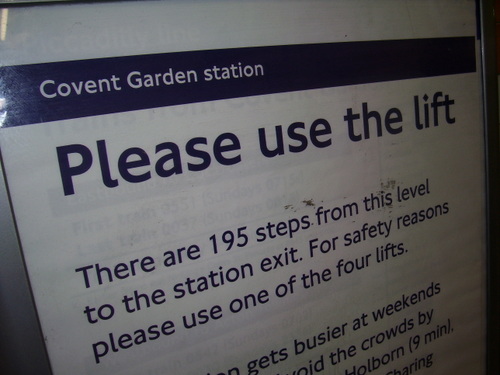
Another reason all that training was worth it. Did all 195 steps, not even out of breath.
Only thing I had time for last night, I just wanted to feel that overwhelming rush of humanity you only get in London (if you live in England).
By the way, it’s so much milder down there. People drinking coffee outside, it’s freezing up here.
-
So I did a flying visit to London to see John Steel’s talk on pitching. While I didn’t have time to catch up with some people while I was down there, I was hoping to bump into some familiar faces at the event. Carol was one, but she couldn’t make it. So for her and anyone else that couldn’t be there, here’s what happened. Sorry if it’s been post rationalised into my blinkered view of the world – I’ll be interested to see what others think. Incidentally, I wonder who was there that I ‘know’ as a blogger?
First of all, I was expecting more on actual pitches and less on working practices, although much of what he said was useful and made sense. He talked a lot about good powerpoint, which most people would know (wouldn’t they) – specifically, less slides, more visual, use as props, not script.
By the way, he’s a terrible name dropper, but maybe if you’re working peers are Martin Sorrel, Andy Berlin and Jeff Goodbye, I suppose hat’s unavoidable.
He recycled much of what was in ‘Truth Lies and Advertising’, but it was great hearing. Like the way the Porsche work would never have happened with normal work practices, or creative ways of doing research. He also used blinding good anecdotes.
Anyway:
Working environment:
- A professional working environment gets in the way of good ideas. If you spend too much time in the same rooms, following fixed process, you do not allow yourself the intuition needed to generate really good ideas.
- Being forced to follow straight, logical process can lead you to miss stuff. You spend more time justifying what you’re doing and less time allowing the brain time to breathe.
- Keep an agency scrapbook. Departments should get into the habit of collecting stuff – and the more stuff that isn’t directly related to the business they’re in the better. Images, experiences, thoughts, they’ll all come in handy one day. All it needs is the right problem and someone to make the connection.
- Agencies suffer from ‘attention deficit trait’. If you constantly expect to be interrupted, it affects the brain’s performance as much as smoking two joints. People work better in environments where they know they’ll be getting on without disturbance.
- Involve everyone at the start of a project – if our work is about ideas, get ideas people involved at the beginning.
Pitching
- Remember to say no! If you don’t think you have a chance of winning, don’t pitch forget pride. If you don’t think their culture and yours match, don’t pitch – you will lose because they don’t like you, or you’ll get fired when they realise what you’re like.
- Try and avoid pitching in the first place. Try and work on small project at cost to see if you get on and show your skills in action.
- The best new business tool is great work on existing clients. The best way to get on pitch lists isn’t professional adultery’ as he called new biz people, you only need that if you haven’t got any good work from existing clients that people are talking about.
- Allocate small groups to pitches. Make sure they will have the time and give them responsibility – and what the boundaries are. Meet as often as you can. Not only can you help each other, you’ll form a siege mentality, which will show as a close knit team come presentation time.
- Work hard at getting an idea first. Don’t flit around doing any presentation stuff, or creative or applications until you’re all happy with a direction. Doing the work for it is easy if you’ve all bought into the thoughts. As you then develop it and see it work, you believe it that much more –and that conviction rubs off.
- Look like you all get on! The above should ensure this, but handpick team members for what they can do, and how they add to the dynamics of the team.
- Rehearse! Some will say they like to look spontaneous, but you just look disorganised. If you rehearse enough, it looks that much more natural – you’ve time to talk instead of reading from a script. It becomes a two way conversation, not talking at people.
- Present what you think is right – if you show what you think people want to see, they’ll sense you don’t believe in it and you’ll lose anyway.
- Powerpoint slides should always be props for what you are saying. Write as little as possible – detail can be in the leave behind.
- Be yourselves, but find a way to get to know the people you’ll be pitching to. There will be different way to emphasise something that will connect better.
- If you haven’t much time, lock yourselves in room, agree what you think is the right thing to do and get on with it. Your first thoughts are usually pretty good, it’s up to the planner to prove them wrong, or find something better. It’s up to everyone to improve them as they go along.
-
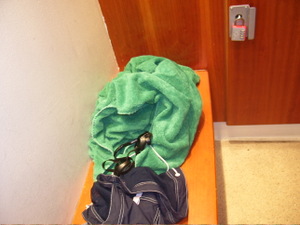
By the way, I managed to do my swimming challenge. It’s official, in late December I was as fast as I was at fourteen. It’s taught me one or two things:
- I’m not young anymore. At fourteen, getting out of bed at the crack of dawn and diving into a cold pool to work every muscle until it begged for mercy was easy. I used to play football at lunchtime and cycle to school too. Now, training at the same intensity was just about possible, but it hurt, really hurt. I had to do twice as much stretching to ease my stiff body.
- My Dad is great. My Dad used to get up before 5am and take me swimming in the morning, or he would do the evening run after work. In between, he did a demanding job and never complained once. I found fitting in work and training quite tough, and it made me realise what a sacrifice he made when I was young.
- Life looks different when you’re tired. Of course you have to watch your temper a bit more, but it’s the concentration. Making decisions becomes harder, you’re more likely to make an error of judgement.
- It’s great doing something well. I’m a naturally clumsy person, but in the water I’m co-ordinated, graceful even. Swimming is a bit pointless, but the feeling of gliding past ordinary mortals and knowing this is something you can do better than most makes it worth doing just for the sake of doing. After years of training, week in, week out, I was heartilly sick of swimming and never really bothered. This excercise has made me fall back in love with the thing I’m best at, so while I won’t be killing myself, I won’t exactly stop either.
- I will buzz and fizz after a particularly good session. Sometimes everything feels perfect and you don’t want to stop.
- Take the good days with the bad. Some days you just fly, some days it’s just a slog. It’s finishing on the days that are a bit of a grind that matters.
- I find peace of mind when I swim. Life can be complicated sometimes and we all need somewhere to switch off. There’s something about being underwater that’s utterly peaceful. It’s not like the gym with pounding music and endless queues for machines. Just you in your little world. Excercise has always been my number one way to relax, swimming’s the best.
- Everybody changes with fashion. I don’t really care about the latest trends anymore, but I don’t want to look stupid. The last time I trained like this, everybody wore tiny little speedos, usually a size too small. Then, the advantages of being able to see semi-naked women were balanced by the very visible effects of cold water. Now I wouldn’t be seen dead in anything but proper shorts, and nor would anyone else I know. It’s a bit like flares – my Dad couldn’t give two hoots about fashion but he doesn’t own any flares anymore.
-
This article from The Independent discusses the UK’s increasing love for fine foods and throws up some interesting stuff:
The growth of retailer premium private label food ALONGSIDE organic and fairtrade maybe shows how much ethical buying is status as much as morality.
Intersting to see that M&S may well lose out on two fronts – from competition from the supermarkest AND cooking from scratch (largely thanks to celebrity chefs).
By the way, I love Sainsbury’s ‘Try something new today’. Rousing customers out of ‘sleepshopping’ uses a great insight, but it’s the way the idea can be executed down a mundane product and price ad that I you see how well it works.

Of course Sainsbury’s returning to a ‘real food hero’ positioning was obvious, but few appreciate that doing it any earlier would have been a mistake. They had to sort out distribution first. I used to work on another supermarket and we all knew that Sainsbury’s shoppers WANT Sainsnburys to do well. They love it there and feel closer to it than customers of any other supermarket. Simply making sure the shelves were stacked properly would win old customers back – not sorting this would just piss them off again.
The genius of the current strategy is that encourages current customers to to buy more, and possibly upgrade, while giving new customers a reason to visit, forage and explore. Very, very clever.
-
And so to the Times. This was the last planned paper in this experiment, but I may as well push on and do the Star, Independent and Guardian in the next week or so.
First of all, it’s a lot to get through – 32 pages on pure news, with opinion sandwiched in the middle. By the time I got to the world section, I was worn out.
While not as straight as The Telegraph, the stories are delivered in a serious manner and seem pretty objective. It’s interesting to see that, similar to The Guardian, they include ‘briefings’ from experts next to the big stories and issues. Very useful, adding more context, but there’s a danger that these can slip into opinion rather than analysis.
I never watch ITN News for this reason. reporters on site never seem to deliver the facts, instead they tell is what they think the facts mean.
My own personal view is that I like reading stuff with a bit of meat, some argument – but that’s only because I listen to a lot of straight news on the radio. It comes down to whether you want more depth and discussion to add to what you know, or you just want to know what’s going on I suppose.
I found the comment section a good read. Dense with strong arguements, well backed up, I espescially liked Mary Ann Sieghart’s analysis of David Miliband. Incidentally, I find it sad that our country seems to pick looks and likeability over experience and talent, but there you go.
The world section was meaty, and I have to admit that I prefer it to The Guardian. While the Guardian’s international coverage is equally robust, on reflection, the delivery is quite biased, sometimes with more ‘background’ and briefing than actual fact.
The sport was packed with a fair cross section of stuff that wasn’t football, although I found the writing more ‘tabloid’ than I expected.
But after all that, I simply couldn’t be bothered with Times2, which may have been a shame, but it wasn’t helped by a layout that suggested everything was going to take ages to read. I just don’t have the time.
So I’ll be coming back to The Times for international news, but overall, I got a little bored. On the other hand, if I’ve missed the news, this may be the place I go.
-
Few would disagree that Global Warming has moved from a peripheral issue to one of the defining challenges for mankind. But on the grand scale of Earth’s history, it’s still pretty cold. The polar ice caps have come and gone many times.
The last ‘Ice Age’ never ended, we’re still in it. It just happens that we’re in an ‘interglacial period’ or a bit of a lull. No one is entirely sure why these lulls ebb and flow, but if nature was allowed to run its course, we’ll be plunged into a worldwide freeze again before it gets very, very hot.
When stuff like this is so finely balanced, it puts our messing with the climate into perspective.
All it takes for an Ice Age to come about is one bad summer where less ice melts than usual. More heat from unmelted snow gets reflected, even less ice melts, less heat again, more ice and on it goes.
They believe that at one point, the entire planet was covered in ice and it took a volcanic eruption to to reverse it. Meteroligists believe this gave us the most chaotic weather ever, with winds whipping up tidal waves to skycraper levels.
Incidentally, there was brief reverse of our Ice Age lull in the 15,000’s, when the Arctic Ice Sheet went as far as the Orkneys, and humans were responsible for it’s end thanks to the Black Death. The catastrophic loss of life resulted in abandoned farmland being covered by trees, and the extra carbon dioxide absorbtion dropped the temperature.
-
So we move on to the Sun. I’ll review today’s Times on Monday.
This is the paper that alledgedly decides British General Elections, easiest the nations best selling newspaper. If you want to get into the mindset of the people, this is a good start.
First off, Page 3. Today it’s Keeley. It doesn’t stop with the press though, you can text a number and get more saucy pics on your mobile. A British insitution or a bastion of sexism? Dunno.
Front page is devoted mainly to David Beckham’s move to L.A. Which is fair enough, according to a Learning Skills Council survey last year, he’s still a big role model.
The Paper follows a similar format to The Mirror, a bit a news, a bit of opinion and loads of gossip and lifestyle. Which is fair enough, this what they want to know about.
The main front section news stories are The Home Office fiasco and a deperssingly small report on Bush’s decision to send more troops to Iraq.
Naturally the subtle tone is at odds to The Mirror. As opposed to John Reid ‘sorting out’ the problems, The Sun has him ‘knowing nothing’. The opinion section includes, ‘labour has lost the war on MRSA’. The Sun’s true colours are clear. It’s unclear yet if Ruper Murdoch will support Cameron or Brown, but he’s certainly had enough of Blair.
So that’s the tabloids finished. I can also tell you that the Express is a watered down Mail and the Star is not really a newspaper. Is it a problem that there is little real, factual news? I suppose not, I don’t believe you can ram serios issues down people’s throats if they’re not interested. These papers give their audience exactly what they ask for – The Mirror’s slump in sales when it went serios shows that.
I was a bit harsh on the Mirror yesterday, since their bending of the facts is no worse than the Sun. All papers have an agenda, red top or no (although we’ll see what the Times is like), all use fact to fit whatever they want to say. I’ve more of a concern with the Mail and the Express that pretend to be serious.
That said, I find it disturbing that the tabloids choose what to report. it’s one thing to have a more fun balancem it’s another to only report on the things you want to people to know.
-
Thanks to the newspaper project, naturally I’ve been thinking about what really matters to people and how to include them in politics, espescially the young and by happy coincidence I found this at PSFK. Myspace US is launching a competition called where members post a 60 second film of their views on the state of America and what needs to change.
It seems a million miles smarter than Webcameron, which strikes me as thinly veiled propaganda, viewed by the young as an old fart trying to be down with the kids (This anti-debt campaign is better, seeded on the web, but it’s still older people tell kids what to do).
Isn’t it a universal truth that the young think the old haven’t a clue? Espescially when it concerns what really matters to them. At the same time, social media and it’s endless niches mean that kids can shut out the adult world more than ever, and they have a very strong bullshit detector. Asking them to tell US what we should do, on their terms makes a lot of sense. If they they’re not interested in our agenda, asking them to help us set it seems very credible, and we may just learn something.


 NORTHERN PLANNER