• I'll be honest with you, when the crash happened in 2008 I was bloody terrified.

    I was working for a global creative network, my office had just lost its biggest client. 

    We were expecting our first child, like most people our savings wouldn't last us forever.

    As usual with the big networks, the Eye of Sauron., brooding in it's tower in New York turned its baleful gaze towards Manchester, it saw numbers that needed to shrink and the consultations began.

    I was one of the lucky ones. The sense of relief was overwhelming and yet…..

    One the most talented juniors I ever worked with was cut. His boss, my boss, never actually said goodbye to him, he was cast out within an hour by HR. 

    It's been shown that laying people off in their first job or so, has lasting damage (believe me I know). My team (not the boss) did everything we could for him. He didn't need help with his career, he's now at one the best and one the best there.

    He needed emotional support. Kindness. 

    I can only remember feeling the conflict of relief at being one of the lucky ones, at war with over guilt of thinking thank God it's them not me. 

    My life is very different now, eldest child is nearly 11, I'm the strategy director, not the minion. It's a very different feeling to worry about your own life, but feel so responsible for all the people who depend upon you at work. 

    It makes me judge that boss even more. It's not excusable not to say goodbye to someone who's life you've just turned upside down, its just not.

    Two months later, the same boss broke down in a meeting because her dog was ill. 

    Her dog.

    She was also caught saying she liked recessions because you cab squeeze more out of your people. 

    Lots of folks in adland are spouting the usual predictions about how the world will change. At least I guess, unlike the annual January  crystal ball attempts to tell us how this is the year of this and that, it's safe to say that the world is changing profoundly. But no one really knows what will happen.

    One theme though is that when this all end, people will judge companies who didn't do their bit.

    Yet we're seeing the usual global groups cutting deep as we speak. I don't know their numbers, but I suspect they'll be judged too when they need talent for the upturn and their isn't any.

    I hope it might be a time for independent agencies to flourish, by being good AND doing good work. But it's only a hope, I don't know what will happen any more than anyone else. So don't judge me.
  • Hello again, it's been a while. You may be thinking I've no work on, I've been furloughed our even laid off, to bother fill my time with blogging. Trust me, I'm not assuming for a second you're bored enough to bother reading this.

    Actually, I'm one of the lucky ones. For the time being, I'm dead busy. It's a privilege when much of the news, not just in our industry but the wider world is about people's livelihoods disappearing before their very eyes. It could change for me of course, but while I'm still employed, I'm going to be grateful. 

    Its fair to say though, that everyone is finding it tough to be trapped within their four walls. No one wants to hear this from a white middle class male with a garden and a spare room, I know, but we all need distractions so I'm going to try re-discover a rhythm for blogging.

    Don't expect too much work stuff, I suspect the few people that bother with this blog liked the stuff about tea and swimming more, but let's see. 


  • If anyone asks me what strategy books to read, one of the top three is always Eating the Big Fish. I still think it's a great way of looking at how a minnow can out think the big boys. 

    (Or just read a book on Judo)

    But at face value, it's still about single minded repetition of the same position, vision or whatever the brand babblers like to call it these days.

    This is good, this is important. Being consistent, in a way that stands out, that helps people not to think too hard about you (they don't want to), that makes them instinctively believe you're better pays back in spades. That's great. 

    But it's not the only way. 

    And perversely, when you can't move for 'Challenger' or, God help us, 'Disruption' strategies, adopting challenger strategies is pretty, erm, conventional. 

    Especially when big companies take a challenger approach to stay ahead. 


    In other words, it may well be that it's time to challenge being a challenger. 

    The other book I'm getting folks to read is the actually a chapter. The bit on 'Winning' in Messy. 

    Basically, the quicker you can understand what's REALLY going on and act on it, against slow and ponderous organisations, the better.

    If you can keep them guessing while you're at it, disorient them over and over again, you're on to a winner.

    It's really why Trump won.

    It's how Amazon destroyed Barnes and Noble – and Toys R Us.

    All this depends on having the will.

    Being up for a different way of thinking about brands and stuff. In fact, scratch that. 

    Being up for jettisoning models that approximate real life (that's what brand theory is, come on, be honest) and actually engage in real life.

    Because real people don't live life in campaigns or quarters, they live in moments.

    They value genuine surprise and delight above predictability.

    Just look at the plot twists and rug-pulls in any successful modern drama. Compare that with the formulas of the massive hits of yesterday, like Columbo or even Bond movies. You were watching the same thing over and over again.

    We don't want that now.

    The trick is to make lots of little acts add up to one big picture.

    Some of that is Byron Sharpe's 'distinctive assets'. MdDonalds can do what the hell they like as long as there is lots of red, a golden arch and that sonic 'I'm lovin it thing'. 

    Much of it is sticking to the same point of view, the same backstory, no matter what you're doing. 

    The quicker you can get into what is really happening in life, removing the layers of research that doesn't tell you anything and needless process, the more successful you'll be.

    Because many organisations won't move until the research picture matches the picture they want, not the picture it is.

    So if you can remove layers of 'strategy' to justify what they already want to do, and provide clarity on what they SHOULD do, you'll do well.  

    I just don't buy the IPA data on the gap the payback for being creative with between long term campaigns v short term campaigns. We all live lives where lots of todays add up to a year, or a decade. The more brilliant today's you create, the more brilliant year you have. 

    Anyway


  • So we've all had the massive exhale as February begins. Back to normal. 

    As you know, most New Year Resolutions die in January week 3, leaving us with a few days of no money and self loathing before we go back to the routine, whatever that might be. 

    Because human willpower is weak, it needs a rest. It's why dieting is doomed to failure.

    We all know this deep down, that's real life, the one that happens outside of focus groups and segmentations.

    Yet, last month we had all the usual New Year Resolution rubbish. None of it embraced the crapness of real life people failing.

    Perhaps the brand owners belief it's more commercially viable to help people lie to themselves. 

    Which it is of course in many cases.  

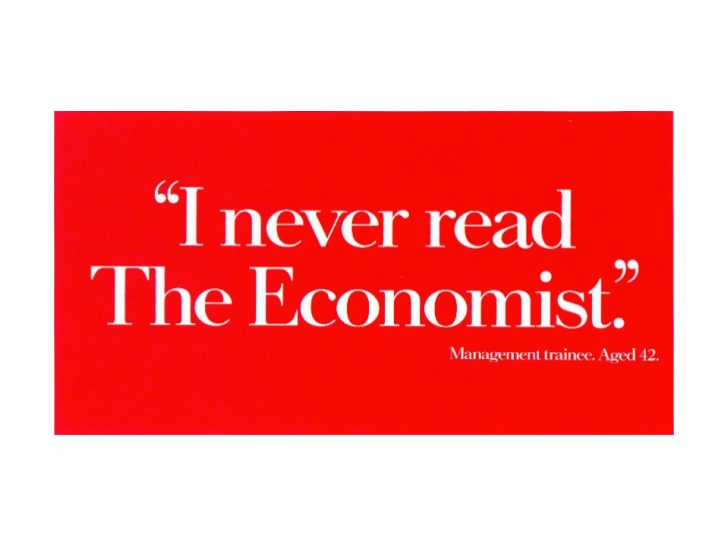
    Just as this famous campaign actually knows that Economist readers take in a few articles, ignore most of the writing, but feel a lot cleverer about it (the weekly equivalent to the unread pile of books on the bedside table, or the unwatched content in the Netflix playlist). 

    The-economist-creative-advertising-8-728

    Yet you  will have read the same data as I have. That claims people are but tired of being pressured to look perfect, and actually like brands to look fallible.

    In fact, making an idiot of yourself makes you more likeable if you take it with good grace. It's called the pratfall effect (incidentally I've been known to spill coffee on purpose in workshops I'm running).

    Imagine if someone actually set out to reach people failing in January Week 3 with a more sustainable alternative (like a 66 day guide to working within your routine) rather than against it. Imagine a campaign celebrating our collective, glorious annual failure. 

    Imagine someone saying wait until February, January is hard enough?

    Maybe next year, or the year after that. 

    Anyway. 

  • Most people have the good sense to not read this blog much anymore. They're all on LinkedIn now.

    However, I still get the odd question from folk who believe I know what I'm talking about. Let's be honest folks, experienced people in this industry are as clueless as you are, they have just got better at hiding it.

    That said, along the way, I've picked some stuff up that may be of use from time to time, so I thought I'd sometimes share what people have asked and how I responded.

    Step forward, let's call him, Steve. He asked what to do when you've started at a new agency and you are in your very first meeting with a new client. How do you impress them and leave them thinking you're a smart guy they'll want to have around?

    We'll Steve, I'm sorry to disappoint you but I can't help you because I'm not a smart guy, like I said at the beginning, I'm pretty clueless.

    However, I'm kind of OK with this.

    It's actually a great place to be. You remember those famous Avis ads where they tried harder because they were number 2? That's me, never the cleverest person in the room, but the person so afraid of being found out, I'm rarely complacent.

    Because I'm not smart, I make sure I'm well informed.

    That won't be the case in your first client meeting Steve, you just won't have been given chance to know what's going in with their business.

    Having worked on a similar client won't help either. If there is one thing that drives clients and agency people alike up the wall, it's the 'When I was working on (insert brand here)" all the time. 

    So the best way to impress then is to hide your lack of knowledge and keep your trap shut. As they say, best to have people think you're stupid, rather than open your mouth and confirm it beyond all reasonable doubt.

    Anyway, you're not there to impress clients, your not their to make them inferior, you;re there to add value.

    Now clients, deep down, know that the suits only pretend to be interested in their business, when they really care about maximising the fee income.

    They know creatives really want to do work that will get them hired by the agency they really want to be at.

    They know the media folks want them to spend more on media than execution, or want to to execute themselves. 

    They know the PR folks haven't a clue, but can get them tickets for whatever they're into. 

    Think about most meetings, especially all agency ones. How many people are really listening? How many people are asking genuine questions? Or are they posing leading questions that push the discourse into their agenda? 

    Clients know all this is going on, you don't get to be head of marketing and secure a decent budget without being able to play the game to a certain degree.

    So if you want to impress clients, admit you don't know anything and shut up. When you open your mouth, ask lots of questions that show you want to really understand what drives their business. Without agenda. 

    You'd be amazed how much clients love someone who is really interested in them. 

    So many strategists stride in, intent on proving their intellectual superiority. No one likes a smart arse. No one.

    Steve, you'll stand out by simply wanting to understand. It worries me that you're just intent on looking clever, I hope I'm wrong. 


  • So my son broke his arm in October. Badly, really badly. It's mostly okay now, but took a fair amount of rehab. We were at the hospital the other day for a check up and, like always, he didn't complain at the endless waiting, the pain of getting his (still tender) arm bent all over the place, or anything. 

    This is nothing though, next to what he went through during the initial break. Pins put in, genuine pain. Then pins pulled directly out of his arm without anaesthetic. I've never been prouder.

    And yet. 

    And yet.

    Like all parents, it's easy to get frustrated in the hurly burly of the day to day. When he argues over time on the Xbox. Forgetting what you told him two minutes ago.

    Normal human stuff. 

    Just as it's easy to not appreciate the brilliance of everyday. Playing football in the street together. Arguing over who's better at FIFA. Seeing the latest Star Wars movie (which we both loved). Swimming lessons. Gently winding up his mother. 

    Whenever I lose patience, thinking about how brave he was (and is) with his arm always pulls me back.

    Just as I always try (and sometimes fail) to stop, to just take in the moments we're having fun just messung around. 

    Being a parent isn't the same with people you work with of course.

    However, I bet they wind you up frequently and I'm sure there is an everyday flow of great stuff you're so used to you don't even notice. 

    I'm also confident there have been moments when you've been incredibly grateful for them. Maybe they've got you out of a tight corner, maybe they've blown you away with something amazing. Maybe they've gone out of their way to help you when they didn't need to.

    Just as with my boy, it's easy to focus on the little frustrations and not the daily flow of perfectly ordinary brilliance. Sometimes the here and now can also cloud those big moments you were so thankful they were there.

    People are doomed to only notice either the very good or the very bad. The perfectly brilliant of the everyday passes us by. 

    And past greatness is soon forgotten, the last experience is always the most vivid (which is why film studies focus group the ending more than any other part of a film. It's always why a really good campaign should end on a high note, not simply stop when the spend does). 

    We just don't appreciate a kettle until it breaks. Just as we don't miss people until they're gone. Just as you don't need insurance until something goes wrong. 

    Why am I telling you this?

    Because it matters more to a strategist than most people.

    Your work quickly gets forgotten when the creative work gets done and everybody loves it the executions. 

    Unless the creative work is bad. Then the strategy, or the brief, is of course wrong. Then everyone remembers it. 

    Yet the moment you try and wow folks, let your ego take over, you're buggered. When you try and do a strategic set up in a pitch like Ted Talk and forget people are waiting for the creative work. When you try and write a wow brief that is a really a thinly disguised creative idea. 

    In other words, when you get in the way, rather than liberate others. 

    It's not fair, but if you want to wow a crowd, join a band or do stand-up. 


  • A few years ago I was working in a creative agency and found myself in the odd position of working to the lead agency strategy, set by the media folks. 

    The same media folks had just appointed a creative director. Now it was, of course, a little difficult to compete over the creative work, but at least they were taking the creative work seriously. They had spent enough time working with good partners to know what to look for. 

    It's not like that now. I've found that media agencies don't worry too much about doing creative work, because they don't believe it's really relevant. It's about precision targeting or maximum relevance. There's plenty of innovation, but it tends to be based on tech or partnerships. 

    That said, when I was working in a media agency, it used to send me into orbit when the creative folks tried to recommend the core channels (usually TV, or at least AV, they still love making telly).

    Then there's loads of creative agencies trying to do best in class digital and digital folks trying to make great above the line.

    Then we come to PR.

    Much of core PR got taken in house a while back, so PR folks carved out a fee for managing social. Then Facebook changed the algorithm and they finally had to admit organic social is really brands talking to themselves. So they're attempting the lead agency creative thing. Now it's fair to say that creative folks think PR is easy, just make great creative that will get talked about – when of course, you need a PR instinct to know what will get picked up.

    But great creative work isn't easy either, any more than media is easy, digital marketing is easy or even getting a journalist to publish your story.

    It takes years to learn the craft to develop that instinct for what will really work. You can't just start 'doing TV ads' just as you can't start writing press releases. It's not good by the way getting great people who have the skills into organisations of a different flavour, they'll end up frustrated when no one else really gets their work. 

    The job has never been harder, as people get better at ignoring brands, the work we do has to be BETTER than ever.  Everyone has their part to play and they need to be right at the top of their game. 

    Understanding what you're good at and focusing on that would be a start, and respecting people who can do what you can't. 


  • Happy New Year etc.

    By now you'll bebored of predictions for the next decade.  I know I am. It's virtually impossible to predict the future, you can only create it yourself. Try new stuff and keep doing what sticks. 

    We all know the Byron Sharpe consistently built distinctive assets stuff, but the problem with consistency if your not careful is that others copy you, or with the low attention span folks have these days, you'll get noticed less. 

    So the the only safe strategy is to consistent surprise. By all means, make sure what you do looks and feels the same, but don't let what you do become predictable.

    Look at the best books. Every page and chapter is different, there are twists, turns and revelations. Every single word is building towards the same narrative though. 

    That's how I think you need to consider brands today. A series of surprising experiences that add up to a consistent picture, not the same thing over and over again.

    Anyway

  • I've never been too keen on marketing or business books. They can be great for frameworks and beginnings of best practice of course.

    However, everyone else will be reading the same books and, therefore doing the same kind of work.

    I like the ones that give you a totally fresh perspective on things, or a unique insight.

    Here's a couple worth looking at.

    When, by Daniel Pink. Unique human insight into how timing is everything and how to time things right. From why reaching people at different times of the day requires different messaging mood and context, to the importance in any situation where you want to be remembered, of being first, last or totally memorable. Also, why being 40ish is the most miserable time of your life. Great. 

    Watching the English by Kate Fox. Only useful to a UK person, but real life insight to the hidden rules that govern culture here. Who know that the chip could have so much meaning.

     Why Most Things Fail by Paul Ormerod, a brilliant pop at the crapness of most economic theory. Evidence based thinking on why most markets are impossible to predict because they're just too complex – the only way to really help survival for any organisation is constant innovation. Make stuff happen, because you don't know what will happen to you. 

    The Science of Storytelling, Will Storr. I know, I know, bloody brand stories. I don't want you to read this for that. Rather, it shows how plot lines, inciting incidents and all the matter, but people ultimately relate to people. Characterisation, a target audience with real flaws and a gaps between how they see the world or themselves v  how it really is/they are, can drive properly inspiring creative world that touches us all. In the book it's book and films, but advertising and stuff is competing with real culture, so you may as well learn from real creatives. It's a different way to think about insights but also, a great way to think about client problems because, in many cases, what is driving many problems is the difference between how they they think people see them/who buys them and the truth.


    Black Box Thinking By Matthew Syed. A tour de force against great leaps of insight that rarely happen and the reliability of incremental gains. Brilliance comes from hard work and looking for little ways to improve. Even Darwinism came from lots of work and ideas by countless individuals, if Darwin hadn't put it in the back of the net, someone else would. in fact they did, Wallace.

    Oh, and it's sobering reading for leaders with big egos who have forgotten to listen, stifling potential greatness by putting themselves under pressure to be the one that always saves the day. It's so liberating to be a strategy type who doesn't have amazing insights, but is able to spot insight from others. That starts with being able to listen.

    Anyway.