• I was reading the paper and came accross the story of a former down-on-her luck single mother who's written a cookbook on how to take control of your family food on just a few pounds a week.

    It started as a very real exercise to regain some dignity and control in her life and, as her blog about got traction, very real way to make some much needed money.

    I liked the bravery, I liked the demonstration of iron will when it would have been easy to cave in and accept her fate.

    But that''s not what got me. It was her description of feeding her little boy one weetabix mashed up with water for breakfast, and the helplessness when the hungry child innocently asked his mummy if he could have some more, maybe just some bread and jam. Neither of which she had, or could afford. Didn't have the budget for milk even.

    I thought of my little boy and could easily imagine how I would feel if he asked me, the shame, the helplessness and the deep, searing motivation to give him a good life, to be worthy of him.

    All the talk about austerity, feckless people on benefits, deserving or undeserving poor. All rendered meaningless to me by one little story about weetabix. Because its about the very real lives of people, children and families.

    It's almost too trite to shoe-horn the 'what planners can learn from this' bit, but the power of real stories that make you feel something will always trump 'persuasion' 'facts' and 'argument'. Find a way to make people empathise within their own frame of reference.

    Back on the subject which is too important to reduce to stuff about 'planning', Mrs Northern and I agreed that we cant' change much, but sitting on your hands achieved even less. So I'm going to look into working in a food bank one night a week.It's not much, but it's something.


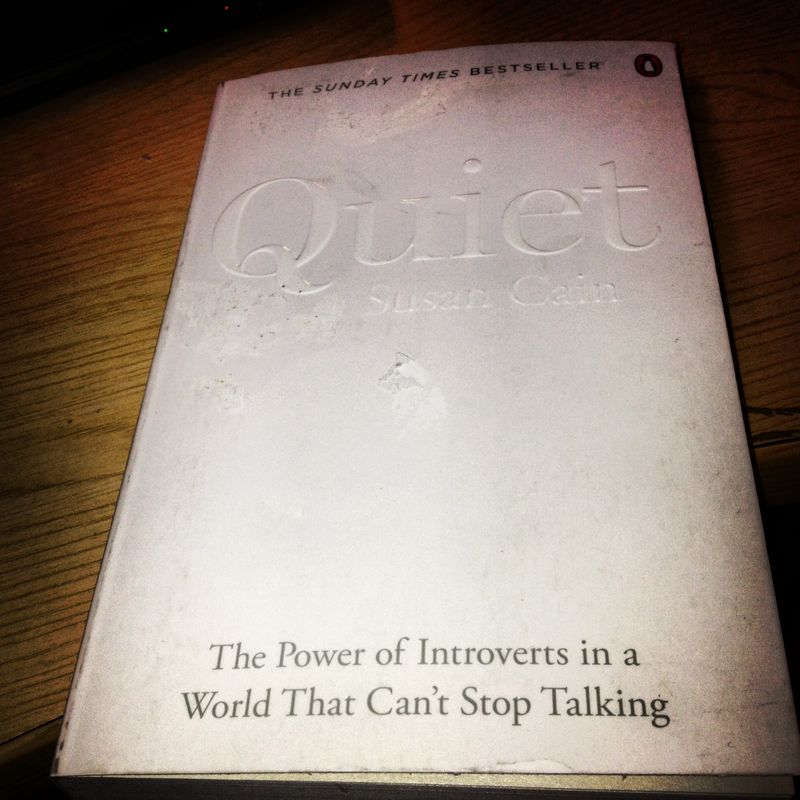
  • Martin's post about a Jo Moran quote took me to looking at his article, about shyness, reminding me I'm reading about The Power of Quiet. Serendipity indeed.

    I'm enjoying it and one killer learning for me is, when you really dig into what makes a good leader, the extrovert, charisma oozing fancy pants approach works some of the time.

    But not all of the time.

    It works best in organisations where everyone is supposed to know their place.

    But if you want a leader to unlock the potential of their people, to encourage them to use their imagination, their initiative and be original and, well, creative, you're best looking for an introvert.

    Someone who likes to listen more than talk, someone who likes IDEAS, not MY idea.

    Someone who isn't intimidating, who thinks before they speak and doesn't want to win arguments, they want the right answer.

    Yet the model for agency leaders and heads of departments seem to be fancy pants model.

    The ones who are always heard in meetings, who always get their way because, we'll, they just do.

    I'm wondering, is it that organisations are not as creative and free-wheeling as they would like you to believe?

    Or do they succeed in SPITE of the leader.

    Is the leader someone who is really just good at networking and making clients like them? Not something to be under-estimated of course. But that's not leadership.

    Just like a creative director who can't put the layout pad down, or can't bear to have someone esle have any sort of good idea down isn't a leader.

    Just like a planning director who can't help telling a junior what their strategy should be, rather than letting them learn from failure – or even make that director think – isn't a leader. 

    I'm biased of course, I'm shy and introverted and every day I try and make this work, rather than get in the way. Not hiding it, finding a way to make it flourish. I cringe at the thought of big groups, I fear big presentations, I'm terrified of small talk.

    Of course, I'm grown up and have found ways around this and, to some degree, have altered behaviour to alter temperament. 

    In fact, when you think about it, this an industry where it's who can talk the loudest wins, rather than who can think the most.

    I for one intend to help change that.

    One day at a time.

  • Booze

    If you're from the UK, you might remember a bit of a hoo hah when they decided to relax 'licensing laws' – in plain English, the legal times you can buy and drink alcohol in public.

    Some thought we would suddenly turn European and drink more slowly, while perhaps while sitting outside with a extra shot of joi de vivre.

    Others thought Britain would become the 8th circle of hell, descending into a chaos of debauchery, violence and creating city centre no-go areas.

    Britain's modern relationship with booze is soaked in binge-drinking, violence and the image of half naked dolts 'largin it' in Ibiza. So you can have some sympathy with those who thought that more drinking time would equal no violence.

    But when the laws changed, hardly anything happened. Alcohol related crime barely moved an inch.

    Because, time after time, in experiment after experiment (inluding one where half of people were given Vodka and half given tonic- but all thought they had stiff Vodka and tonics..and all displayed similar displays of drunken behaviour. Another got people of identical age and build to drink identical drinks and observed wildly different behaviour and levels of intoxication), the way that people behave when drunk is based on how society expects them to behave.

    Now consider this, in 2003, a Home Office report stated that fighting while drunk was seen as 'an inevitable fact of life' by many.It's part of the culture for some cohorts in British society.

    The problem of British behaviour when drunk,  is less to do with British drinking,  as British behaviour itself.

    The root cause is the culture around drinking, not drinking.

    Yet so much of the national conversation is around curbing alcohol consumption, rather than looking at the root causes of behaviour alcohol is linked with.

    What can planner and brand folk in general learn from this? Just the usual.

    Avoid bad research.

    Avoid making the available facts fit your argument.

    Don't get cause and effect in the wrong order. 

    Learn to discern between symptoms and fundamental issues.

    Try and look for cultural and societal issues rather than artifical 'brand issues'.

    This is heavilly borrowed from Mark Easton's excellent Britain etc. Which is the final thing we can, don't read books about marketing and planning. Read books about how culture, people and the endless quest to understand how and why people behave as they do.

  • The alarm goes off in my parents bedroom. I know Dad will be another ten minutes, so I try and shut my eyes for another few precious moments of sleep, but I'm already wide awake.

    I look at the alarm clock, the red numerals cutting through the winter morning darkness and into my 12 year old brain. It's 5am.

    I snuggle under the covers, waiting for Dad to come in. Like every morning, I'm hoping he'll decide he can't be bothered and just go back to bed, but he never does.

    He come in an switches on the light. Same ritual, pretend to be asleep. He knows I'm awake but plays the game, gently rocking me until my head pokes out of the warm covers.

    "5 minutes", he says.

    I fall out of bed, as the microwave starts downstairs. I put on whatever clothes come to hand, pick up my bright yellow 'City of Leeds Swim Club' bag and stumble down stairs, a whirlwind of gangly elbows, knees and mismatched winter clothes.

    Dad hands me the mug of hot mile and digestive biscuit and I take it out and into the car. Anything else to eat would mess up my stomach and ruin the swim I'm about to do.

    The 15 minute drive from Wetherby, a relatively comfortable suburb, to the Leeds city centre is only fifteen minutes. At rush hour, it's more like an hour.

    It's surreal this drive, the streets are dark and empty, just a few cars here and there, and since it's 1985, a milkman. You wonder what these people do, why they're up so early.

    Dad plays Radio 2 all the way there. I hate it. Old fashioned music, an annoyingly cheery DJ and his daily 'bog eyed job' where other wierdos up at this ungodly hour phone in to talk about their morning run.

    All can think about is how much I want Dad to turn around and just take me home.

    At the same time, I look forward to the swim. I'm a clumsy young man, shy, walk into things and sometimes struggle for words in large groups. But in the pool, my body knows what to do and I feel confident. It feels like home.

    (This loving and hating is how I will feel about my job 29 years later. It's probably closer to the truth about how I feel about lots of other things too and my 39 years old self will suspect that living in the 'grey' (to quote Rob) when it comes to feelings and needs will be closer to truth about people than the normal black and white assertions)

    I never think about how much Dad probably wants to go home too on these journeys. It will be another fifteen years before I understand this.

    We arrive at Leeds international pool. It's a montrous building, a true bastion of the mad archticture from the 60's.
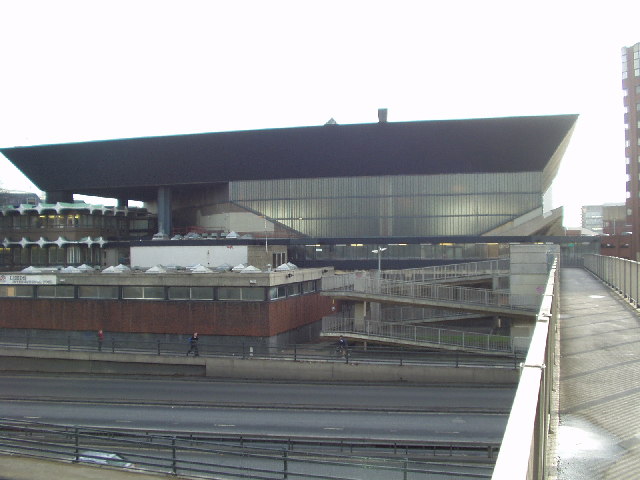
    Leeds

    They designed a groovy lighting pattern on the ceiling, which means backstrokers career all over the place, following the chaos on the ceiling, rather than the parellel straight lines of other pools. There are cockroaches in the changing rooms, you learn quickly to wear sandals,rather than endure the sickening 'crunch squelch' underfoot that can only mean one thing.

    On poolside, no one talks that much, no one wants to be here. The heating didn't have time to kick in on any of our cars and te boilers at the pool haven't come on either. We're all freezing and all we have to look forward to is diving into a cold pool.

    We do our stretches, our arms blurring into windmills as we swing the stiffness of our shoulders and allow our coaches to bend them into excruciating positions.

    Then we dive in to do our warm up, each of us in turn off the blocks. Eight hundred metres. Two full stroke, two pull, two kick and two swim again. Gradually, the 'hating this' turns into acceptance and the body begins to warm up.

    Then we're into the rest of the two hour session. Lots of drills, then a gruelling main set. This is deepest winter, the time when you put the work in that you hope will pay off later next year. This main set will hurt then. Something like 10 x 400 freestyle, or 3 x 1,500. The pace will be quick, little rest between each rep.

    You're on your own in there, just you and your mind in the water. But the mind doesn't wander. You're totally in the moment.

    At the same, you're swimming with ten other people in the chain, trying to stay ahead of the person behind you, willing yourself to close in on the one ahead.Training is competitive, it means a lot to lead the lane, but I never get to do that in the long distance sets. I'm a middle/short distance swimmer, here I'm looking to survive.

    The next couple of years will see me develop my medley. The equivalent of the 400m hurdles in athletics. Not long, but agony nonetheless. You start with fly, and then hold on. It's a sprint by as much about endurance as any mile swim.

    We move on to kicks, pulls, shorter reps on other strokes and medleys. I tend to lead the kick sets, the backstroke and medleys. I always lead to the one hundred free sets, It feels good out in front but it's also hard to have no one to pull you along.

    It's spooky how every session is roughly the same yet totally different.

    Training for a sport like swimming isn't pretty. It's months and months of repetition. There's variation between sessions, but it's like the back-catalogue of Status Quo…it's just variations of the same theme. I've often thought that sports champions are not built on talent or the abilty to handle to pressure, what decided winner in the capacity to put up with, or enjoy repetitive, excruciating work.

    You make up little challenges, you look for best times in training, you play games against the clock, but ultimately, it's about that bastard second hand spinning around, never giving you enough time to recover between sets, just enough to stop your body packing in.

    At that age, you don't understand the nobility in pain and sacrifice yet. You can't articulate the joy in doing something well, you just feel it. Some fuzzy emotional glue that binds you and your team mates in some unspoken pact. It creates relationships that are more adult than the ones in school, which makes swimmers can be at once replete with fast, loyal friends in the pool, and yet very lonely.

    When you have no time for what everyone else does after school, you miss out, which is made worse by the fact you know something is missing with these other kids, what knits you and other swimmers together is missing here.

    But yes, every session is different too. Some days, it's usual. Not too bad, not too great. Just work that feels good. Others days, it starts off as agony, but if you swim through it, it melts away into a natural high, you feel like you could swim forever and the loss when the session finishes is quickly overshadowed by the pain of having pushed too hard. Very occasionally, you dive in and just feel amazing, it's not a high, just a day when you can do no wrong.

    But then there are the day when you have woken up in someone else's body. You're lethargic and sluggish, even the warm up hurts.These are the days you have to push to do anything beyond surviving. These are the days where you really understand what sort of engine you have. The days when you feel great are not easy, but they zip by with a light joy. Every minute of a 'body-snatchers' session, where you feel you've been invaded by another person who has never swam a length in their life, every minute takes a lifetime.If you can get through these sessions, you can get through anything.

    I've often thought my capacity to get through difficult stuff as an adult was forged in the furnaces of body snatcher sessions.

    But my introverted nature,  and preference for a few, close friendships was created here too.

    The session finishes, the boys are bantering as they get showered and changed. As usual, we take too long and Dad is cross when I emerge from the changing room, red goggle marks livid aroudn my eyes.

    While I've been training, he's been out for a run and got the paper. We're back in the car and hated Radio 2 is back on. It's Derek Jameson -even worse. But now I can get lost in the paper and munch on the Kit Kat Dad always gets me on the drive home. We're leaving the city, while everyone else is fighting to get it, so the drive is still pretty quick.

    Then we're home. Dad gets changed into his suit, I get into my school uniform while Mum makes breakfast.

    I have the ritual  massive bowl of porridge.Then a four sausage sandwich, the lashings of tomato ketchup make it look like roadkill. Of course, there' gallons of tea, made properly in the pot.

    I'm still hungry but physically unable to eat anymore. The sensations I associate most with those swimming years are hunger and a constant pain in my shoulders and arms.

    My greedy personality was created in these years as well. My thirties become the developing trade off between learning to eat less and maintaining a training regime in a body that's slowly starting to say no more and more.

    Then Dad's out to work and I'm out to school.

    Eight hours before a go training again. Already, I'm at once dreading and loving the idea.

    21 hours until the alarm goes off again.

    Day in day out. I love this. I hate it. I want it to stop, I want to this forever.

    My 39 year old self feels exactly the same, he's just learned to live in the eye of the conflict.

  • I'm starting to read this.

    Quiet

    I've only read the introduction so far, but I'm already hooked. 

    Partly because, to be honest, I'm sort of shy and introverted myself. I've managed to get by in an industry, and a culture at large, that seems to value people who can talk, rather than the people who can think. Anything that can help me is valued.

    I suspect I'm not alone, especially amongst planners.

    Even more acutely, I really don't know why I'm shy in groups and fear small talk, yet make me do presentation and, these days, I seem to do okay, I even enjoy it.

    It used to be the same with swimming, the more important it got, the better I seemed to perform.

    I'm hoping to find the reason and ways to channel the 'presenter' a little more.

    It's not an uncommon malady.

    Prince is famously shy, yet a titan of a live performer, while many stand-up comics are far from funny, even confident in person.

    I'll let you know what I discover.

  • And to make up for the self-indulgent introspection of the previous post, here's a classic Imperial Leather ad that wasn't ironic back then, but curiously, would work today for very different reasons.


  • So I've been riding the new/old bike for a couple of months.

    I've got embarrasingly tight lycra shorts and a merino jersey.

    Recording rides on Strava.

    Bascially I'm getting into it.

    My legs don't scream bloody murder the day after a long ride now, partly because I've modified my technique and remembered to ride with the whole leg, not just the quads.

    My hamstrings are no longer tighter than a piano wire.

    It feels good, I'm enjoying it.

    Better than good, it all feels new.

    Because when I was a lot younger, I used to ride everywhere, to get to the swimming pool, to get to lectures, to get to tennis practise, to the pub (and back). Miles and miles.

    Basically, riding for riding's sake is brand new to me.

    I'm loving discovering something it seems my body can do, and seemingly, do pretty well. Finding out how far, how fast, what it feels like.

    It's all unfamiliar. Uncharted waters. That feels good.

    I'm going to do a 50 mile ride tomorrow, just to see what it's like. I'm planning a 100 mile race in September, just to find out what happens.

    But I'm still swimming.

    Not because it's fresh.

    Because swimming feels like home. I've been doing drills, sprints, endless laps and stuff since I was 7. If there's anything that connects who I've been and who I am, it's this.

    But age, time to train, work/life/sport balance all means coming close to swimming like I used to just isn't possible.

    To quote Leanne Shapton, "Every session is like a phantom off the swimmer I used to be". The feeling, the freedom, the sense of doing something well, the joy in pain, they're all there.

    The ghosts of that 7 year old in his very first training session

    Of the teenager falling out of bed at 5am to go morning training, drinking a mug of hot milk in the car on the way, then eating a quadruple sausge sandwich while getting ready for school, red goggle marks beginning to fade.

    Of the 14 year old training in the open air in Chicago, during the best summer of his life.

    Of the 37 year old doing 3 hour sessions on a Saturday morning before his 1 year old boy gets up.

    All those ghosts are there. They're welcome to join too. It's bittersweet though, feeling those people you'll never be again.

    While it's simple joy to embrace the new.

    The happiness (and challenge) of parenthood.

    The comfort of nearing middle age and not having to try too hard.

    To not only want to continue to search, to have a better idea of what you're looking for and the maturity (sometimes) to appreciate what's already here.

    Somehow cyling and swimming embody those two sides of what it's like to be nearing 40.

    Not quite resolving the gap between who I was, who I am and who I might be, but happy with the contradiction and realising that conflict and inconsistency are more true to life than coherence.

    I suppose the one area of consistency is the realisation of the need to lighten up.

    I don't know if I took to swimming because I naturally like rigour,enjoy overcoming obstacles and have a vaguely masochistic joy in the redemptive nature of pushing through pain, or swimming taught me to like these things.

    I do know that when it comes to cycling, I'm already addicted to the feeling of molten lava in my legs, the chestbursting climbs and, well, white hot agony.

    Just as I prefer 'hard books' music you need to listen to, banging my head against a brick wall to get quantum phsyics to make sense, to cook things properly from scratch, to never compromise on the day job. 

    I'm learning to to remind myself to just enjoy things for the sake of it.

    To sometimes just do stuff without having to do things properly.

    Perhaps, to know the difference between happiness and pleasure, and realising that sometimes, good enough is good enough.

    Anyway.


  • Tweets

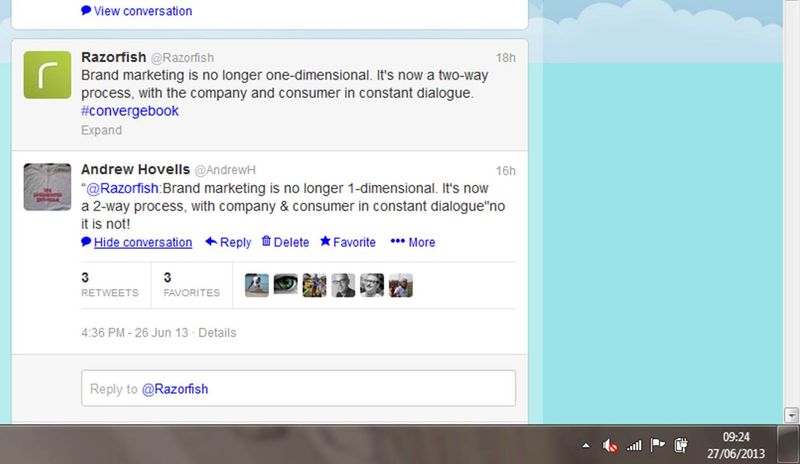
    I sent this  tweet out, responding to this completeley untrue statement from Razorfish (most people don't even know why the brand they buy is different, let alone want to talk to it).

    It got a little flurry of activity.

    Nothing much, mostly a few planning and marketing types talking to each other.

    It didn't make a dent it the universe, not in Twitter , not in marketing and not even in the self-absorbed planning community.

    In fact, next to the 1,100 people who 'follow' me on Twitter, the number of followiers 'talking to me' about this piece is miniscule. Because I'm just another planning egotist amonst the hundreds they follow who thinks people care what I say.

    Maybe a little reach, thanks to a couple of influential people engaging a little growth in penetration from a couple of new followers who saw it.

    That's it.

    I don't matter.

    But if I was a brand and believed the twaddle peddled by Razorfish and their like, I'd be believing that the planning community wants to have constant dialogue, that folks want to engage, that I've influenced the preference of planning directors and CEO's to hire me.

    I would believe it mattered. 

    Beyond a few people who already agree with me, know me quite well and are wierd enough to care.

    Like Razorfish (who I'm sure are ace at their job and know far more than a Northen Monkey like me) and the 'brand as verb'  'brand as conversation' witch doctors, I would be very deluded.

  • I was reading about Macguffins in plots, for something or other, especially for cinema.

    "A plot device in the form of some goal, desired object, or other motivator that the protagonist (and sometimes the antagonist) is willing to do and sacrifice almost anything to pursue, protect or control, often with little or no narrative explanation as to why it is considered so important. 
    The specific nature of a MacGuffin is typically unimportant to the
    overall plot. The most common type of MacGuffin is an object, place or
    person. However, a MacGuffin can sometimes take a more abstract form,
    such as money, victory, glory, survival, power, love, or even something
    that is entirely unexplained, as long as it strongly motivates key
    characters within the structure of the plot"

    A I strongly feel that most presentations should feel like well told stories.

    While most brands need some sort of inciting incident or purpose, rather than an essence… perhaps Macguffins should be used more.

    Stuff that provides a structure and narrative coherence, but also provides a framework for other stuff that matters more.

    I've often though that a proposition or 'role for advertising' on a brief is like a Macguffin, or should be.

    It sets everyone off in the direction of travel, but the journey and the ultimate destination tend to matter far more. You don't work TO a proposition, it's just the jumping off point.

    And what a great way to frame a presentation – "we set out to do this (your brief), but  then came accoss these challenges along the way (what people really think, cultural context) and got to a core issue to resolve – eventually we got to here".

    Perhaps Dudley Moore and his Tesco chickens is the best pure advertising example.In any case, this is one of my favourite collection of ads.


    Anyway.


  • "Some people are more certain of everything than I am of anything" – Robert Rubin