"People have a much higher tolerance of boredom from advertisers than they ought. They wouldn't stand for such yawn provoking intrusions from their children or friends, so why should they take it from any Tom, Dick, or John Cameron Swayze who happens in? But they do take it, poor souls, and it's a pity"
"My idea of a piece of sculpture is a road. That is a road doesn't reveal itself an any particular point or from any particular point. Roads appear and disappear. We either have to travel on them or beside them. But we don't have a single point of view for a road at all, except a moving one, moving along it"
A long time ago, 1988 to be precise, there was a great TV movie about the Roger Bannister story- you know, breaking the four minute mile.
The actor that played Bannister, Richard Huw was an OK runner, but had to train to look credible and copy Bannister's precise running style. What was interesting was his claim that as Richard Huw, he could run OK, but as Bannister, he was quicker.
That's right, when he was acting as a famous runner he was faster than running as himself.
It doesn't make any sense, but it makes all the sense in the world.
The mind, and what it believes it can do, are far more maleable than we lead ourselves to believe. So is the actual self.
You can atcually change your personality by 'acting' like the person you want to be. If you want to be more confident, pretend to be more confident, copy the mannerisms and traits of someone confident you admire and eventually you won't be pretending any more.
But you can have an instant effect too, with all sorts of ways to trick the mind. That's why wearing the sports gear of your heroes isn't so dumb- you feel a bit more like them and start to play a little more like them.
Even more, copying Federer's forehand does't just help technique, it makes feel a little more like Federer and that precious mental spark makes you hit the ball that little bit better.
Just as my defective freestyle stroke was healed by trying to copy Micheal Phelps' distinctive stroke. Not just because of the technique, more that trying to BE more like Phelps enough tricks the mind into thinking you are.
Just as the biggest crunch meeting of the last few years for me saw myself and the very pretty account director decide to go as Don Draper and Joan. Now, it surprised the clients, expecting the usual overpriced, agency smart casual garb, but more than that, we nailed it. I really felt like I was presenting carousel.
Anyway, what I'm driving at is that if you want to address your personality, or if you want to be better at something, or get through a difficult twenty four hours, the only thing stopping is you is you.
If you're a suit wanting to be a planner, look at planners you admire and copy them. Their mannerisms, how they come accross, in fact, dress like them. But do more than that, read what they read, watch what they watch. And by acting like them, you'll find you become them.
That goes for planners wanting to be a bit more organised, or hold the room like a suit.
Just as,if you want to be patient fun parent, copy parents you admire, become them. Flick that mental switch when you become someone else.
Just as, if you want to hit better topspin forehands, invest in some Nike tennis gear and copy Nadal. Pretend you are him.
Just as, when Richard Huw copied Bannister, he ran faster.
That's why using relevant celebrities in brands isn't that daft. L'oreal might not make you look like Beyonce or Cheryl Cole, but it will make you feel a little more like them and perhaps that's all that matters.
So yes, it's not so much that you can be who you want to be, it's more that acting like someone else actually MAKES you someone else eventually.
When I was a student, there was a girl in the swim team. She was beautiful.
But she never really spoke to anyone. We all thought she wanted to keep to herself and had a hidden clique of equally beautiful and cool friends she'd rather be with.
We thought she just came to swim.
Until she came out on my final years sports ball (Always an interesting affair, since teams wore their respective sports kits. We made it respectable by wearing our training tops and baggy swim shorts – skin tight lycra wasn't a good look even in 1996).
As is traditional, the beer was cheap and plenty was consumed. By midnight, it was the usual mess. But there she was, nursing a drink by herself in a corner.
Looking lonely.
So, thanks to alcoholically fueled courage I decided to go talk to her. And the ice queen melted.
Not because of any charm, or because she'd been waiting all this time for moment I'd talk to her.
Now that would be silly.
Simply because I'd bothered. Because she was painfully shy and found talking to people hard. And because people assumed she was the usual self confident cliche with cool friends, no one bothered trying.
She joined the swim team to swim, but also make friends. But she didn't know how.
The only people that talked to her were louts trying to get off with her and other beautiful (but shallow) people.
When she came for training next week, she started chatting to me, and then others joined in and found out how nice she was.
That's the problem with perception. It becomes reality.
What you see isn't what you see, it's what you think you see.
You see the impossibly arrogant, beautiful girl instead of the shy lonely human being because culture teaches us that pretty girls have it all and have all the confidence in the world.
Just as you see people don't want to talk to you in your new job because they're all aloof. When they might be intimidated.
The creative director who is an egotist but is really insecure.
The aloof client, who is actually intimidated by self-confident agency types.
The creatives who won't talk to planners, not because they're arrogant, they're just scared that the 1% of their work that doesn't end up in the bin will be credited to someone else.
Or your perception of youself. "I'm not good enough for that. I'll never be allowed to switch departments. I can't say that, they'll think I'm mad".
Your perceptions and beliefs of situations, other people, and even yourself, are based on past experience, cultural conditioning and past experience.
They become your reality. If you want to change your reality, simply change your perception.
I was at an excellent Future Foundation conference this week. You don't usually say that about trends companies, but this one bases their stuff on data and is good at proper digging. And it's more about what people care about, rather than what's cool.
Come to think about it, that's a decent descriptor to good planning, but anyway.
One of the things they raised was the gap between between the 'social self' and the real self. Cut the pretention of that statement and you get into the fact people will often tell you what they think is socially acceptable, rather than how they actually feel or think. Now that social media is making lots of people create a 'better version of me' alter ego, not only does it mean social medai gurus should watch out spouting 'free research' and listening exercises as reliable, it points to something fundamental.
You need to work out if your targeting someone's self image or the real thing. And sometimes you're best resolving the tension between both.
For example, most people in the UK agree they're not influenced by celebrities. Many gurus will tell you it's all about peer to peer these days (the social graph if you're a jargon idiot). But success of the Mail Online (how big us Kim Kardashian's but today?) suggests otherwise, as does the continued success of celebrity endorsed brands. We're fascinated by celebrities, we just don't want to admit it.
So do you omit celebrity endorsement and make a big thing of it? Targeting the social self? Do you target the reality and use celebrity – but make it relevant and even ironic to make it socially acceptable?
Just as the myth that the British are getting angry and we're facing a generation war as young people realise baby boomers have left them with nothing. When actually, young people seem to be less bothered and are knuckling down and working harder. Or are they? Are they saying this but really waiting for a catalyst to get angry?
Pepsi with it's 'Live for Now' position is very much about 'Safe Rebellion' but not many brands are owning the idea of hard work and finding a way to make it cool – or even rebellious to make it work for both.
Take the 'Naked Citizen'. Right now in the UK we agree 'were on our own' and personal responsibility is on the up as the accepted social norm.
But not only do I have a hunch this is more lip service, there will be a gap between cultural pressure to control your own life and the realities of the skills and confidence of real people out there. Big chance to provide real help -or resolve tension to make us feel good, to provide an outlet.
Just Do It is a classic example of how this might work.
This really matters. Advertising really deals with how you feel about a brand, it creates memory structures that make the brand easy to buy. The long term effect of this lasts longer than the 'messaging' that quickly gets forgotten.
So, when you think about how you want to make people feel, ask yourself which person you're trying to get a response from. The real person, or the one they want people to see. Ideally, find a way to deal with both and resolve the tension between cultural pressures and the pressures of everyday life.
I was at an excellent Future Foundation conference this week. You don't usually say that about trends companies, but this one bases their stuff on data and is good at proper digging. And it's more about what people care about, rather than what's cool.
Come to think about it, that's a decent descriptor to good planning, but anyway.
One of the things they raised was the gap between between the 'social self' and the real self. Cut the pretiousness of that statement and you get into the fact people will often tell you what they think is socially acceptable, rather than how they actually feel or think. Now that social media is making lots of people create a 'better version of me' alter ego, not only does it mean social medai gurus should watch out spouting 'free research' and listening exercises as reliable, it points to something fundamental.
You need to work out if your targeting someone's self image or the real thing. And sometimes you're best resolving the tension between both.
For example, most people in the UK agree they're not influenced by celebrities. Many gurus will tell you it's all about peer to peer these days (the social graph if you're a jargon idiot). But success of the Mail Online (how big us Kim Kardashian's but today?) suggests otherwise, as does the continued success of celebrity endorsed brands. We're fascinated by celebrities, we just don't want to admit it.
So do you omit celebrity endorsement and make a big thing of it? Targeting the social self? Do you target the reality and use celebrity – but make it relevant and even ironic to make it socially acceptable?
Just as the myth that the British are getting angry and we're facing a generation war as young people realise baby boomers have left them with nothing. When actually, young people seem to be less bothered and are knuckling down and working harder. Or are they? Are they saying this but really waiting for a catalyst to get angry?
Pepsi with it's 'LIve for Now' position is very much about 'Safe Rebelllion' but not many brands are owning the idea of hard work and finding a way to make it cool – or even rebellious to make it work for both.
Take the 'Naked Citizen'. Right now in the UK we agree 'were on our own' and personal responsibility is on the up as the accepted social norm. But not only do I have a hunch this is more lip service, there will be a gap between cultural pressure to control your own life and the realoties of the skills and confidence of real people out there. Big chance to provide real help -or resolve tension to make us feel good, to provide an outlet.
Just Do It is a classic example of how this might work.
This really matters. Advertising really deals with how you feel about a brand, it creates memory structures that make the brand easy to buy. The long term effect of this lasts longer than the 'messaging' that quickly gets forgotten.
So, when you think about how you want to make people feel, ask yourself which person you're trying to get a response from. The real person, or the one they want people to see. Ideally, find a way to deal with both and resolve the tension between cultural pressures and the pressures of everyday life.
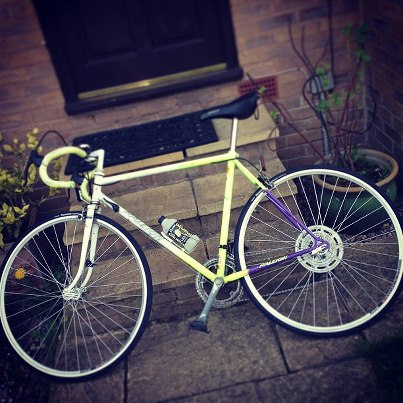
It was my father in law's, but he's long past going out on the road. I wanted to get back into road biking, so he gave it me. At that piont it was still his. Basically, it was a frame that needed building back up.
But now it's mine.
I wanted to do this partly because this is the year of not buying anything, so I couldn't buy a new one anyway.
But it's more than that.
This is a Raleigh bike. That used to mean something, when they were made in Nottingham,like this one, rather than a factory somewhere abroad. I grew up with Raleigh Strika's and Grifters. I love Raleigh.
My father in law loved cycling, still does. When the Tour De France comes through Yorkshire, he'll be up at 4am to make sure he gets a good spot. He loved this bike and seeing it come to life means something to him.
And if I'm learning anything this year of not buying what I don't need, it's that you can't buy happiness. You get out what you put in. I could have bought a bike, but I wouldn't have loved it like I love this one. Because I've helped build it back up. It's mine in a way a brand new one never would be.
Cycling to me is freedom. So much of it now is about aesthetics and having the right gear. That's not what it is to me. It's something simple and real. Road biking just seems like the purest expression, the level of wind, the breathtaking speed. It's real.
Now it's been a while since I was on a road bike. My legs are killing me, by back isn't used to that crouching position yet, but the sense of velocity, of being out there by yourself…and being able to go so far on your own steam is pretty special.
And doing it on a bike that, in so many ways, feels like 'mine' makes it feel more special. Because we all feel more attached to stuff that has required some effort, things we've had a hand in making. Stuff with history and story.
So when I'm on this bike, I'm not just riding with my father in law, I'm riding with all those craftsmen in Nottingham, I'm riding with the blokes in the little independent shop that helped me restore her, I'm riding with 10 year old self on a Raleigh Strika, a 15 year old me with racket bag on my shoulder, haring through town on my racer,to play tennis, a 20 year old me whistling through the streets to get to lectures or make swim training in time.
In fact, this bike might be 'mine' but you could say it's 'ours'.
Part sponge, part despot, part aggressive protector of team, part diplomat, part crafts-person, part researcher, mostly ideas fountain
Never undermines their team, looks to build their confidence, leads by example and guides rather than tells
Sometimes not a little bit frightening
Excellent judge of strategy and ideas, even better at presenting them
Never says 'No' to anyone without giving a good reason
Draws out the best in people without doing their job for them
Knows when to advise their team the creatives or the suits are right. But also knows when to defend their team when they are not
Never throttles bad thinking without inspiring the thinker to think better
Still trying to change things and learn, rather than boring everyone with the stuff they did ages ago
Exists to help others shine: their team, creatives, suits, the clients, rather than existing to maje it work the other way around
Is adept at politics, but doesn't believe the route to success is being political
Believes great planners care less about planning and more about real people in the world, and looks to build a team of people who are experienced in life, rather than advertising
Kicks their team out of the office to go look at real people living real lives
Exists to liberate creativity that builds businesses, rather than exists to do (insert proprieratary process here)
Encourages their team to understand their clients' business from end to end, not just the 'brand' bit
Bans marketing speak, brand bollocks and general jargon
"Every human being at every stage of history is born into a society and from his earliest years is moulded by that society. Both language and environment help to determine the character of his thought; his earliest ideas come to him from others. The individual apart from society would be both speechless and mindless"
"I am already discredited, I am already politicized, before I get out of the gate. I can accept the labels because being a black woman writer is not a shallow place but a rich place to write from. It doesn't limit my imagination, it expands it"
 NORTHERN PLANNER