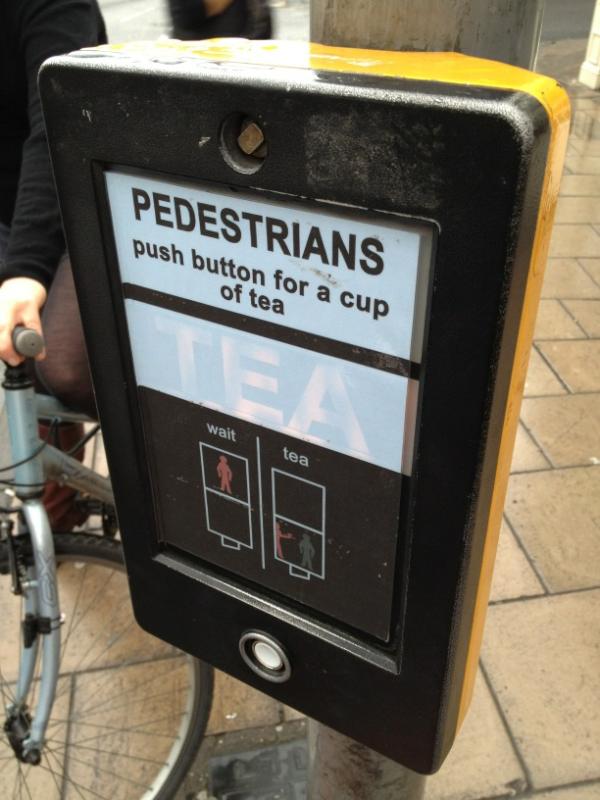
Found by the Tea Appreciation Society
Found by the Tea Appreciation Society
I liked this article from The Observer to how entertainment culture in the US is responding to difficult times- basically, escapism or wallow in the situation with grim reality.
Not only can this found in the UK, on many levels, including brand ones: thrift culture/back to basics v escapism and nostalgia, actually all dramatised to wonderful effect in this:
It's accross westerb culture in general.
Actually, you can see the wallowing or denial approach in all sorts of stuff. In the ageing population phenomenon in the western world, people of a certain age get frustrated at the way culture ignores them. They respond either with total denial and escapism, trying to fit in with the culture shutting them out, going for the mutton dressed as lamb approach:

Or wallow in it, with the grumpy old fogey, rebellious, sod the lot of you approach:

Increasingly though, there is the emerging third way, where individuals decide lifestage is irrelevant and choose to defined by attitude rather than age. They embrace the opportunities that good health, decent money and freedom give them:

It reminds me of all those King of Shaves discussion from the APSOTW project, about the male reaction to their loss of status and uncertain role in the world. Much of culture and the ads and stuff that reflect take the this way or that way approach:
The wallowing, reactionary rebellion:
#
Or going the other way:


But, like the Helen Mirren example for baby boomers, there is a third way. Both for austere times and for men. Instead of giving in to one cultural pressure or the other, brands can relieve tension with another answer, rather than following the behaviour already there.
I'm suprised we're not seeing more examples of the 'man of action', and I wonder what the modern version of that might be.
Back in the 1930's Superman worked as both independent hero, outside of the system who got things done, in a time when men felt emasculated, helpless and resentful of authority and institutions that restricted their freedom but didn't deliver on the other part of that deal – security and prosperity.

Marlboro man is another great example, as was the empowering, self motivated rallying cry of 'Just Do It' back in the late 80's early 90's when individual responsibility and merit were standards few felt they could live up to.
Of course, the idea of an earnest serious superhero probably isn't right for these ironic cynical times – or hold on, maybe it is?…., with the possible exception of the - tongue firmly in cheek - Iron Man, the string of comic book adaptations are pretty earnest and gritty. Not mention modern day hero icons without super powers:

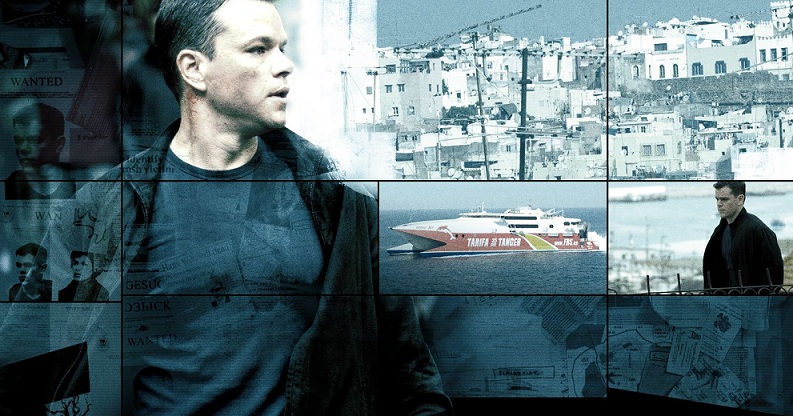
Or even better, what about anti-heroes. Like Omar Little from the Wire, Christopher Nolan's Batman, Tony Soprano, Nucky Thompson from Boardwalk Empire or even Don Draper. Men who step outside the rules of the game to alter the status quo. They're morally ambiguous and contradictory, but they don't wait for permission, they don't worry for too long. They ACT. Something that isn't just an answer for masculine identity conflicts, but the helplessness we feel as the world around us collapses. Something that rubs against some of todays cultural norms, from the get rich quick for doing nothing of use myth that applies equally to the bankers, Peter Andre and sleb culture, to challenging the ruling elite that looked after each other while they fucked us all over. It challenges the convention of make sulking, while the world leaves them behind and champions men who..erm, act.

On the other hand, it doesn't have to get so serious. I wonder what someone like KOS could do with the subculture of real life superheroes. Not only would they be a vehicle to convey all sorts of angles on the above stuff, it could drip in irony, avoiding the blood curdling earnestness of the category and be, well, rather funny and maverick. Something that category badly needs. Something that would cut through. Something that implies, rather than tells.
Imagine tapping into the rich love for slightly uncomfortable mockumentaries where people don't know how funny they are, like The Office etc. Let's face it, these guys are already doing it………
Anyway.
WARC are calling for essays to tell us what the future of planning might be.
Picture thieved from Russell Davies
I'm in two minds about this prize, since I get impatient with planning intellectually talking to itself, rather than reaching out beyond it's faux academic walled gardens and engaging with the real world out there.
But on the other hand, the more people put in fresh points of view, the better we'll all be for it. I love planners and our enthusiasm for stuff other people can't be bothered with, it's a great skill to make dull things interesting for others, even if one of those things is planning itself.
So do have a go, especially you Young Turks, shake up the smug establishment. I dare you.
Oh. I've just read Martin Weigel's post on why magic and stuff is still important. If you want better reasoning than the below post, on why it's still important to suprise and delight etc, you should read it.
I regret to admit that I'm old enough to remember the 1970's when nothing was open on a Sunday in the UK apart from news agents, off licences and pubs. It was rubbish of course, but on the other hand, it was a very real example of how things were just not as accessible as they used to be.
If you wanted to buy a record (not a CD in those days) you had to go to a record shop, sit in a listening booth and carefully, well, listen, to some choices before handing over your money. You didn't want to risk getting it wrong and wasting you're hard earned cash. It was a bit magic.
Similarly, if you wanted some new clothes, you got on the bus to the city centre and navigated the racks in the shops before you found something that roughly matched your budget and whatever self image you wanted to project. No fast fashion, clothes were expensive and the act of finding them was a little magic.
We've lost all that specialness these days in favour of access and ubiquity. If you want something, you can find it on the internet and buy it there and then, with music and film, you just download, probably without even paying. This is great of course, for all our lives, but on the other hand, having it all does leave us jaded.
When so much specialness and occasion has gone when it come to what we want and what we can have, it mystifies me why so many brands insist on being your 'best mate' or 'one of us'. From the ad with the consumer insight played straight back to you, to the overly familiar tone of voice, from the crowd sourcing NPD wheeze to the 'consumer as campaign ambassador' route.
In a world where you can have get hold of anything you want, at any time, brands need more specialness, intrigue and detachment. More magic.
Never more so than today in these uncertain times. You don't need an overpayed trend watcher to tell you people want their money to go further, but that doesn't mean the only answer is cutting price. It can also means making your stuff more magical so it feels worth it. It's a spark in otherwise grim times. Why do people continue to buy overpriced silver and white Apple gadgets? Because the believe the myth.
Another, rather obvious 'trend' is the way people are looking for comforting anchors. That's why so many brands are tapping into their heritage to justify a price premium. To simply read into it that people are looking nostalgia and signals of less troubling times is too superficial. They're looking for an escape from the realities of everyday.
Yes, to feel comforted and safe:
But also capable instead of helpless:
Part of the solution, rather than the problem:
Able to 'Open Happiness' rather than fear:
Or just in safe hands:
I guess I'm saying that access and downright subservience are very commone brand strategies in the times we live in, but the best approach, like it always was, is suprise,delight, instrigue and magic.
One the main faults of planning blogs is the habit of portraying the world as perfect. You see it in APG case studies too. If your only experience of life as a planner originated from these sources, you would get a very wromg opinion of the what it's like to do the job.
This stuff tends to propagate the myth that all a planner's job is startling original thinking, stuff that constantly shifts the paradigm. Work hard at examining the problem and all the stuff around, think brilliantly and everything will into the place.
As if everyday was an episode from the A-Team and a Hannibal is loving it when a plan comes together.

It doesn't. For a start, there's lots of very dull stuff to do also. Planners don't spend most of their days composing grand strategy, they're swimming against the tide of pointless meetings, writing decks for clients, Neilsen data and god knows what else.
It doesn't happen at the 'cool' agencies all the time either. Not at WK, not at Mother, not at Crispin Porter. They might megaphone their trophy work, but look at their entire reel and you'll see all sorts of pedestrian stuff and other bits that are just plain wrong. Getting it bang on is bloody hard. These organisations constantly look to do it better, but it's not just about specific departmental excellence.
Planning needs to gel with creative and account handling. More often than not, you need great research relationships and to be able to get on with the media people. Any dissonance here can be catastrophic. The research agency might ask the wrong question if they're pre-testing, or fail to see how the work builds on their original findings for example.
And then there is the client. You need to be able to inspire the client and persuade them. Make no mistake though, buying the best work is always a leap of faith for a client no matter how wonderfully you present it. Few get fired for following the category rules, which means not cutting through, as opposed to taking risks that don't come off. Or LINK testing until it's beating heart is completely ripped out
Then there is the culture of the region you work in. If you work in London, New York or some other 'creative hub' it's more expected to push things than regional outposts like, erm, Sheffield, where I work.
If it's not often it comes to together in Madison Avenue, it's a hundred times harder in Birmingham.
But if you're at a place where 'doing it right' is that much harder, should you give up? No way. If you can't constantly push things to get better, to open the eyes of those around you, I don't see how you do the job. Planning needs to add value or it shouldn't be in the room.
So I don't care where you work, or what client you work on. It's not acceptable to say the client, suits or even the creatives don't 'get it', are too conservative, don't care or whatever. There is always something you can do the make a difference and make things better than they would have been otherwise.You're job is not be right, it is to inspire, persuade and bring change.
For myself, I made a decisions that I wanted my kids to grow up happy, near family and fields. I wanted to be able to get home for bathtime and stuff. That means my work circumstances are such that it's that much harder to do the kind of work we all want to do. But not impossible. There's satisfaction every day in knowing you made a difference, and the quest to get into that place when everything comes together.
Just once, to do it really right. If you don't believe you can make that happen, even worse, if you don't care, you're in the wrong job.

One of my silly concerns getting closer to the birth of my little girl was how on earth I would ever love her as much as Will, our 2 year old little boy. He sometimes felt like my entire world and loved, and love him with a fierceness that's exhausting. I was afraid of somehow dividing that up, because I didn't believe there was anything more to give. Foolish.
It's just doubled. The visceral, ridiculous, joyous fierceness is simply X 2. Exhausting.
On my favourite bike ride, the last stretch us a mixture of short sharp hills and great flats for psychotically fast sprinting. If I push it, from start to finish, it's the length of this song on the Ipod.
The Velvet Underground are not to everyone's taste and, perhaps are a tad overated. But I always loved them and, maybe, love Lou reed and much of Johns Cale's solo stuff more.
Songs for Drella was their collaboration in tribute to Andy Warhol when he died. Not only was it the best of either's work in years, never have two people buried the hatchet in a more dignified fashion.
This track is maybe my favourite. It's manages to be sad, loving and celebratory all at once, tinged with the regret we all feel when we realise we've lost the chance to say what we wanted to someone.
 NORTHERN PLANNER