• My sister is an amazing cook. She can turn any mixture of ingredients into a great meal, she just has that knack.

    Just as in the wrong hands, the most expensive steak in the world can be inedible.

    Just as the finest red wine in the world is wasted in a plastic cup.

    Execution and treatment are everything.

    Basic ingredients can become things of wonder.

    The most wonderful raw material can be destroyed without the experience, car and attention to treat them properly. 

    I really love this track. Much of it has to do with the context of the final scene of Sex Education where I first heard it.


    Some of it is to do with the fact I was going through one of two things at that time.

    But mostly, it's because the song has the rare power of a deceptive cadence that builds without you realising it, the song is quiet and dreamy and it's only when it ends that you realise that. 

    Put another way, the execution – the quiet whispery voice, the gentle strings and couple of deft changes of pace really work for me.

    After, I discovered this version. I guess it's the original.


    Totally different and I can't stand it. Same song, same lyrics, yet one (to me at least) is amazing and the other is meh. 

    Which goes a long way to reinforce the point that you really don't have a good creative idea until you start to execute it. 

    So it delivers more than a message, or builds on a so called insight.

    It connects. 

    Just as Sex Education, the truly excellent Netflix show is about much more than the shock value of lots of sex in high school, it's about the confusion of being young (and being old), the thin line between friendship and love, love and lust and tension between being who people expect and who you really are – even though you're still working out who that actually is. 

    Here are two ads broadly based on the same message – our cars are reliable.


    The first, the classic VW ad isn't just about reliability, it's designed to resonate with something specific about the culture of the UK in the 80s. Roughly something to do with female independence, while still connecting with the materialistic aspirations of the time. It's also a story. 

    The second, less recent, but still a classic Honda, is pure theatre and showmanship.

    Both got people talking and generated talk value, with loads of free PR. In very different ways.

    Both could have started with same brief – make the car's reliability desirable rather than dull.

    The trick is in the execution.

    One taps into culture. One tries to create an event.

    Just as both these are about dramatising feeling great about saving money.


    The first (in my opinion) rewards the viewer, builds theatre and has deft little executional fairy dust (like the Skeletor laugh at the end).

    The second is devoid of any flare whatsoever, sorry. It even proves that even a great track can't save a bad ad.

    But the same track can transform a good one into a great one…


    Our industry still spends millions pre-testing propositions, messages positionings and other abstract concepts that matter far less to the success of marketing communications than the texture of the stuff that actually get's made. Of course, precision in solving the right problems helps, as does delivering the appropriate message, but when you're really competing against Netflix, YouTube, Tick Tock or someone's favourite soap opera, the message is the easiest part.

  • I love and hate this time of year.

    There's the ghost of dread as the nights get darker and and edge of coolness in the summer warmth. Yet when it gets to the end of August there's a sense of change and even a fresh start as Autumn beckons.

    A childhood of new school years in September and now my children going through the same thing means this point in the calendar often feels as fresh as January (Without the cold, darkness and guilt from over-doing it during the festive season)

    This September the transition is greater.

    My son starts secondary school, leaving me incredulous it's come so soon, torn between the joy of watching him gain more independence and the pain of that little hand, that used to gratefully reach out to hold mine, begin to slip away.

    And I start a new job next week here. I've never worked in healthcare before which makes me a little nervous, but if you have no fear, it means you're not moving forward and at 47, I'm grateful to be doing that again.

    In contrast to recent experiences, the culture isn't something they suddenly want to develop thanks to MeToo, nor has is quickly become a veneer in response to shifting expectations provoked by COVID. The people come first. 

    In even greater contrast, strategy isn't something they desperately think they want, but then feel threatened by it and seek to undermine its role at every opportunity.

    It's central. (While it's paramount for a strategy department to surrender its ego and include everyone and collaborate, it's another thing for everyone else to try and do the job for you. I used to agree that strategy folk need to earn their place in the room, but it's totally exhausting)

    And finally, because it's healthcare, it means I get to actually make a difference in the world.

    I've never felt particularly troubled about the real nature of the job, namely getting people to buy things they don't really need. Which is why I'm always fearful of 'Progressive brands' or 'purpose' – the majority of which are either there to make marketing folk feel better about the fact their job is sell things people don't really need, or lazy strategists who see trends and think a brand should get involved, with or without any credibility. 

    However, the opportunity to actually have an effect on lives, rather than shift a few points on brand health scores feels great. 

    There's a lot to learn and much to prove to a stellar team, but nothing easy was ever worth it. 

  • I had a hard time in my first agency, I won't lie.

    Much of this was down to the fact I was in the wrong job, maybe the world's worst account handler.

    What got me through was actually doing strategy without realising it.

    Well nearly through anyway. 

    This wasn't the whole story though, much of it was culture.

    A creative department and studio who delighted in tormenting inexperienced suits just because they could.

    A macho culture built on bullying and pushing their people until they burned out. 

    Many of us have been there and probably still carry the scars. 

    Thankfully this kind of agency is much rarer these days, however, the pressure to fit in still persists even if the experience is less bruising.

    Even today, many of the best agencies are more or less cults, with a very specific culture, a way of behaving and doing things that is pretty inflexible.

    They'll say their culture is precious and it's important that new hires don't upset this.

    Being 'easy to work with'.

    So they end up hiring more people like them.

    Which is perverse considering agencies are supposed to be about new thinking and original ideas.

    Diversity is important simply because, well I don't really have to spell it out do I? 

    It's also very uncommercial, because doing things the same way over and over again leads to the outputs becoming gradually staler and more formulaic.

    So when you can, try and work in a different way every time. Inject a little chaos into the routine. 

    Muscles get used to being trained the same way, you have to keep then guessing, even the one between your ears. 

    From a people perspective, even if your agency is one of those who keeps you in tight teams, or hires for a tight, one size fits all culture.

    Inject some diversity into your working practices and projects.

    Set up a network of people you know in your life who will tolerate talking about brands and stuff.

    Talk to them about your project, about your brand or whatever.

    Not only will they not be jaded by all the brand pseudo science, they'll offer a fresh view that will keep you on your toes.

    If you have kids, talk to them and listen to them, they haven't learned to not ask difficult questions yet.

    Go out and talk to strangers (in a non-weird way). 

    This is hard if you're shy like me, but learning to overcome this is no bad thing and you get a constant feed of different perspectives.

    Read stuff you don't usually read.

    Go places you don't usually go.

    Wear stuff which isn't usually your style.

    Listen to different music.

    The job of strategy was, is and always will be to bring the preferences and lives of real people into the process.

    Yes it's a lot more, a hell of a lot more, but the core skill has never been more important.

    When creatives chase whatever in fashion in awards land.

    Digital specialists don't even see people, they see data points.

    When more of us are working from home (a good thing if lets more people do the job of course). 

    The more stimulation you can expose yourself to from the diverse, much more interesting world out there.

    The more you'll stimulate better thinking and ideas.


  • I had a conversation with the leaders of a business who were trying to talk a good game on diversity and inclusion in their business.

    With one, exception every single one was white, middle aged and male. They were also the only people in the business with parking spaces.

    That's right, the ones most able to pay for their own parking were the ones who did not.

    It's a small point but it speaks volumes about what they really think.

    When I asked why this was, the conversation was immediately shut down. 

    This is just one example of actions over words when it comes to REALLY embracing diversity.

  • If there's one thing that's conventional about advertising, it's Disruption. You can't move for briefs asking you to 'disrupt the market', a certain agency had even made Disruption its core positioning. 

    Like most ways of working, it has its place, just like nearly every other approach, especially when you're in a market weighed down with complacency and tradition. 

    That said, in the wrong hands, it tends to turn into shock tactics or extreme points of view and novelty.

    Granted, this might create stand-out advertising, but it's less likely to create long term brand and business value, because while people can't help but notice novelty, anything too far removed from what they're used to gets rejected.

    Brands exist to help us think less and remove the risk of buying rubbish product, never forget this. 

    So what do you do if you have to work on a disruption brief?

    Simple really. 

    Find the link between what people care about and what the brand cares about.

    Make sure it totally undermines the competition in a way that they can't react too quickly.

    But ground the delivery in something they are already familiar with or can relate to. 

    Take some of the most famous 'Disruptive' work from Apple. 

    Few people will disagree that they like the idea of being creative and, at the time, most hated the clunkiness of computing, while Apple was focused on making computers that were not only a joy to use, they freed up the skills of creative people

    Then, there is a reason the 1984 ad was called 1984. It tapped into a very familiar story many could relate to.

    Just as 'Think Different' used very familiar figures – and in the west at least, flaws in psychology makes most of us believe we're not average when of course we are. 


    Now think about shaving.

    It's become very conventional for men's shaving brands to go on about male identity, which is kind of fair, because shaving is tied up with masculinity. 

    Gillette is supposed to be the best a man can get, so, in their endearingly clunky way, they're trying to tap into new codes for masculinity. 


    I suspect this will have an effect, but it does feel like a big brand late to the party, or bowing to the new conventions in the market. 

    The truth of the matter is, most men HATE shaving, they certainly don't want to spend more on it than they have to, which is why cheaper subscription brands like Dollar Shave Club or Harry's have done so well.

    But you know what? I'm tight fisted, so I naturally subscribe to cheapo brand myself, but one day found myself out of blades and bought Gillette to tide me over.

    I'd forgotten how good they were, shaved closer, no irritation, no dragging, just better. 

    It made me wonder, thinking about disruption and familiarity, maybe the best thing Gillette could do right now is be confident and disrupt the market by simply talking about the fact the their razors shave better – reliability, performance.

    Just find a way to execute it that steers as far away from slo mo models and sciencey close ups as they can. 

    The convention is tapping into how men feel about being a man, but really, shaving is a necessary evil than men would rather not think about – Gillette delivers the best blades so you can crack on with all the other shit you have to think about. 

    And in case you think reliability and commitment to performance is a bit dull, one of the best ads ever basically riffed on how to make reliability desirable rather than dull…..


    This last one is very dated, but I still like how, in classic BMP style, they push the simple benefit to the most extreme outcome. Also, funnily enough, tapping into 'independent women' tropes in a wonderfully subtle way next to heavy handed shaving brands and manliness. 

    Anyway, there will be a million reasons why my thoughts on shaving are all bollocks, but still, conventions, disruptions…

    In a nutshell, don't be lukewarm, stand our and get noticed – but don't forget to make people want to buy and for Gods sake.

    Familiar novelty. 

    Anyway. 

  • One of the first things I was taught in this job was a simple, effective truth – no one really wants you in the room. An iron law that I drum into my teams to this day. 

    Humility is probably the most valuable character trait for a strategy person, even more important than intelligence and curiosity. When it comes to the people you work with, it's still good practise to be generous with your thinking, let others take credit and see yourself as the liberator of other people's skills.

    As with any job, taking people with you is always the best approach, but then again, you have to ask what the do the people running agencies think they're doing? Why do they pay the wages of strategy departments, only to feel threatened and try and undermine everything they do? Why are strategists not supported more?

    Why is this the only department who is made to feel like they have to fight for their existence every day? 

    Of course, some of this is down to the practitioners themselves. The job requires you to be intelligent, but no one likes a smart arse and trying to make everyone else feel stupid is actually really dumb. This is perhaps far too common and maybe one or two strategists have not only made their own bed, they've made it tougher for everyone else.

    Collaboration between teams always works best, it simply does.

    And yet…

    No other department has to 'take everyone with them' in the same way as strategy does.

    We all have to do workshops primarily to get everyone to feel like they've had a hand in the thinking (don't be coy, you know you do).

    We've all had the dread of the agency leaders who have read a couple of books and want to 'collaborate'. You know, the kind who reject any proposition or core thought on the basis they haven't thought of it themselves, but can't articulate anything of use on their own. Then they get cross when you reject their thinking, or you get a little frustrated because you just want to be able to do your job. 

    There is a difference between surrendering your ego and surrendering your role. 

    I think the core of the problem is that strategy looks easy. In fact, it kind of is, the first page obvious stuff I mean.

    However, the kind that cuts through the clutter to get to something simple, generous to various channels and yet have that leap of imagination to spark great work – it's hard.

    It's tough to do it by yourself, which is why I always advise people in our job to find a sounding board, someone they trust to knock stuff around with.

    Just as you should shut your mouth in meetings and listen hard, ready to spot a flash of genius someone else shares. Always be ready for someone else to spot the solution.

    However, even then it needs honing and finding the clarity you need isn't helped by a cacophony of people trying to do your job. 

    You don't find strategy people trying to do the end of year accounts or negotiate with the landlord, so I don't totally buy the acceptability of everyone trying trying to write the comms strategy.

    This isn't the experience in any agency by any means, but I think it's time to give strategists a break.

    Or at at least, if you want to do their job, don't hire them.


  • So it's the Olympics, which I'm enjoying immensely. As an ex-swimmer, Adam Peaty winning the breast stroke has been a highlight, however his comments after really struck a chord.

    Basically he was expressing relief rather than jubilation, similar to Victoria Pendleton after her last cycling gold. A release of all that pressure and sheer gratitude to not have messed it up. 

    Because losing is a much more intense emotion that winning. You might have found this with pitches, or even just those high pressure meetings and presentations. 

    You put so much into it and when you find out you didn't cut it, or you work gets rejected, you feel crushed, so of course a thick skin and the ability to bounce back are pre-requisites for the job.

    However I wonder if we should getting at enjoying the highs. 

    I can only speak for myself, but I know I'm not alone when I say that winning is often quite a numb feeling. Mostly because of that wave of relief that you didn't lose, however it's not all that. Also, there's the immediate focus on now having to deliver what you presented and the mind moving to that other pitch or project you've got on.

    That's the catch with working in agencies, it's rarely dull, but we don't seem to be able enjoy those moments when it all comes together. The end isn't as fun as the start, it's the exploration and development that gets us out of bed I think. Like the disappointment of finishing a great book, it's getting there that's the good bit, but still. 

    I suspect it's down to the types who do well in agencies; restless, curious and always wanting to move forward (the good ones anyway). It stops you getting stale but it's shame we can't enjoy the highs as much as we feel the sting of the lows.

  • So it's the summer holidays, my children are off for five weeks.In between the usual tensions over XBox and Tik Tok, they hang out with their friends, in real life and virtually. There's a lovely cadence to the days where I work, they potter and play and we come together for lunch, or the occasional trip out.

    That's the beauty of remote flexible working, it's not just about working when you at your best. It's also working when it's best for everyone. 

    All of the above is true of course, but it's not the whole truth, it's the showreel. The highlights that get on Instagram, or the bits that might get put into an ad for Teams over summer, or a house cleaning product.

    There is plenty on the cutting room floor. 

    There's the big stuff, the sit-downs over too much XBox or not being home when they promised, yet the real challenge is the reverse marginal gains.

    Marginal Losses.

    The build up of all the things that are just about OK when the kids are out for most of the day. yet add up to horrendous time suckage when they school's out for summer. 

    The constant flushing of un-flushed toilets. 

    The trails of hay around the house from the daily feeding of guinea pigs.

    The socks on the floor.

    The glasses and cups around the house. 

    If you never believed all that marginal gains stuff, try spending 5 weeks with a couple of pre-teens, a little begins to add up to a hell of a lot, which is worth thinking about if you're thinking of returning to the office and all the little distractions and time thieving that goes on there.

    At least the toilets get flushed, or at least I hope they do. 


  • Greg Lemond is the only official American winner of the Tour de France (we'll leave out the discussions about a certain Texan). 

    He won it three times, even more impressive considering wins two and three came after being being shot by his brother in a hunting accident.

    He rubbed many up the wrong way because he could not help but be honest and, to some, over earnest.

    But whatever you think I think of thst, I love this very honest quote about what it's like to a pro cyclist.

    "It doesn't hurt any less, you just go faster"

    This gives comfort to an increasingly creaky boned forty something like me.

    Knowing that they may go a hell of a lot faster, but they feel the same agony as I do climbing a steep hill.

    It means something else though, which is worth bearing in mind if you do strategy work.

    Not only can you not avoid putting the work in, if it doesn't make you suffer sometimes, you're not doing it right.

    I don't mean the ridiculous presenteeism culture or sweatshop mentality.

    Certainly not the bullying.

    (like the false belief that doping has been eradicated in cycling, don't believe for a second that the very real dark side of agency life isn't still there because in many places it still is)

    I mean the pain of doing the work really well. 

    Don't believe the case studies, it's not easy. There are few ta dah moments, it's mostly banging your head against a brick wall until something emerges. 

    The simultaneous fear and love of the blank page.

    The knowledge there is a simple idea idea forming but you just can't articulate is yet.

    The exhaustion from going over every single piece of information again and again, knowing there is no connection, but it will come.

    Strategy directors go through as much pain as juniors, they just hide it better.

    Even worse, their instincts and experience are greater.

    It becomes seductively to fall in love with your first thought and articulate the shit out of it.

    Or recycle a small library of great strategies again and again. 

    Many agencies you will know of frequently recommend the painfully obvious but dressed up with clever words and amazing storytelling

    Like creative ideas that hide behind the Mac, refusing the exposure of the rough scamp.

    Too much strategy hides behind data and cultural reference, avoiding the glare of the simple 'get' 'to' buy'. 

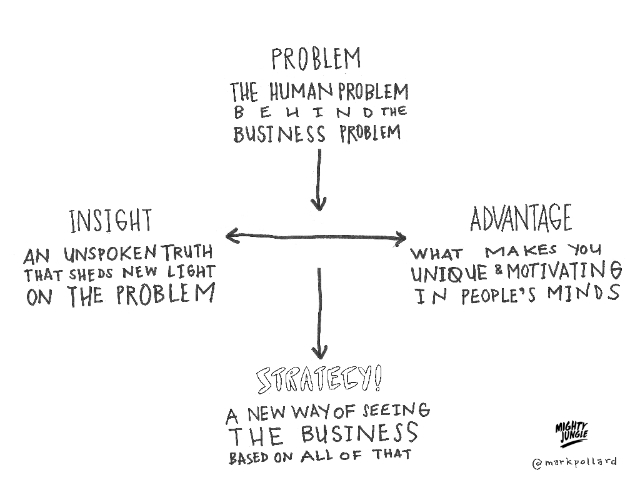
    Or 'issue' 'insight' 'idea'.

    Working at Pixar is painful. Their best films emerge from constant improvement at the most detailed level.

    One of the most creative companies in the world simply works harder on their movies and leaves nothing.

    Just as the best sculptors chip away at a stone block for the work to eventually reveal itself.

    Hard work and perseverance may be uncool, but they are the only sure ways to excellence. 

    It's tempting when you have the option of short-cuts or re-purposing work you did before to just do that.

    But it's not like taking EPO or steroids, it doesn't make you better. 

    Unfortunately for strategy people, there is no equivalent of doping in our job.

    It if it isn't painful to some degree, you're not doing the job as well as you could or should.

  • I was chatting to some friends this (actually face to face to face, yay!! Even though it was under a canopy and the rain was pouring down, it was ace).

    The discussion roamed far and wide, but there was a spirited difference of opinion on Game of Thrones. A minority thought the whole thing was an overrated waste of time, while a real outlier thought the ending was actually quite good (if you haven't watched it, the common view is that the final series was something of an anti-climax). 

    It got me thinking, there are plenty of things in popular culture you're expected to love, things that are beyond criticism. There are others you're supposed to hate. 

    Take Mrs Browns Boys. Most people I know think it's hateful, but there is a reason the BBC gives it primetime. The so called mass market loves it.

    Actually, most people couldn't give a monkeys about Game of Thrones. 

    What does this mean for the job?


    First, know your audience and avoid doing strategy for yourself. 

    Do everything to understand what the people you are trying to influence take to the hearts and enjoy, it's not likely to be the same as you. 

    Marketing is really a battle for popularity, don't forget that. 

    Take time to read weird reference to generate originality and a fresh perspective, but spend even more time watching, reading and experiencing the real day to day of their lives.

    They think life is more interesting than brands, so genuinely start with what they find interesting and work back. 


    Second, be wary of the 'you must like this and hate this' rules in your own job. 

    Just as millions of people like U2, Mrs Browns Boys and Venom (panned by the critics), don't be pressured to parrot Byron Sharpe.

    Question Mental Availability, it's only part of the story.

    Question the relentless 'short-term is evil, long-term is the one true God' agenda. 

    Successful digital clients are questioning the focus on digital performance and moving back to brand building, you should too.

    But then again, be wary of the 'emotional brand is good, rational persuasion bad' dogma.

    Be even more a wary of those who say people want to buy from a brand with a social purpose, but they will be right some of the time. 


    In other words, it's good to respect the experience and practises of people in the industry, but the reality is, most ways of doing things work some of the time, but not all of the time. 

    No one likes to admit that the job is artful dance of doing what will work and what you are expected to do. 

    I didn't say it was easy.

    And that person who thought Game of Thrones ended well was me!!