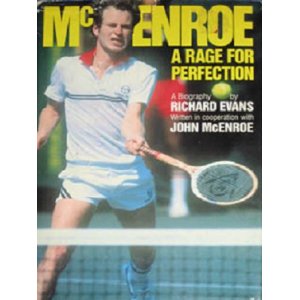
• One of my favourite sporting books is this biography of John McEnroe.
    Rage

    I love the writing. I love the insight into the golden age of tennis- from the late seventies to the early eighties. Mostly, I love the insight into the man. If there was ever a flawed genius, it was this one.

    Anyway. I particularly love the description of why he was only an average amateur. In part, because it was fun at this point and only part of a much wider sporting repertoire that included 'soccer'. Mostly because he has a big problem with making other people look like an idiot.

    He had all the tools, but just couldn't bring himself to make the other guy look so bad. One exception was an opponent who kept on cheating on line calls (amateurs called their own lines). He have the guy one more chance and asked him if he was sure it was out and then, when he still didn't play fair, McEnroe cut him to ribbons with sheer brilliance.

    While that approach obviously doesn't work in sport too well, it does if you work in an agency. Especially if you're a planner. Next time you're in a meeting with a really good account handler, see how they handle debate and negotiation. You'll notice that they're always at pains for nobady to feel like they've 'lost'. Everybody feels like they've come away with something. They never make anyone look like an idiot in public, never set out to show someone how wrong they are in front of everybody else. Because they know that the secret to any negotiation -and planning life is full of negotiation, from agreeing how to develop a route in a creative route in a review to carefully changing bits on the brief so the CD will sign it off – is making sure nobody feels like they've lost. No one should feel they've lost 'face'.

    Leave winning to professional sport.

    But you'll also notice there are moments when the same suit proceeds to 'cut the opposition to ribbons'. They know they've given someone every chance, but eventually it's time to demonstrate a little authority. And it's so much more powerful when you don't use it very often. And even then, they'll try to do it in private rather than humiliate someone in public.

    So for a planner, yes, you can probably cut someone else's argument to ribbons any time you want. But that won't really get you anywhere. You have to take people with you. But occasionally, showing a little steel can work too.

  • You know

    The automotive segmentation that uncovers the gem that some people love the exhilaration of driving

    Women sometimes change their look for different occasions

    People tend to ignore marketing that isn't engaging, given half the chance

    People want a bank they can trust

  • The spoof training camp where staff are put through their gruelling paces to ensure second to none results/service etc for you

    The bumbling Dad who always gets it wrong and the reseourceful Mum who always quietly saves the day with a knowing glint in her eye


  • Turning the enemy into evil little, but slightly cute characters.

    You know, the smug germs in your toilet suddenly shaking with fear when Mum (always Mum) appears with New Improved Bleach Brand.

    Or the evil little bacteria critters skulking between your gums, suddenly on the retreat from New Impoved Mouthwash or toothpaste.


  • One of the better aspects of getting older is not having to bother with what other people think.

    I don't mean mean inconsiderate or ignoring other people's feelings mind, in fact, I can honestly say that's improved with age.

    I mean not worrying what other people think of your preferences and choices. I really enjoyed Submarine for example and I think I understand it's supposed to be something middle class, Guardian reading people like me 'should like'.

    But I don't care. I just like it very much, it reminds me what it's like to be a boy who is at once fascinated and terrified by girls. I also like how it breathes and resists the urge to rush anything. Too many films rush to the action or the obvious plot device or inciting incident, mostly because the focus groups told them to. And if you're a planner, you know collective focus group wisdom has shit for brains.

    On the other hand, I'm at once excited and deflated to be imminently watching the final season of Battlestar Galactica (the new one, not the one with Face from the A Team). It's not as clever as it thinks it is, but I really like multiple plot strands and the embracing of ambiguity. I know this makes you think I'm a Sci Fi geek, but I'm old enough not to care.

    I'm also mortified to note it's 20 years since Achtung Baby. That makes me feel old, but it also makes me rather wistful for being 17. I'm supposed to hate U2, aren't I? I hate THEM, of course, I really mean I hate BONO. The hypocrisy, and sheer self importance. But I love this record. I know much is inspired/stolen from Primal Scream and Sonic Youth to name but two, but I don't care. It's still dark, brutal, confused and unsure and makes me feel something (at least it's not Queen). 

    I wonder if that's really why kids find their parents so embarassing. It's not what they like, it's that the allow themselves to like it.


  • You know what, to hell with the last past. As has been noted, no one reads blogs anymore which means I can write what the hell I like.

    So

    I'll rephrase what I said in the previous post. There won't be much planning and thinky stuff for a while. Just stuff.

    Like noodlings with Instagram:

    Sunset

    I like the drive home from work. I like anticipating the excited 2 year old who will be staring out of the window waiting for Daddy. I like time alone with Radio 4. I like feeling free, because, let's face, driving is one of the few times we feel in control (and isn't it a shame they cocoon cars so much we can't feel anything anymore). I also like the views I get of lovely Yorkshire countryside. This sunset looked pretty good too.

    And, of course, rambling about tea, swimming and kids until every single last reader gets bored enough to leave and never come back.

    Feels good Paul and Ben. Like shedding skins or something.

    Oh, Wilco is on work's Spotify. Thats good.

  • Crazy

    In the next 13 days I will be moving house (if the stars align and my halfwit buyers pull their fingers out), plus presenting something important that's taking a lot of work (in the abscence of the account director).

    All before the arrival the long awaited second baby and the two weeks re-learning what sleep deprivation means.

    So this little corner of the internets is closing for a (long) while.

    See you on the other side sometime.

  • It's not news to you (hopefully) that most of how marketing communications works is as much about how it makes you 'feel' as what it 'tells you'. Due to a quirk of human nature, this possibly calls into the question the REAL effect of campaigns that parody the competition. Let me explain.

    Gossip lubricates the cohesion of every social group. But be careful how you do it. Sharing juicy news and speculating over half baked rumours really is way to bond with co-workers, friends or whatever. But talking about people behind their back in a negative way backfires, in fact, saying negative things about people in general isn't advisable.

    That's because whenever we hear someone talking about someone bad points, subconsciously, we attribute those bad points not just to the subject of the conversation, but the person slagging them off. Talk to someone about how lazy and unreliable Rob is and they'll end up withe the impression YOU are lazy and unreliable. Gleefully tell me how arrogant John is and I'll end up thinking you're more arrogant than I would otherwise.

    Which makes you wonder what the long-term effects of these two financial services campaigns were. I don't mean what feedback people gave in unreliable research, or even shifts in awareness or consideration etc, but the longer term implicit memory planted in people's minds, the thing with the longest and, in the end, the most important effect.


    In the case of Natwest, I know the resolution is the brand as the solution, a lone alternative in a morass of unhelpful, untrustworthy enemies, but you do wonder if people just lump Natwest with the brands they were trying to criticise.


    And in the case of Nationwide, is it even worse, when you also personify the brand as fat and annoying?

    You can see why they might have shifted the strategy the focus on the solution rather than problem..


  • One of the oldest, and probably most boring, debates in this business is the endless arguments over the merits of 'brand ads', especially in the context of 'product' ads. You know, ads that are described as purely focused on how people feel about an organisation v ads that focus on something to with the product.

    Like most 'it's black, no it's white' arguments, the answer is really sometimes it's white, sometimes it's black and sometimes it's grey.

    That's because the fundamentals of strategy remain the same. Where are we now? Where could we be? What do we need to do to get there? That's it.

    What's the fundamental challenge we need to overcome and how do we overcome it?

    Sometimes the problem is image, sometimes the problem is what people know or don't know about the product or service. 'Brand' or 'image up' campaigns are not always wrong, but they're not always right. Nor or are  'product attribute' campaigns. It all depends on where you are now and where you need to be.

    For example, once upon a time, Skoda had an image problem. Hence stuff like this:


    But when enough people didn't have a problem considering a Skoda, not enough went on to test drive because they didn't know enough about the cars themselves. Leading to stuff like this:


    Now, let's look at the first ad again. A 'brand' ad according to common parlance. It wasn't as simple as that, it never is.

    There were more than enough people who didn't have a problem with Skoda's image. What was getting in the way of them considering a Skoda was the grief they would get from the majority of the population who DID. In other words, this wasn't a vacuous 'brand ad' it was work that addressed a specific problem that was blocking sales..THAT HAPPENED TO BE MORE TO DO WITH IMAGE THAT PRODUCT QUALITY. So the solution wasn't to address attitudes head on, it was to collude with the people who thought Skoda was OK and gently make fun of the people who didn't get it yet. More sophisticated than that, Skoda made fun of itself too and positioned Skoda owners as smart, informed reasonable people. 

    A 'traditional' brand ad with a sweeping manifesto about the company's vision wouldn't have had the same commercial effect, because the problem wasn't what potential buyers though of Skoda, it's what others people would think of them.

    But both ads reward your attention, they make you, or me at least, want to talk about them, they make you feel something about Skoda.

    That's the real truth about brand ads and stuff. Sometimes you have to address something specific about a company or product image, sometimes you have address something to do with how people use a product, what they know about it or what they think they know about it. Sometimes it's black, sometimes it's white.

    But if every piece of communication doesn't build how people feel about the brand, if it doesn't make you feel something and cut through, it's a waste. Because we remember how we felt a longer than we remember what we were told. We don't think about brands and stuff very often and make decisions on emotion far more than marketers realise or admit, and more than we can admit to ourselves. So sometimes, in fact, all of the time, it's grey. It's just what shade is right for right now. 

    It's rare that the problem or opportunity is purely 'image', usually, it's about showcasing something about how it's used, made or features about it in way that, not only cannot be missed, it continues to build the correct, unique, positive feelings about it.

    This is a 'product' ad for Nokia. But it does a hell of a lot more than tell me about how the product works.


    All of this campaign is based on the product and who actually buys it, namely how it smells and the fact women buy it for their men.


    This campaign is based on new product news – it now curls and flicks as well as straightens hair.


    One final thought. This is lovely work from Ikea.


    You could argue this is the 'brand led' curtain raiser to more product focused stuff like this:


    But it does a lot more than re-position Ikea as the place to come to create a happier home (rather than the unvalued place for disposable throwaway furniture it was becoming) it showcases the store and the products available.

    More importantly, it does the 'brand thing' in a different way. Rather than the usual, sort of self-obsessed,  'Do things our way' manifesto thingy, you know. 'Just Do it', 'Think Different' it's more of an offer, an experience, an invitation into a particular kind of world you might like to be part of. 'Happy Inside'.

  • On the other hand while I love being defined as Dad and all the responsibility that entails, that isn't the whole story.

    While I feel less defined by what I do at work and more by what I do at home, there wil always be a little rebel inside that refused to accept mediocrity and can't stop fighting for great work.

    There will always be the 'me' that needs to be alone on a bike, that craves the simplicity of the swimming pool, that feeling of doing something you were made to do.

    Every now and then, there's the need to cut loose, to drink too much and act very childishly.

    Sometimes, you just need to read a book on your own.

    Other times, you need to take your wife out and remind each other you existed before your children did and you wanted to be with her because she took your breath away.

    Being this other person is not contradictory, but it isn't selfish or hypocritical, as long as there's balance.

    Embracing all the stuff that comes with being a Dad, to me at least, just makes the other stuff more special.

    To deny you want these other things too sometimes is lying to yourself. But to pretend you can, or even want, to do do as much as you once did is lying too.

    I don't really know why I'm telling you this.

    Anyway.