As I was saying, becoming a parent makes all sorts of things magic as you look at them through your child's eyes (thank you mirror neurons, you're ace).
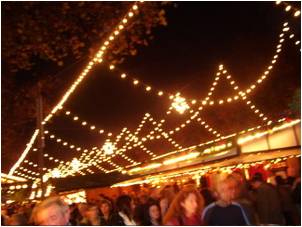
Two years ago, I would never bother going to the switching on of the Christmas lights in our village. Turns out that all you need is one year old boy to make a few, not very good really, lights and some better fireworks seem perfectly wonderful.
Right, as discussed, let's get down to some proper planning. Or, perversely, for this post, un-proper planning. Let me explain.
Your clients will mostly likely be fully fledged marketeers. They'll have gone through higher education doing a marketing and marketing related degree and build their work around what they learned. Not only is much of what they have been taught out of date, is is fundamentally wrong, built on principles of economics and business that assume that all people make rational decisions and respond to incentives in a rational way.
This is, of course, untrue. We know know, through psychology, anthropology and Behaviorial Economics that people make decisions irrationally, intuitively and emotionally.
Still, they can be useful when thinking about the category alone, but they're useless when thinking about the brand, a valuable asset that, if managed well, should be less about the category and more about life. Successful, long lived brands occupy a role in people's and certainly don't play to category rules, they redefine them.
But there is no point ignoring the process and rules clients live by, rather, it pays to understand them and find a way to work with them.
To be honest, that's not really different to working with an agency proprietary process. Most agencies go about things the same way, they just sell it different. So if you have to work around TBWA's Disruption, MC Saatchi's One Word Equity or McCann's Brand Footprint (the most sensible and usable in my book) you'll be doing good thinking and post rationalising it to fit with with the process that's been sold in. It's not that different to working with traditional marketing processes and rules.
We've all got experience, since everyone's pretended to be interested in someone else's stuff to make them like us and trust us, it's called dating.
So we're going to take a look at some tried and trusted marketing models, how they work, why they're flawed and what to do about it.
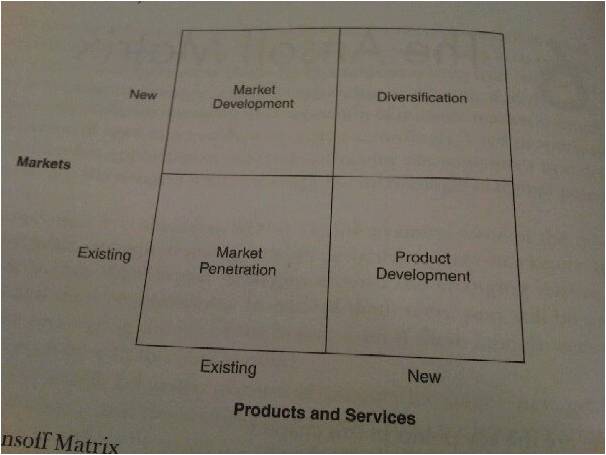
So firstly, step forward The Ansoff Matrix.
It's supposed to help develop thinking for how best to plot a strategy for growth through analysing the market.
It's main focus is on the rational benefits of your product and service and largely ignores the emotional and cultural aspect of the brand.
If it's used carefully, it can keep a brand healthy by encouraging collective brains to constantly think about opportunities for development in the immediate category your in, but it doesn't account for the value that brands add, and can ignore the business you're really in.
For example, it could be argued that Nike's real value is in personal growth, Apple might say it makes you more creative rather than helps you do computer type things.
Basically, it it gives you four options for growth by matching up existing and new products and services with markets that exist and possible new ones.
If you go to the bottom left, that's nearest, safe and warm area of comfort;Penetration. Now why on earth this is the case I don't know, but here, penetration doesn't mean going after a new type of customer, it means it means selling more to the type you have AND getting more of the same.
Now this is already a problem to me – that's actually two very different strategies, increasing frequency us very different to recruiting new ones, the same type or not.
Anyway, building loyalty is bloody hard and to be honest, without the brand magic that transcends the category, it is very, very rare to have more loyalty than anyone else.
Sainsbury's Try Something New Today is a good example of doing this well, and that tapped into a deeper need that was a part of culture – resolving the tension between growing popularity of cooking and the skills, time and budgets of real people with real jobs.
Now go to the top right and you have market development. Bascially, getting new customers to buy the product without changing it. Through new target segments, like Apple targeting more entrenched PC users
Or geography – like Morrisons going down south and taking the marketing 'upmarket'
Or just finding new channels to market – recently God knows how many retailers have gone online. But also, mobile companies have opened their own branded stores.
This is all good of course, but just focusing on product or service benefit throws up all sorts of problems. You need to look at the brand, how people feel about it and what it stands for (if anything). In many cases, it's too entrenched to stretch to new people or new places. HSBC launched packaged it's telephone banking service as First Direct because the potential customers rejected big bad financial behemoths.
John Lewis is brilliantly middle class, but would struggle to gain shoppers outside of the emotional heartland it's built.
Morrisons nearly came a cropper when it moved down South, it's Northern, common sense heritage just didn't wash. It was only when they used their fresh offering to communicate quality that things picked up.
Some brands can stretch, some cannot. Much of that depends on how they've built their relationship with people, if it's a big, human, cutural truth, that can stretch – Nike can use it's 'anyone can be an athlete no matter what their gender, background or race' to become relevant to all sorts of people for example. From being a brand for men to empowering women for example, but then again, their failure with skate parks made them buy Converse.
Coke can't target the health conscious with much credibility so bought Innocent.
So, yes, this get to the heart of why Ansoff's just isn't realistic, it doesn't measure brand value and doesn't take into account how elastic it is. Sometimes it can be made to work for new people, some times it can't. You can't thinki about decent market development strategy without it.
Now, lets move onto product developmentm making new products for existing customers. These rely on existing brand strength. Of course, they have functional benefits, but coming back to Nike, some people think the key point they were succesful was the Nike Air launch. It wasn't. The technology was available for ten years before that, with no success. What made the relaunch successful was getting the brand right.
Think UK supermarkets selling insurance, or immenently selling mortgages- it's only the trust people have in the brand that lets them do this. How on earth can Virgin sell cable TV and transatlantic flights? The brand provides the glue.
You can't have a sensible conversation about this without intangible brand stuff to come in. Again, how and where can we stretch – if it all.
The most difficult is complete diversification. New product to new customers. Straight away, you need to ask, what credibility do we have?
One way is partnership. Team up with someone with experience and credibility in that category – Guiness agreeing to Guiness flavoured Marmite for example, or Sony Ericson. But in both cases, it was as much about brand fit as product fit. Both Guiness and Marmite are distinct products that you either love or hate for example.
Yep, the brand muscles it's way into the conversation again. Now, if you want to attempt doig this without partnership, you really do need to be a brand built on values and a point of view rather than product attributes and even emotional ones wrapped around them. Virgin can do it, but even Nike can't go into, say fashion without looking stupid, it may be a cultural brand but it's built on sport.
So there you go, a whistle stop tour of the Ansoff Matrix. It's useful, it's a way of thinking about growth, but it's too wedded to the category and product benefit.
So if someone in a marketing department you're in, or work for, starts using this model as a basis the business strategy you've been briefed on, or wants to use it to frame some workshop exercises, be ready.
Don't reject it, praise it, talk about how useful it is to channel thinking about the immediate category and challenges for targeting, product innovation and distribution. But then proceed to work from your areas of expertise, your credibility – the real relationship the brand has in people's lives, its reas srouce of authority and it's role in culture. Be the champion of brand behaviour to augment the hard thinking the client is doing, or has done.
In other words, add value and channel what's good about this model into something even better.
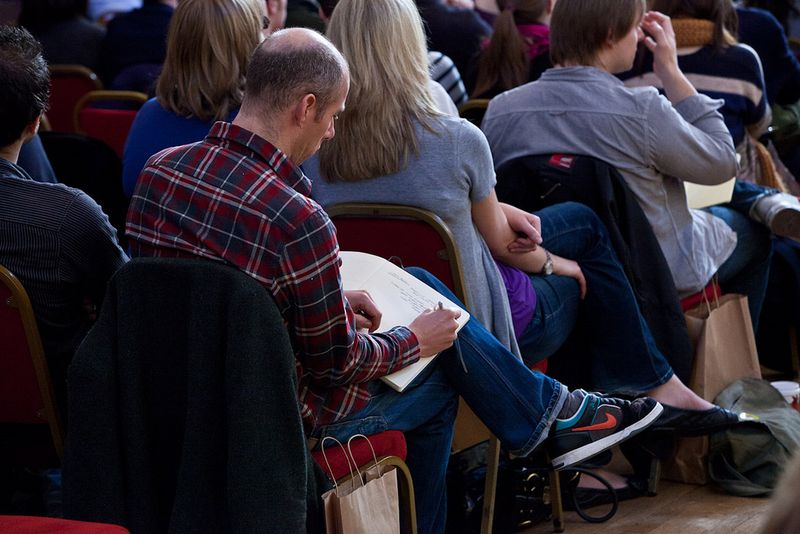
I went to Interesting North on Saturday. There is much I can say, but there's little need when you'll be able to see the videos and stuff in due course. In any case, other people are reporting already, here too.
I really liked it though. The speakers were excellent and it reminded me how important it is for planning type peopl to collect interestingness – the day was full of all sorts of stuff that will come in handy some day.
I liked the fact this was full of more techy and arty people, there really weren't too many planning types, which was a good thing. I also liked the fact that people were there because they were interested, rather than wanting to be around the cool kids. There was a distinct lack of smugness and posturing to the day.
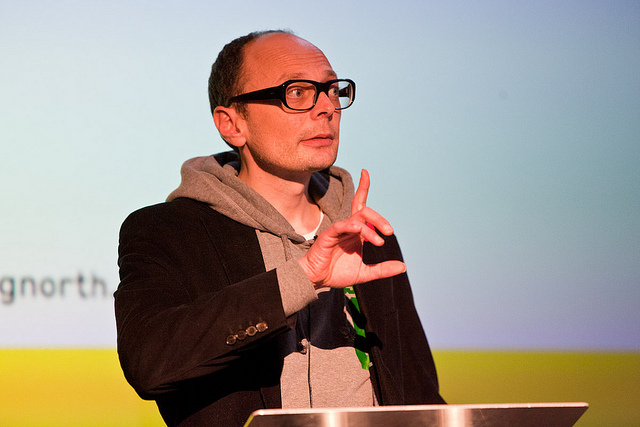
The only talk I'll quickly touch upon was Marcus. He was brilliant, as you would expect, but not how you'd expect. You'll know he has too much imagination and simple need to DO stuff to be contained in a single blog, which leaves the web littered with his projects and personas. They're hard to keep up with and sometimes confusing, but you always know Marcus will be up to something. And most of us expected a talk around this stuff.
But he didn't do that. He talked about a deeply personal time in his life when he thought he was going mad. It was incredibly brave to do that in front of all those people and it just worked. There isn't enough stuff in this world that makes you feel something, there are not enough storytellers, there are not enough people willing to talk about stuff that actually matters.
Marcus reminded us all that we were at an event full of people too clever for their own good, and that the bollocks we all do is irrelevant next to real stories about real people. He reminded us all that good writing should be treasured and people who can perform their works, rather than just read them out should be treasured too.
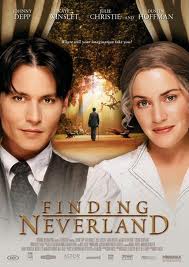
Three unrelated facts. We watched Finding Neverland last weekend, it's a Bonfire party at Will'sGrandma's tomorrow and it's Christmas very, very soon.
What brings them together is the way being a new-ish parent changes how you look at things. I used to moderate groups a lot more than I do now and always got frustrated at the Mum who talks about everything from the point of view of her kids. Still annoys me but I understand it a little now. It's inevitable that your perspective on stuff changes when you have kids.
Finding Neverland is about lots of things, but mainly about the magic, imagination and innocence of childhood and the pain of losing a loving parent. I wept a little watching this for the first time and I'm not ashamed to say that thinking about my little boy and how much he loves his Mum enhanced the emotions this film evokes.
That's related to Bonfire Night and Christmas, both are events that lose their magic as you get older, that you value for bringing family together and, with Christmas, being allowed to be nice to people without them looking at you funny. But with a little boy, the wonder comes back as you see it all through his eyes. I'm excited for him and can't wait to see his face when the fireworks start going off, or when he's helping (or most likely hindering) Mum to put the lights on the Christmas tree or stare with wide eyed amazement at the Christmas markets in Manchester.
It's tinged with a little pain, you remember being that innocent and feeling that loved and safe and know it can't be like that again, but that just makes you more motivated to make THEM feel like that.
Yes, kids make things magic again. We're very lucky.
I really enjoyed this Do Lecture from Alan Moore, about how changes in technology are fundamentally changing our behaviour, like movable type did. You might have heard this argument before, but basically; top down organisations are going through their last throes of success, the future will be communities doing it for themselves (it's more nuanced than that of course, but..well, just watch it)
I don't know if he's totally right, but I'm not so sure and I think that's my point: no one does. History is littered with little flags placed in moments in time where someone has pronounced 'The Age is this' 'The death of that' but usually, it's nothing of the sort, it's a little wobble or a bit tacking in the general direction of getting a little better.
I agree that we're all getting more bolshy when told what to do and suspect kids are even worse at accepting hierarchyy than they've always been, but just because our penchant for community is being freed up a little again, but surely that doesn't mean that how we live in communities per se will change?
All communities have hierarchy and leaders – it doesn't matter if that's human communities, chimps or Lions. The strongest stag earns his right to be at the top of the pecking order, the male with the most impressive plumage gets first pick of the females, think we're going back to that…we still want leaders, we still want organisations and institutions to help us live our lives, they'll still guide and soemtimes even tell, but they have to earn our respect, love and adulation, it's no longer theirs by right or due to size, money or whatever.
For brands and stuff, that just means there's no excuse for crap products or marketing that's boring or insults the intelligence. But while we want to partcipate, we still want things that surpise and delight us, things we can't do for ourselves. Yes, we'll enjoy noodling around and making and sharing our own stuff, but we can't be arsed to do the great stuff ourselves.
In other words, make something great and then let me join in.
That's why 'brand as verb' 'brands as conversations' is so much hot air – the good ones always were, it's just that now, no one has to put up with the bad ones.
(picture from Russell) You may have seen the plea for a return for proper blogging. I miss the so called 'golden age of blogging' too, before everything got short, Twitterised, Facebooked and Posterouserised. I miss slightly longer bits of thinking and the conversations that followed.
Blogging has enabled me to meet people I wouldn't otherwise, online it's true, but also in real life. I'm too shy to introduce myself to people I don't know at conferences and certainly wouldn't ask to meet someone for coffee I've never met, but blogging let me do those things and made (and still makes) me feel closer to the whole planning fraternity thing, which is something you don't get from doing this job in Sheffield. That's why I still muck around on Rob's blog everyday, I go where there will be others, and I feel I know Rob to some extent, even though I've never met him.
Writing a blog is a little like those psychometric tests they put graduates through in the 90's (and still do for all I know), where, no matter how hard you try to avoid it, you're real personality emerges. Writing a lot of posts over time paints a rich picture of the person, which is why I've always found it easy to talk to bloggers when I meet them – I know them already and they are how they write. Funny that.
Anyway, like I said, I miss all that and within this found something to start writing about again. Proper, rigorous planning stuff. It's all well and good banging on about ephemeral planning wonkery, which still pervades most planning blogs and wider stuff, but few talk about the basic enough. I enjoyed doing that for a while and then tailed off a bit. I'd like to talk about the stuff that really takes up a planners day to day, stuff people should find useful no matter what country or agency they are at.
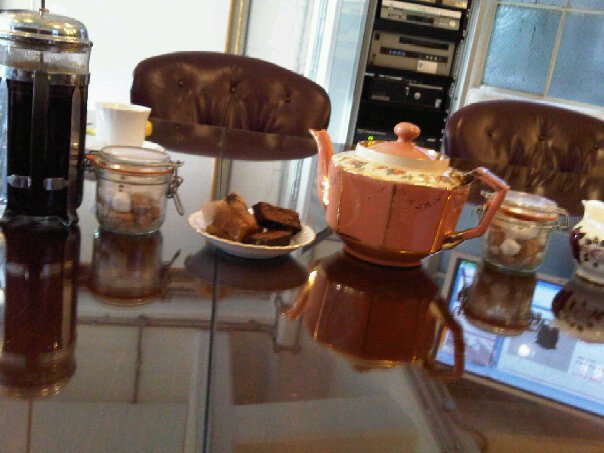
Of course, this will be punctuated by the usual bollocks on tea, swimming and cooking.
Half of UK daters aren’t pretty so instead of fishing in a small pool of prettiness and getting nowhere dive into an ocean of uglies and have more choice.
Ugly people are a better calibre of human – pretty people generally aren’t very nice and are often a bit shallow.
Ugly people have had a tougher life and therefore tend to be more considerate and more loyal. A recent TUBB survey also proved that they try harder in bed.
Once with an ugly partner it is unlikely that anyone will try and take them from you meaning you can let yourself go completely once you’re together.
In these straightened times TUBB is cheaper as a) We don’t charge much as the pretty sites and b) Ugly people have lower expectations – for a first date a Family Bucket will usually do the trick.
There seems to be a trend at the moment for retailers to create engaging showpieces that not only show off what is available and start the process of investigating the range, they make people feel good about making the choice within the brand's particular walls - two of the primary roles for retail marketing (third is tactical price promotion) that tend to be done seperately. MAkes budgets work very hard and, to my mind, doesn't dilute engagement, clarity or anything like that.
Here's Curry's taking us on a tour of their range through the eyes of Artoo and Threepio (but where on earth is the online?)
Here's some cats showing us what's available in Ikea
Here's some skinny jeaned hipsters showing us Ikea's kitchens
Who doesn't like chips? But what kind of chips? The lovely, soft, slippery greasy chips from a good British fish and chip shop? The big fat chunky and robust chips from a pub? The European 'fry' thin cut and dipped in mayonnaise?
I love all of the above but on a cold, dark winter's night, one of those that requires a thick pullover and something good to drink, when only a comfy sofa, good telly and warming, casual food will do, I'm going to share the chips I want – or wedges really. Made with love, without fuss or waiting, but well worth the effort.
Now that the clocks are changing in the UK, seems like the right time to share. Step forward duck, of goose fate, chips.
You want Maris Piper Potato's. Don't bother peeling them, just make sure they're scrubbed. Cut into nice thick wedges.
Choose a baking tray your chips will fit into with plenty of room and put in a good knob of duck fat or goose fat (you can buy it in the supermarket these days). Put the tray in an oven at 220 degrees C.
Put them in a pan, cover with water and bring to the boil. Then boil for another 10 minutes. Drain the water, sprinkle with sea salt and shake it all about to rough up the edges and coat with the salt.
Bring your tray out of the even, with the fat now hot and spitting a bit – gently tip in your chips and toss in the oil until they're all coated. Put the tray back in the oven, check after ten minutes. They should be nice and crisp and a fork should go through them easily. If not, give then another five minutes.
Then enjoy however you like – I like Heinz ketchup and if I'm hungry, make a couple of sandwiches with lovingly buttered soft bread. The chips will be nice and crisp, but outrageously soft in the middle and there's something about the chunky, crisp softness laced with the duck or goose fat that lifts the spirits and warms the soul.


 NORTHERN PLANNER