The fact he's Welsh obviously has nothing to do with it
The fact he's Welsh obviously has nothing to do with it
I went to the APG event last week, which was rather good, so maybe it's worth doing a bit of a report type thing.
If you can't be arsed to read my long spiel try this.
It was called 'Head, Heart or Herd' and in a nutshell:
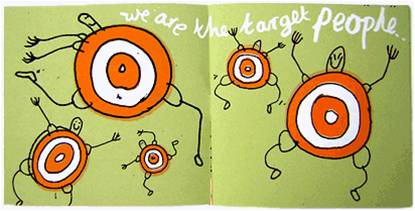
Picture from Andy Smith
Science and consumer thinking evolve. New models emerge explaining how and why consumers do the things they do, and new techniques arise to better understand them. But there's still no real consensus: if anything, there are more views than ever as to what makes us all tick.
Each panelist stood and gave us our point of view before a bit of questions and answers from the floor
Panelists were:
John Kearon of Brainjuicer
Mark Earls: Former Head of Planning at St Lukes and Ogilvy, author of ‘Herd’
Rory Sutherland: President of IPA, Chairman of Ogilvy
Nick Southgate: Former head of planning at Grey and IPA Behavioural Economics Consultant
Gemma Calvert – founder or Neurosense (they scan actual brains in the name of research)
The premise of the night was that most traditional research isn't much good beyond a comfort blanket for clients - – most research is a waste of time. Quant research just proves a point you hope to make and focus groups, no matter how good the moderator, are really lots of people agreeing with the a minority say.
What follows is a summary of what each panelist said, with running commentary and paraphrasing from me.
First up was John Kieron:
His first premise was that quantitative research is basically arse covering. It doesn’t really tell you anything, but can be useful to give clients the numbers they need to feel confident in what they’re doing.
It’s an imperfect science though, where the answers direct questions depend as much on the phrasing and order of the questions as much as the mind of the consumer.
Qualitative techniques are much better than that, they can get to depths of emotional knowledge, and this is essential since it is ‘emotions that drive us’ – according to most behavioral scientists (this a direct quote from Paul Ekman who is worth Googling)
We make decisions based on how we feel far more than any, so called rational basis – although we might ‘post rationalize’ this after.
Essentially feelings boil down to the following:
Contempt
Sadness
Fear
Disgust
Anger
Happiness
Surprise
And if you really want to understand how a brand, idea, creative concept etc is REALLY working, you need to uncover how people feel about it.
There’s even a way to apply this to quantitative studies…
A new technique is to show people facial expressions with the above emotions and ask people to pick the one that most represents how they feel at the time (it has to be at the time, people don’t remember correctly and are useless at predicting how they’ll feel- for more relevance see Daniel Gilbert’s Stumbling on Happiness) – incidentally HSBC use this technique (using Brainjuicer I presume).
Now here’s some evidence that this is a good approach. The Gorilla ad is claimed by Cadbury to be their most successful campaign ever (now I could rant that since it was aimed at impulse where the hell was the instore?) contributing to 9% market share, but it failed Millward Brown’s pre-testing, which is unfortunately, the gold standard for many brands. It’s based on rational responses like ‘persuasion’ ‘brand consideration’ and ‘brand preference’. Perfectly rational, reasonable things to ask people of course, if you’ve done any pre-testing or ongoing tracking, these are the usual measures.
You can understand why – most people would SAY, I can’t understand any message; it won’t make me buy Cadburys etc. But when it was tested for emotional response – basically feelings of joy – it was off the chart .
The IPA has built up a Databank of Effectiveness Award winners over the last 20 years and found, consistently, that campaigns that that provoke a strong emotional response are the most commercially efficient (I might add that THE most efficient are the ones that have ‘fame’ at the heart of their strategy – quite literally getting talked about, it creates quality perceptions, increases frequency, encourages trial etc really well – and is usually created by created a strong emotions around what the brand stands for and what it’s point of view is).
Focusing on rational persuasions messages actually gets in the way of feeling – and emotions are actually what makes consumers act according to science – and action is what we really want, we’re here to make people change their behavior, it’s just perverse that the most commercial sense is the fluffy stuff the bean counters hate the most.
So….work out what you want people to feel and then makes sure you devise the appropriate method to find that out.
In other words, whatever tactic, medium or idea you’re working on or in, know how it needs to make people feel and make it sure it delivers that.
Gemma Calvert was up next:
She cited the split brain research done by Roger Sperry which (correct me if I’m wrong) isolated the right brain hemisphere as the intuitive emotional spontaneous side and the left brain as the rational ‘planner’ (no pun intended).
Humans have two thought points of view at the same time – these two sides usually in some form of conflict. In many ways, we’re not really conscious of our deepest desires and how they influence how we make decisions and how really act; as opposed to how we believe we do. We believe we’ve listened to our rational side but don’t notice (or refuse to accept) how much it was based on how we feel…our intuitive, instinctive side.
Lots of stuff happens below our awareness, like the way someone else must have driven the car for us when we arrive at work and realize we haven’t paid attention for the last ten miles, or when ideas pop into our head when we have stopped thinking about a problem.
Our rational conscious thought evolved hundreds of thousands of years after our emotional instinctive side – which is good of course, it deals with lots of stuff below our attention, like responding to the opposite sex’s pheromones or scouring motorway for hazards (Malcolm Gladwell’s Blink explains how our intuitive side is much cleverer than our rational side – which is why first impressions are usually right).
So her suggestion is to use brain imaging to find what is going on because it happens below people’s awareness. But of course this costs a fortune. In my view, she’s only proving the point for measuring feelings as in the first point and focusing on techniques that expose how people really behave rather than how they claim – i.e. researching with people as they go through the process and more observing and forensic methods which brings us neatly to:
Rory Sutherland and Behavioral Economics:
He started with the argument that marketing people and agencies base their processes on a model of crafting messages and basing decisions on brand persuasion – basically become someone’s preferred brand and sales will go up.
This IS important but it isn’t the only game in tow. For example I’ve researched orange squash and found that while most Mum’s prefer Robinsons, many will shop from a repertoire and make decision based on what’s on offer.
As an analogy, gravity is massively important and the main reason we’re all here as we are (according to Stephen Hawking anyway) but there’s also the strong nuclear force, the weak nuclear force and electromagnetism.
In fact, gravity is pretty weak – think about it, you can beat gravity just by a half hearted jump in the air. We just notice it more because it acts on very big stuff. The strong nuclear force is actually much stronger, but we don’t think about it since it only words on tiny distances – inside an atom basically. To beat gravity, just lift your hand, to break an atom in your arm and beat the strong nuclear force you need to heat it to 10,000 degrees.
Anyway, our basic job as marketing people is turning human understanding into business advantage – and that means both the ‘long range’ measures like brand preference and the short range stuff like what happened at the actual decision to make a purchase.
Humans don’t make decisions rationally; they’re affected by all sorts of irrational influences – that are actually quite consistent. We need to bake more of this thinking into long range comms as well as what we do online and instore.
For example, all decision making is relative. We will choose something of there is something similar to compare it against over something without anything to compare.
A neat trick is understand the basis of comparison and even redefine it; for example, the AA made people compare it with police and stuff by calling itself the 4th emergency service for exactly this reason.
Offer a choice and people will choose something – red or white wine, coffee or tea.
Decisions are also sequential; strengthening brand preference can be a waste of time if there are more pressing decisions. A bed retailer needs to deal with brand preference of course, since most people who enter the market have no idea where to start and a default choice would be commercially helpful since people just want to get it over with – but most people actually put changing a bed off since it’s a pain in the neck to get rid of the bastard old bed you have. Dealing with the most pressing problem first would actually bring more people into the market and straight into your door or home page.
Another tack: Eurostar is spending millions to upgrade the infrastructure to make the trains faster. However, that’s only because they’re comparing speed with speed. With the money they have budgeted, they could afford to have every passenger served vintage wine by a supermodel – which would probably have people begging for the trains to actually go slower!
In other words, look at the close range stuff as well as the long range and use both to influence each other.
There’s masses of psychology books to read to help, including stimulus on research techniques – start with ‘Nudge’ and ‘Predictably Irrational’ and carry on from there.
Then up came Mark Earls to talk about Herd Culture
In essence, it’s a mistake to see us all as individuals – we’re social creatures. If you want ideas to spread, don’t ask people to make an individual choice, don’t merely persuade them about product quality –work on social meaning and making it feel like you’re joining in with a group.
All the science points to the fact that we’re social beings. We learn by copying other people (that’s how infants develop – they copy Mum and Dad and why adopted kids oddly seem to resemble their adoptive parents, they take on their mannerisms). We’re advanced monkeys and have evolved to exist in a tribe.
As a mad example, think about Star Trek. The heart of it wasn’t sci fi, it was about people – the tension in the relationship between the emotional Kirk and the logical Spock.
Humans can handle all sorts of challenges and pain, but what drives us mad the most of being lonely (that’s why solitary is the worst punishment in prisons).
If you get the chance, read Connected by James Fowler and Nicholas Christakis (have a lend if you like).
Here’s some scary facts – you’re 57% more likely to be obese if a friend is. A teenage girl is far more likely to be pregnant if a friend is. Our preferences, decisions and actions are profoundly affected by those around us.
So rather than just understand people, understand the social context, what happens between people in your given subject and how the in-between is structured – so you can be in those connections and perhaps even change them.
I’d like to add here that cultural inspection is a useful tool. Find out what is REALLY going in culture, find a problem or a tension in the lives of real people, that they talk about and go through together and help them resolve it – do it with them or on their behalf.
Like Dove’s campaign for Real Beauty invited you to join a group of women who wanted to be celebrated as beautiful as they were and fought the unrealistic images of the beauty industry on their behalf.
Or Persil’s ‘Dirt is Good’ campaign that resolves tension between Mum’s wanting their kids to play but discourage them to get out there and get dirty, incidentally, it only began to really work when it targeted the interaction between parents and their kids and helped parents remember how to play with their kids
Then Nick Southgate talked about the value of basing insight on your own experiences:
A fundamental question – why don’t you know what you want to know about a particular consumer group?
The sad truth is that in most cases, you do consumer research because you can’t be bothered to go through their experiences yourself (out of interest, the CEO of Unilever regularly hires a minibus full of recruited consumers and goes shopping with them to understand them first hand)
We’re all people and it’s bollocks that we’re all different (see Herd argument above) – humans are 99.9% alike, but most western civilization pretends that the 0.1% matters more than it does. We all react to different situations in pretty much the same way.
So you can practice empathy thinking.
Imagine you want to sell £4,000 bags. I’ll never have the money to buy the wife one of them. But you can safely assume it’s a big ticket, one off special purchase for most of its target audience. It’s something tied up in status too.
We all have gone through those. Could be a designer dress, an expensive suit or a flashy flat screen telly – think about how that felt, the stages you went through and you’ll soon learn what it feels like.
Just go out and watch them or be cheeky and talk to them – your mirror neurons will fire and you’ll be in your mindset. (It works in the same way as when you play a song you love someone else and you immediately hear it through their ears).
So if you work on public transport stuff, you need to get the bus or train from time to time
If you’re selling suits to bankers, go for a drink where they do after work and watch and listen
etc
And as a quick one to one research technique – get people to talk about other people rather than themselves – the empathy kicks in quick and you get a truer picture. People find it hard to talk about themselves truthfully.
So there you have it.
On the day, if people had to choose one, they chose Behavioural Economics – but do what is tmost appropriate for what you’re doing, your budget and the time you have.
Broad conclusion on everything though, would be that getting insight about feelings, how people actually behave and how a group interacts are all a blend of the same approach – build learning around the fact that we’re irrational, we don’t do what we claim and we’re most influenced by other people and want to belong to someone.
Constantly try to get under the skin of culture around the product/brand, by reading lots of stuff of course but mainly doing what you’re audience does, and that includes online experiences, actually meeting them and even just relating there experience to yours, if you have no time and no money when a project comes in, you can do a pretty good job of getting insight – all that’s missing is the proof (hello quant research).
Traditional focus groups and quant are slow and expensive, being an amateur psychologist that actually goes out and meets real people outside of rooms with one way mirrors is not, and if you’re constantly building up a bank of knowledge, it’s there, ready when you need it. That’s the beauty of all those online conversations sloshing around; you just need to tap into them.
Some quotes:
“Two thirds of paid for research Franklin’s Gambit – is proving what you’ve already decided”
“Most planning and strategy is really pre-emptive post rationalization”
“Agencies built models of brand persuasion because they were easy to sell to clients, but the problems started when they forgot it was a selling tool and started to actually believe in it”
After the cancellation of the Great North Swim I wasn't about to let about 9 months of training go down the drain, not to mention sponsor money. In addition, the build up of carbs and nervous energy had left me with a whole planet of frustration bearing down on my shoulders (quite broad from training but not broad enough). So I pledged to swim 6k in a pool, in under 2 hours. And then things really went pear shaped.
A cold turned into a cough, which transformed into a chest infection. I was bed ridden for 3 days followed by about two weeks of creaking around like the waitress in 2 soups.
No swimming obviously. So the plan was a couple of weeks to get back into it and then,finally do the cursed swim and move on. But then Marcus put himself in hospital walking for Dr Peter Figge and shamed by his bravery, I decided to get on with it.
So last Wednesday morning, I went to the pool, did a few stretches, a quick warm up and just started swimming.
Let's be clear about a few things. I was never a distance swimmer, part of the fun of this year has been finding out what my body would do over long distances. The official swim marathon is 5k, I did that once as 10 year old and never bothered since. I've done plenty of 5,000 and even 6,000 training sessions as a teenager and once or twice as a grasping at youth man in his thirties, but that's interval training with plenty of rest, even as a youth that was tough.
So it was a little foolhardy to do it coming straight out a pretty bad illness, but, you know, nothing ventured….
The first 1,000 wasn't that great. You lose your feel for the water amazingly quickly if you don't keep up up and it was nearly three weeks since I'd last got wet in anger. It took the first 1000m to find any sort of rhythm and I was a little worried at my shortness of breath. But by 1,500 things had changed. Psychologists talk about Flow, that weird point when you get lost in a task and the body and mind blur together, everything else is shut out, you're fluidly doing, aware of the tiniest detail within the task, but nothing else.
When I used to train for 30 hours a week it was nearly always like that, it doesn't come often enough now, especially when a big chunk of th build up was sorting out a malfunctioning stroke, but it was here now. My breathing stabilised, my hands felt like frying pans in the water as they pulled through, nothing seemed to ache too much – after 60 lengths i could finally start.
The intention had been to keep to 20 minutes per 1,000 metres, for first 4,000, and then go for broke in in the last 2,000. That should have been a nice controlled pace, and hopefully, quite easy pace before letting rip.
I can still do 1,500 metres in under 21 minutes (or could before I got ill), that's 1.45 per 100, I was giving myself lots of leeway at this pace, and with a sub-two hours target. But this was the unknown, I'd never gone this far before.
That dreadful start made a mockery of all this and after 2,000 I was on 45 minutes. 5 minutes behind pace. Bollocks. I was out of condition and the first 1,000 or so had been controlled thrashing, it's was understandable but not acceptable. So I decided to push it. I felt good now, I didn't feel tired, quite the opposite, I was buzzing.
I hit 4,000 metres in, almost exactly 1 hour 20. Bang on course. I was breathing harder now, but nothing to write home about, so I began to increase the pace. Which worked for 500m or so, then things started to go a little wrong.
I've some scar tissue in my right shoulder that sometimes flares up. If I'm swimming, it means that when I pull my arm through the water I get a sickening pain that feels like a rusty scalpel being gouged right in. And perversely, it decided to say hello. I can get around this usually by my arm entering the water a little to the right instead of in line with my shoulder and an hip and pulling through a little further out. The rest if the stroke needs to compensate and in training that's fine. But not after 160 lengths.
Suddenly I was thinking again, and my body decided to tell me it was tired. My lungs were struggling and I was gulping air in, turning my head to get as much as I could and making my stroke lopsided, while accounting for the right arm. The more I thought about it, the more I began to thrash. Then everything began to hurt. The right arm was working harder than the left and really ached, the legs were working too hard to keep my wobbly body lined up properly and everything just ached.
By 5,000 I didn't dare look at the time, I just kept going, concentrating on only two things: keeping my breathing as regular of possible and that right arm. Then suddenly the pain in the shoulder went away again. Straight away I put my arm right and things started to work again, it felt relatively smooth, thought it still hurt. Now I was putting in effort and getting something back.
Everything was hurting, my lungs were on fire and I was at that point in sport when you want to stop as much as you want to carry on. You viscerally hate the pain, yet you welcome it too, it shows you're doing something worthwhile and the same time it tells you how fallible you are. I wanted to find out what my body could do and it was telling me (at least what it could do after an illness and lay off).
I think there's a choice you can make at this point. You can focus on the excruciating sensation in you body, or you can choose to ignore it and focus on something else, so I began to count my strokes. When my stroke works, I do a length in 11 strokes, when I go ragged it starts to go up. I focused on stretching out and counting to 11 in each length. And it seemed to work, I can't remember anything from the last stretch apart from the counting, until my body went numb.
With 200 metres to go the pain went, the form disappeared, I couldn't feel a thing. The harder I tried the less anything seemed to happen. So I flailed for those final eight lengths. And then it was over.
I looked up at the clock and found it was 1 hour 58 minutes and 43 seconds. I didn't even care, I was just pathetically grateful it was all over.
I had 10 minute swim down, drank a litre of water, had a long coffee and a mountain of sandwiches in the cafe and then drove to the station and got on the train to London. That was it.
It was an odd sense of anti-climax. When I was young, Mum and Dad and other swimmers were there to cheer, congratulate and commiserate. This felt as personally important as any other sporting thing I've ever done, apart from beating Dad at tennis for the first time maybe, but there was no one to see it apart from me. And that was fine, maybe even better. This was done for the joy of doing something well (adequately as it turned out) the only things to beat were the clock and my own weakness. Totally fitting it was all done alone.
So it's over. No big fanfare, that's the end of this pointless exploration in grasping at youth and self delusion.
The only other thing to say is that I seem to have spent my swimming energy for now. I've only been in the pool once since and it seemed much more effort than before, like that swim depleted some sort of swimming pool of energy. I've done a workout in the gym, which I quite enjoyed for a change (don't really like gyms that much) and look forward to more cycling, but I need to force myself to swim.
So I need another goal. After a rest, time to start training for next year's Great North Swim – hope they don't cancel the damn thing or this time next year I'll have to do something really extreme.
(Remember when an apple was just an apple?)
An apple is an excellent thing – until you have tried a peach.
GEORGE DU MAURIER (1834-1896)
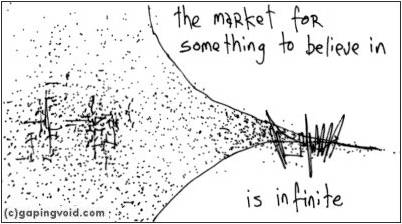
Gaping Void at brilliantly simple best
Grant McCracken has an interesting argument about Sketchers' intentional crapness designed to deflect the Eye of Sauron also knows as Nike.
Judging from this example, they're very good at it.

“Ants are so much like human beings as to be an embarrassment. They farm fungi, raise aphids as livestock, launch armies into war, use chemical sprays to alarm and confuse enemies, capture slaves, engage in child labour, exchange information ceaselessly. They do everything but watch television.”
LEWIS THOMAS (1913-93)
I'm going to the APG evening meeting tomorrow, since I'm in London anyway and it should be interesting .
It might sound like hell on toast for many, but it's also nice to be amongst lots of planners talking about planning stuff. Not too often of course, planners need to mix with others at all costs – or it gets a bit like this:
Anyway, I've a bit if free time late afternoon. If anyone wants coffee etc let me me know.
The APG Panel Debate: Head, Heart or Herd – how do we best understand consumers?
Science and consumer thinking evolve. New models emerge explaining how and why consumers do the things they do, and new techniques arise to better understand them. But there's still no real consensus: if anything, there are more views than ever as to what makes us all tick.
We've assembled a panel to discuss the ins and out of the various ways to understand consumers:
John Kearon – Chief Juicer at Brainjuicer
Gemma Calvert – Founder of Neurosense
Mark Earls – Herdmeister
Rory Sutherland – IPA President
Nick Southgate – IPA Behavioural Economics consultant
The issues that will be debated include…..
Date and time: Wednesday 6th October 2010, cash bar opens 6.30pm, debate 7pm.
Venue: Holiday Inn London Bloomsbury, Coram Street, WC1N 1HT (Booker and Turner Suite).
 NORTHERN PLANNER