There's a quote that goes something like, 'History is written by the victors'. That's probably wrong, but basically it says you have to be careful when you read the history of stuff because it hasn't just been recorded, it's been interpreted and and, to be honest, maligned to suit the circumstances of the writer.
That's why I get a little shirty with people who bemoan the times we live in and long for the bygone days when life was simpler, when kids could play outside and we could all have good honest clean fun. It was never like that really.
The thing is, things were not really better, they were just what you were used to. Ask a 20 year old if they would like life without the internet, Sunday closing and even shops closing on a Wednesday afternoon and they'd recoil in horror.
Remember the 80's with affection if you like, bits of the music were good, there was also Thatcher, mass unemployment (far worse than now) and Barbara Whitehouse.
So do be a bit cynical about 'The Golden Age' of anything. Mostly it wasn't, it was just a time when people older than you wished things would stay as they are. That includes advertising. I know there was more money in the 80's, I know you got massive budgets and just put stuff on popular telly channels – but there was also burn out, backstabbing, cocaine and naff people driving naff sportcars. And most if the ads were not any good, like most of them are no good now.
Once upon a time, when I was working somewhere else, there was one of those Great Re-inventions of the Creative Brief. You know, where the boxes get moved around a bit and the their names undergo a little tinkering, before it's unveiled to much fanfare. One of those.
As with many journeys, the end was much less interesting than what tumbled out in the struggle (internal projects are always a struggle aren't they?) to get there. As part of that, the planners actually went out and asked the creatives what they wanted from briefs, and naturally, much of that became what creatives wanted from planners.
First point, the creatives didn't see planning as the people to solve the strategy puzzle, in fact, most of them didn't have much of clue what planners really did. They saw themselves as much more than making the answer compelling, they saw themselves as the problem solvers. You can argue all you want about the fairness/veracity of this view, but it does demonstrate the need for planners to include creatives in the process.
Second point, the briefs and briefings that creatives really found useful were not the bullet hard single-minded ones (despite what they actually claimed), or the ones where someone persuades them to do what someone else wants, they were the ones packed with ideas around a theme, a direction. In other words, don't tell creatives what to do, make them think, just make sure you're making them think about the right stuff!
Nick Southgate thinks most planning blogs are useless. His main argument (I think) is that most share opinions rather than actual fact, which is fair enough but that's actually what I find most valuable as a writer of one and a reader of others.
Facts are my day job, actually that's not true, it's making facts compelling. Facts are easy, great facts are less so, making them compelling bit is bloody hard. That requires imagination and inspiration – blogs are good for that.
One way of working is to get an opinion fast and then test it to destruction – you need a good start, something to get you looking somewhere…so blogs that share good opinions are useful in my book.
The problem is when readers assume what it written is gospel. There are a few blogs that pretend to be The One Truth, that's not healthy, but most are just venturing an opinion and working things out in public. That's good, as long you take them that way.
Remember these? Good weren't they? Who says that brand storytelling etc is anything new? I guess the only thing that would be different now might be each character having their own Facebook account, the book, the extra episodes online, the exclusives and the leaks and maybe even releasing new characters and story arcs to hardcore fans and maybe letting them in on the story.
The dynamic at the heart of the story is unreleased sexual tension. It's not the only beating heart to a good story, but it certainly is a good one.
Like this..
This….
This..
And this…..
And this ;-)….
But it's not in this (nor any chemistry whatsoever)…
Like most good elements to a story, we can relate to UST because we see our own lives reflected back at us. Something ad people and genuine entertainers could do well to remember, we want new stories of course, but in reality, we want stories to talk to us about our own lives. It's just that it's usually more powerful when the context isn't humdrum real life but something else. That's why I get annoyed at so called down to earth, community focused clients wanting to only exist in hyper-reality – people don't want their own lives played back at them exactly. Look at soaps, they are not reality, they're exaggerated in almost everyway.
I wanted to pick an argument with someone who opined that Shakespeare is overrated. Fair enough if you consider the emphasis he gets in schools over other's (even Ben Johnson in his own era), but there's a reason. No one has consistently told us about ourselves in a collection of works like Shakespeare, mostly because he has the knack of dealing with universal truths and issues by placing them in unreal settings.
The debate over Shylock – understandable victim of prejudice or a warning against greed is echoed in arguments today over someone as a terrorist or freedom fighter, layabout or forgotten generation.
Rosalind in 'As you like it' was a great source of inspiration for some work I did on dressing up and being able to play with your appearance and identity – how wearing a costume changes you inside – or brings out a version of you hitherto unknown.
Anyway, all I'm saying is that it doesn't matter if you're making an ad, writing a book or scripting a film, whatever the setting, storytelling needs to talk to humans about humans in some way to be truly great and in many cases, it's more powerful when it's not 'real'.
By the way, a useful rule for UST is the same as food – if you lick it, you have to eat it.
One of the things being a Dad makes me lament is the passing of those times we could go see a film whenever we wanted. Which was plenty.
However I fully intend to see Scott Pilgrim, mostly for work related reasons. This might sound daft, but I think it got things anyone involved in brand communication need to think about very hard and very quickly.
Hollywood is scared. Forget the record revenue figures and look at the actual individual sales for films and you find they are down. One theory is that people that have grown up on multi platform doodahs and video games just don't enjoy linear, one way 90 minute pieces of entertainment (and there's downloading of course).
What is Hollywood doing? Rather than embracing a bit of complexity and treating their audience as the sophisticated people they mostly they are, they trot out the same old blockbuster crap, aimed squarely at the lowest common denominator.
They turn to ever more incredible effects, refusing to accept that when people get used to the spectacle, they soon found out you've left out an actual story. I'm not a Harry Potter fan, but it's the story that people love. The Dark Knight may have been a sequel to Batman Begins, but it was the story, the depth, and the acting that made it…and it didn't even have a happy ending.
Have you seen Robert Altman's The Player? You should. It's bitingly observant – not just about Hollywood but marketing in general.
Does any of this sound familiar? It should to anyone who is still trying to make message based ads, but don't get smug digital people, you're worse. Some of you believe that people will fall in love in the coolness of your technology. when course that Wizard of Oz moment happened long ago. They're seeing behind the curtain and finding nothing but a charlatan. Even worse, some of you know this but know you can still make money selling this to clients – which, all in all, is just as bad as making Transformers 3, or other even more pertinently as far as Scott Pilgrim is concerned, Prince of Persia.
So back to Scott Pilgrim. It's not a film that blatantly rips off a video game, it's a film that IS a videogame. The plotting, editing, aesthetics have as much to do with a video game experience as a movie. It embraces the new culture, it doesn't rip it off or blatantly ignore it.
That's something marketing people really need to learn. Ignoring how people consume and enjoy culture is bad, papering over the cracks with coolness is worse, it has the opposite effect and, most of all, getting involved with stuff they love only works if you do it with 100% commitment.
Bits of Hollywood are starting to get this. The Matrix is one the first, and best examples, of a complex story told across multiple platforms – the films left much for DVD extras etc to fill in, and even more for forums and fansights.
TV is way ahead of course, with multi-layers and channels. From the depth of the Sopranos and The Wire, to the number of platforms Dr Who is now told across.
That's why I got interested in the apparent green light for film version of Stephen King's Dark Tower series. The books are not for everyone, I happen to like them. But a complex story told across 7 books, with yawning backstory for the reader to fill in (or buy the graphic novels if you're that way inclined) with strands that appear in other books, if you can be bothered to read them, just can't be adapted to cinema without losing most of what makes the books good (in some people's opinion.
So they're not. They're filming three movies with on ongoing telly series to wrap around them. Here's hoping there's a video game that complements and adds to the narrative rather than just re-works it.
Of all people, George Lucas seems to be way ahead of the curve. I could write a saga on the prequels and why they were better than received wisdom seems to think, but few would disagree they lost the charm and story of the originals. Yet Lucas has created a mammoth universe you can take as far as you want, through books and games. Some of the games are just shoot em up, but most actually add to the saga and reveal new bits and bobs, if you care about that. And you don't even had to read or play them…you just join in a forum and share with those that do.
Anyway, I'll be interested in Scott Pilgrim because it's a great example ( I hope, I haven't seen it yet but people who have seem to give it the thumbs up) treating your customers with respect and staying relevant. Marketers (and the rest of Hollywood) take note.
An obese man struggling to get out of his Porsche in a car park
Someone about to throw his chocolate wrapper on the floor until he realised he wasn't alone
A very attractive girl admire herself in a shop window until she walked into an OAP
A skinny jeaned teenager in tears on an unspecified conversation on his iphone
A shoplifter sprinting away, security guards in hot pursuit
You see I work only 5 minutes from a large shopping centre, which is fortunate since I'm an enthusiastic people watcher…or maybe I'm just really nosey.
Either way, I find it really healthy to give myself a healthy dose of real people, rather than the made up ones you see in segmentation study.
There's more drama, intrigue and insight in one hour wandering around a mall than any TGI run or blog post.
It's really important not to limit yourself to the usual research sources, or even the more lateral, crumbly little bits on the internet when it comes having ideas about how people behave.
It's dangerous to base your future success on what other agencies are doing or the cool trends you read in PSFK. Original ideas depend on original stimulus – if you just fish where everyone else does, guess where that leads?
There is nothing as surprising, nothing as interesting or admirable as real people going about their lives. It's how you watch them that makes all the difference.
I think there's a lot to be said for this. It's extremely unnerving to work with brand managers who still operate as if it's 1995 and Web 2.0 and stuff never happened – you know the type, do some telly, build a website, communicate product benefit etc. There are plenty of people who grew up on that stuff that find it hard to work any other way (it's even more terrifying when you come across this type internally).
But then there's another side to that. You're no good to anyone until you've made a few mistakes. The first time you break up with a serious boyfriend hurts more than the other deaths of relationships – you learn how to deal with it better. For myself, I'll always be grateful for swimming because it showedme how to deal with both success and failure early, it also taught me the value in hardship and difficulty.
I've also worked long enough in this very odd industry to know that the only thing you can be sure of is that things don't stay the same for long. Experiencing and dealing with change and upheaval makes you – you guessed it – good at experiencing change and upheaval.
Those old enough to remember the Thatcher recessions, or even the recession at the start of the nineties, or the advertising recession at the end of the dotcom boom were probably better prepared for what's happening in our lives right now.
The so called death of the agency model isn't that new either…agencies used to make money from media commission and do the creative for free, it's only relatively recently that media and creative split and creative agencies charged for their time. What's happening now is just another adjustment.
Even if the detail of the future is different to the past, experience still counts – it's the mindset that matters. If you shut your eyes and ears and will things to stay the same, it's you're own fault. If you've embraced change and evolved with it, you'll do fine.
By the way, I don't entirely accept that the future is different to the past. It does get tedious to find we're listening in the 'Age of insert you're self serving epoch here'. There are few genuine upheavals in history – just the slow process of things gradually improving, a couple of steps forward, a couple back, some sideways but a general progress.
My beautiful new mug went missing this morning. As some have noted, I'm an angry mess of carbs, unvented nervous energy and the need to swim a very long way very fast.
So wasn't going to take it laying down. Thankfully, common sense pulled the all-users back from def com three:
Dear all
Sorry to disturb your Friday with triviality, but while the perfect tea doesn’t matter to you, I’m have to admit to being a loser and it really matters to me.
That’s why I painstakingly warm my tea pot, only use Yorkshire Tea, never stir and brew for exactly three minutes. And always, always, put the milk in first.
The ritual isn’t complete without giving such tea the mug it deserves. And here we finally come to the point…
The enclosed picture is my tea mug. It’s bone china, tea tastes amazing when imbibed from this wonderful vessel. Despite the fact it’s vaguely effeminate, this is the perfect mug.
Someone else seems to agree since they keep on using it.
Please, please leave my little mug alone, if you really love it’s wondrous property to enhance the flavor of your tea, I’ll even buy you one of your own. Promise.
The responses were the predictable banter:
How come you didn't title it Tea Leaf?
Leaf it out
Stop milking it.
My response:
…and the only appropriate punishment for the light fingered mug pincher is tea bagging?
and
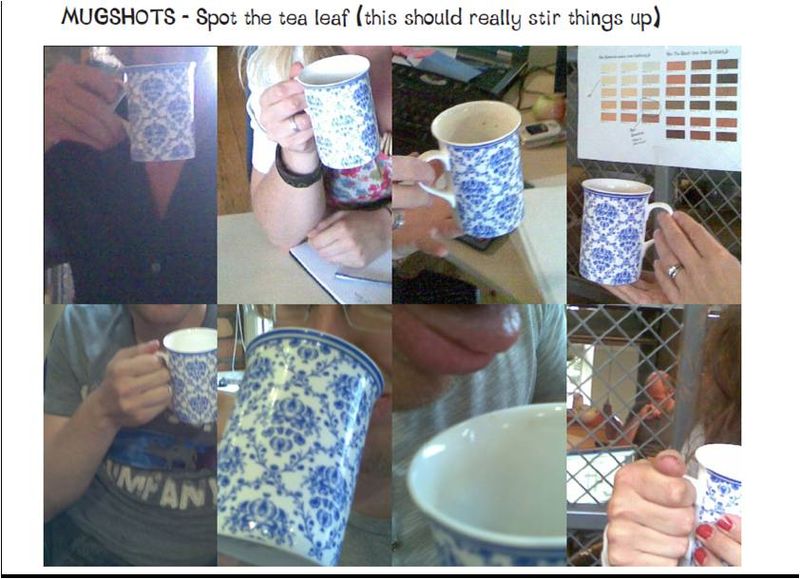
Two hours later, no mug, but I got this email from Nic Oram instead:
Andrew, please see attached. PS Incidentally, I’m not Nic. Buahahahahahahahahahahaha.
 NORTHERN PLANNER