There was one other thing on that IPA Modern Briefing that, talking about it with someone, made me go 'Are you sure?'. It was something Patricia Macdonald (from Glue )raised.
Before I start, let me state that she's obviously a lot cleverer, successful and talented than I could hope to be.
Let me also say that I enjoyed her advice to turn business problems into behavioural problems, something too many strategy types have forgotten, leading to 'making great work' as their only goal, rather than 'great work that solves business issues'.
BUT, I didn't agree with her use of data to support the assertion that 'participation is the currency of the modern campaign'. Specifically this data:
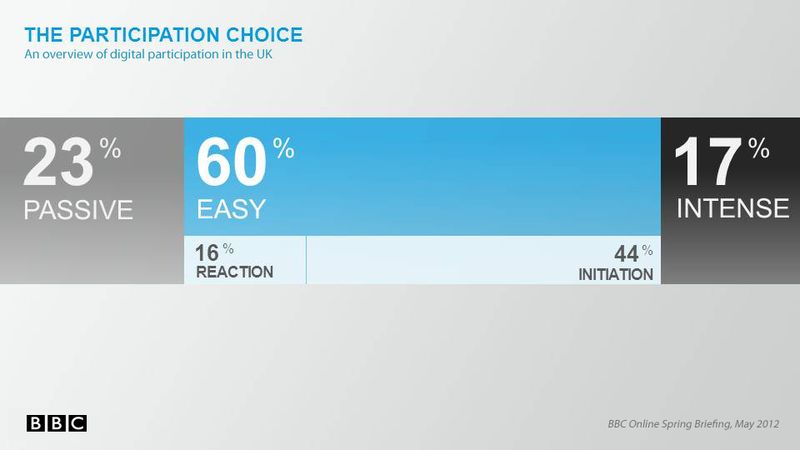
Yes, the 1:9:90 may not be correct for today's post-digital folk, yes, it may be well be a 'way of life' for more and more people, but that doesn't make it the natural heartland of brand communication.
Oh, and then there is this:
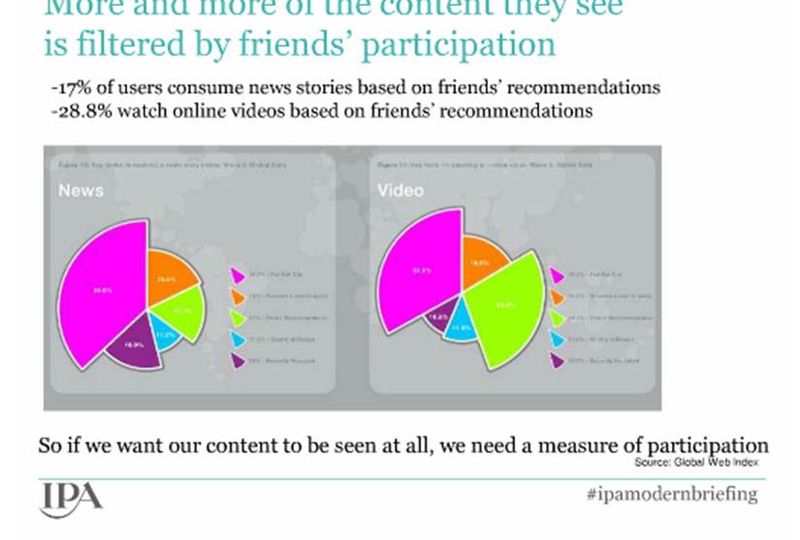
This really isn't evidence for participation, it's evidence that the large MAJORITY of people DON'T rely on friends for content. Isn't it?
Then there's this quote (backed up by proper quant analysis by the way) from the Future Foundation:
"It must be significant that 1 in 3 of us say that we now feel more influenced by experts than we once did. Meanwhile, an identical proportion will report that they feel less influenced by contacts on our social networks"
Again, only a third of people, but if she can quote that content chart, I can quote this!
Topline, the data isn't about participting with brands, it's more about people participating with each other. Just because that's what people are doing, it simply doesn't follow that brands can muscle in.
Getting traction in this kind of way is completely different to paid media, where most people implicitly accept the deal they make, accepting interruptive advertising in exchange for cheap or even free media.
Even then, it's wrong headed to assume that because TV watching is a way of life, TV advertising is the currency of the modern campaign either.
People ignore crap ads and do their best to avoid them.
Just like they flick past crap print ads, or ignore crap outdoor.
Just like no one will give up their valuable time to participate with anything a brand makes that isn't either widly entertaining, or wildly useful.
In fact, where there's so much stuff to play around with, to assume most people will play with brands without a very good reason is even more wrongheaded.
In a more crowded world with more to do, people want to think about brands LESS not more.
And, as has been said elsewhere, you have to assume that those who 'participate with brands' are likely to heavy buyers, who shouldn't really be the focus of budget in most cases.
So yes, most people might (MIGHT!) participate as a way of life, but they don't participate with BRANDS as a way of life and they never will.


 NORTHERN PLANNER
Leave a reply to northern Cancel reply