Tweets

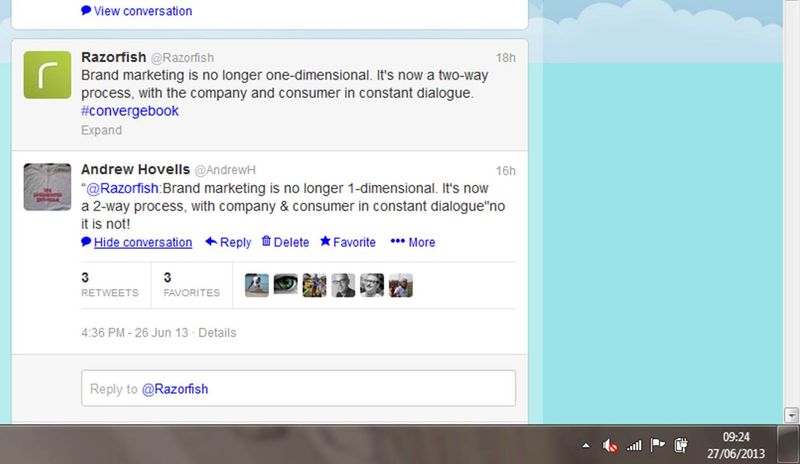
I sent this  tweet out, responding to this completeley untrue statement from Razorfish (most people don't even know why the brand they buy is different, let alone want to talk to it).

It got a little flurry of activity.

Nothing much, mostly a few planning and marketing types talking to each other.

It didn't make a dent it the universe, not in Twitter , not in marketing and not even in the self-absorbed planning community.

In fact, next to the 1,100 people who 'follow' me on Twitter, the number of followiers 'talking to me' about this piece is miniscule. Because I'm just another planning egotist amonst the hundreds they follow who thinks people care what I say.

Maybe a little reach, thanks to a couple of influential people engaging a little growth in penetration from a couple of new followers who saw it.

That's it.

I don't matter.

But if I was a brand and believed the twaddle peddled by Razorfish and their like, I'd be believing that the planning community wants to have constant dialogue, that folks want to engage, that I've influenced the preference of planning directors and CEO's to hire me.

I would believe it mattered. 

Beyond a few people who already agree with me, know me quite well and are wierd enough to care.

Like Razorfish (who I'm sure are ace at their job and know far more than a Northen Monkey like me) and the 'brand as verb'  'brand as conversation' witch doctors, I would be very deluded.

Posted in

6 responses to “What a little flurry of Twitter activity says about having ‘dialogue’ with brands”

  1. Razorfish Employee Avatar
    Razorfish Employee

    As a razorfish employee I’m slightly embarrassed by this sort of thing but sadly it’s pretty standard rhetoric within digital agencies. It’s just been repeated so many times people just assume it must be true. The ‘engaged brand zealot’ doctrine is certainly not a view I encourage in our office but it can be a bit of an uphill battle more broadly.
    I think fundamentally it comes down to a confusion between opportunity and motivation. We spend so much time looking for the next thing, thinking about what ‘can’ be done that we don’t think enough about why anyone would want to.
    PS I’d love to have a northern monkey on the team…assuming I don’t get fired first.

    Like

  2. Kevin McLean Avatar

    I think that in planning/research our foot often hovers above the ‘twaddle pedal’and we must resist the urge to use it. I struggle with the idea of ‘brand conversations’; I like the idea, there is SOMETHING in it (I even own a dormant URL with that name which I don’t know what to do with) BUT I am well aware that people have conversations, brands don’t. Brands appear only fleetingly and often ironically in real conversations. Yet surely there is a KIND OF ‘relationship’ (a connection rather than a relationship) between people and brands whcih did not used to be there, to the same extent, in the digital age. An asynchronous connection. DEFINTELY NOT a constant dialogue. More a sense that brands recognise me/need me and that I recognise and use brands more consicously than before? Or have I just hit the twaddle pedal…

    Like

  3. john Avatar

    Did people talk abiut brand relationships before social media. Though not.

    Like

  4. john Avatar

    Did people talk about brand relationships before social media? Thought not.

    Like

  5. Shanghai61 Avatar
    Shanghai61

    Actually, there were conversations about brand relationships before social media, but they tended to be a lot more thoughtful and realistic about their nature and limits. They were framed as questions, not assertions.
    The main problem now is that too many people (with a vested interest and a sales target) assert the importance of ‘brand relationships’ without ever thinking about which kind of relationship their brand might realistically have with its users.
    People have a very wide spectrum of relationships with other people. But the zealots assume brand relationships only exist at a very high level of both ‘importance’ and ‘intimacy’ to the individual. Hence, the assertion that people these days desire ‘lovemarks’, not merely ‘trustmarks’.
    Let’s put this uni-dimensional thinking to a simple test. Ask yourself: what kind of relationship do you have with your postman?
    He delivers your mail. You might exchange greetings with him if you happen to pass in the street. You may even tip him at Christmas.
    Is this relationship satisfactory from your point of view? Probably.
    Do you want it to become more intimate? Invite him to your next party? Maybe.
    Have him round for drinks or dinner? Unlikely.
    Do you crave greater frequency of contact, or a stream of updates on what’s been been up to, or what he thinks about other topics or news items? Almost certainly not.
    He provides a service for you – one which you value – but there’s no desire for more contact or more depth. You’re perfectly happy with things the way they are.
    Now substitute your brand for the word ‘postman’.
    I, for one, don’t find myself craving a more meaningful dialog with my shampoo, despite the fact that the technology now exists to facilitate it.
    Conversely, the more a brand tries to create an unrealistically intimate relationship, the more deluded and unattractive it becomes. Nobody likes a stalker.
    (And yes, of course postmen can be women).

    Like

  6. northern Avatar
    northern

    Hi there, love the post man (woman) metaphor, I’ll steal that

    Like

Leave a reply to Kevin McLean Cancel reply