I have a fear of focus groups.
I'm not one that rejects them out of hand I might add.
In the right location, an actual dealership if you're researching car buyers for example, rather than a faceless hotel room, they can still shed light on all sorts of stuff.
They might only expose group think and reveal what people claim to do rather than what happens, but in the hands of a good moderator, they can still provide great input.
Not least because herd mentality, and the connection between people, are possibly more important than individual (and mostly illusionary) motivations.
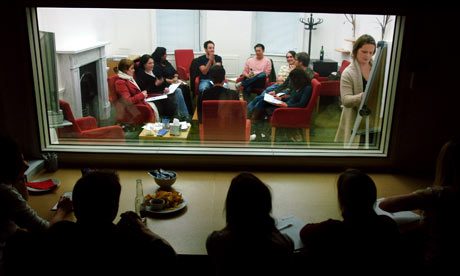
No, I fear focus groups because of the response of those that observe them. The clients, suits (sometimes creatives) and even planning folk lurking behind the one way mirror.
I fear confirmation bias. We're all guilty of it, it's as locked into our psychological make-up as social copying or the way we helplessly admire beauty.
Who hasn't watched a group where a client punches the air when a respondent says they love the product because of so and so?
Who hasn't seen a suit do an Irish jig when one person proves the cleint wrong and gushes about the creative route the creative director wants sold in on pain of death?
What planner hasn't felt a rush of pride when one or two people seem to confirm the proposition, or validate that precious insight?
Hands up all of us. We all notice, remember and cling to the evidence that supports our point of view and ignore or forget the tricky bits that seem to conflict.
All of us.
It's axiomatic.
It's why I tend to read the Guardian and others might read the Telegraph. I'm a bleeding heart left of centre type and don't like hearing anything that might support a more right wing view.
That's why we notice advertising for stuff we've already bought. We want to justify our decision.
That's why, when we've buggered something up, the brain quickly re-arranges the version of events our memory gives us to make it less our fault.
When it comes to brain, memory writes our history to make us all winners.
This is really dangerous in agency life of course.
Where everything is subjective, where there is always the conflict between departments, between clients and agency, between 'creativity and selling' (despite one leading to the other).
It's seductively easy to give into The Dark Side of The Force and find the evidence that lets you win the latest battle in the endless inter-agency, inter company conflict.
Even more challenging, we want to reduce things down to clear stories, simple propositions.
We have segmentations that paint a clear story, as if people that think and feel in only one way.
When, of course, life is messy and contradictory.
Because people are complex, contrary beast that say one thing then do another. They do one thing, then do something utterly different the next.
It's quite possible, to quite Orwell and Doublethink to hold two utterly opposite points of view at the same time and not feel it's a problem. Scratch that, it's human nature.
People are hypocrites. Naturally.
Confirmation bias not only justifies bad decisions, it makes us strive to ignore the contradictions and tensions that make for brilliance of real life.
To not make communications full of meat and drama, the stuff people notice and react to.
To make instead, the stuff that's 'right'. To add to the 95% of crap.
The stuff that breeds indifference.
So what to do?
As a human, it means reading more than one newspaper.
It means meeting as many different people as you can, forcing yourself to listen to them and theiur points of view.
As a planner, it means reading less marketing and planning books and more stuff about real life.
Avoiding the same processes for every job, especially the 'proprietary ones' that look to lock out messiness and create fake clarity and 'single mindedness' as soon as possible.
Less looking for the 'insight' and more gathering as many observations as you can.
Looking for tensions and contradictions and embracing them.
It means making friends with people who work in the opposite way to you, people assertive enough to push their own views onto you.
So you can exist in the eye of the contadiction.
And it means carefully horse whispering in research groups, or when data is revealed, so people are encouraged to see the whole picture. Not the bit that confirms their point of view or suits their agenda.
It also means working differently.
Looking to empower EVERYBODY to own the strategy and proposition.
Because the less you feel you thought of something yourself, the less you 'own it'
The brain won't be as inclined to trick you into defending it to the hilt without even realising it.
You won't do something dumb simply because you thought of it.


 NORTHERN PLANNER
Leave a reply to northern Cancel reply