(Okay I lied, a couple of extra posts before a long departure)
There have been many examples in history of famous quotes, pieces of work or leaps forward in technology that have been mis-interpreted on purpose, or through lazy thinking.
For example, Einstein once said, “God does not play dice”.
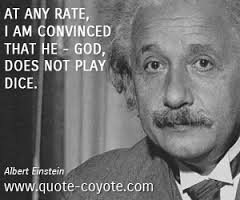
This was in relation to being uncomfortable with the random nature of quantum mechanics.
But plenty have taken it as proof that once of physics’ greatest minds was religious.
He was borderline atheist. He just believed nature would be a little neater.
In fact, many have taken the weird nature of quantum mechanics too far.
They think it means you can’t measure what is happening.
That physics is bollocks.
When quantum theory has been measured to ridiculous lengths. Because of quantum theory, we know what is happening in stars billions of miles away, we can predict what will happen to them too.
Perhaps ‘survival of the fittest’ is the most terrible.
Darwin didn’t actually write that in ‘Origin of the Species’ and it doesn’t mean the strongest.
It doesn’t even mean individuals or species.
It means genes that produce traits and qualities that are best suited to their environment.
Homo sapiens are far weaker than previous species of hominid.
Homo Erectus would destroy you in a fight.

And it’s more genes that survive an environment as much as accidentally making you better.
The appendix is fairly useless but doesn’t get in the way for example.
Which brings us to developments in brand and marketing theory.
Which does get in the way, as all sorts of people use to sell all sorts of weird and wonderful things.
Now most theory in brands and marketing are bollocks anyway.
Opinion dressed up as science based work.
But even some stuff that is good if often not understood and applied wrongly.
To show you what I mean, let’s rewind a few years, to when I once worked on a global client coming to grips with digital.
They still held on tightly to the comfort of the Millward Brown brand pyramid.
The brand teams worked in isolation of marketing and sales teams.
Both has separate measures of success.
They could spend millions on brand stuff and be happy with shifts in brand tracking.
Sales didn’t matter, that was marketing’s problem.
Distribution was a discussion for a totally separate department. Despite the fact it was a low interest purchase you had to make the effort to buy.
Now because of the famous Millward Brown pyramid, ‘awareness’ was a credible measure.
Which meant most digital stuff was measured on pure reach.
The game became how little you could spend on production and media to get the logo in front of as many people as possible.
It didn’t matter if they cared, it didn’t matter how relevant the stuff was.
Just that it reached a decent number of people.
So the PR charlatans has a field day. The social media folks thought it was Christmas.
Because they knew how to get stuff out there.
But they didn’t know how get people to buy anything. They didn’t have to.
Since then, Saint Byron Sharp has given us all some evidence based ways of thinking afresh how brands work.
And the same organisations that were able to peddle paid/owned/earned reach as brand metric are newly empowered.
Because the central argument of ‘How Brands Grow’ is that the most efficient role of advertising in all its guises is to reach as much of the market as you can.
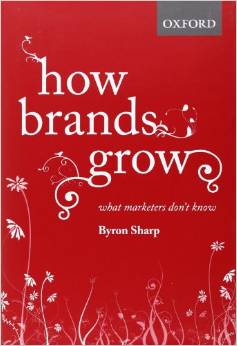
In the wrong hands, this information can be really unhelpful.
Confirmation bias means many of the awareness peddlers have leaped on it as proof of the ‘reach’ approach.
For some it’s a genuine mistake.
While the more devious have blatantly post rationalized it, to suit their argument that reach is all that matters.
But, to quote Rob Campbell (I admit I’ve passed this off as my own how and again), most people are aware of Hitler. I don’t many who are particularly fans.
Even worse for the digital reach brigade, simply getting stuff into people’s timelines or clicks on YouTube Trueview or whatever doesn’t mean people have taken anything out of the communication at all.
Even worse, many display ads are really cunning at making us click by accident, but that click gets recorded as a score.
The real argument that came from Byron Sharp was ‘salience’- Mental Availability. Making sure the brand gets front of mind in buying situations.
That means you have land something distinctive with people. They need to remember.
Which is why ‘Fame’ campaigns that get people talking work so well.
They stir the emotions that generate longer term memory, they make the brand feel it’s on the up – while being seen to lead creates a feeling of quality.
Because people can’t be bothered to think about buying most things.
(which is also why my old client was daft not making everyone think about distribution – physical availability. In the case of some categories, especially FMCG, shoppers, even allegedly loyal ones, will simply buy what’s there. If your product isn’t you’ve lost the sale and given your customers the chance to build up a new habit).
So, when it comes to digital brand communications, we need to apply exactly the same rigour that’s applied to TV and other channels.
In fact, scratch that. I bring you back to my old client again. The entire brand tracking system needs an overhaul.
Of course, knowing how many people saw and recall something about the advertising is fundamental.
But understanding if it drove salience with those people is the measure that really matters.
And the contribution both short and long term sales, or whatever the hard business measures are.
Econometrics, real time reporting, control groups, whatever.
Of course if you have a ‘response’ led client, you can measure the journey to sales online, but even in these cases, there will be plenty of people who didn’t convert right then who did later – or even bought offline.
By the way, short term measures do matter, namely removing reasons not to buy, but overall, there’s enough evidence out there to show that the real contribution to profit is building long term brand salience over time.
So yes.
Any great piece of writing or thinking can be used for evil in the wrong hands.
It’s a real danger in marketing.
With all those received wisdoms.
All the different disciplines and agencies competing for, the increasingly squeezed budgets.
The temptation digital presents to measure all sorts of vanity metrics that have nothing to do with growing a business.
Back to Einstein. He also said we shouldn’t strive to be successful people. We should strive to be people of value.
Whatever the latest theory, that should never change.
You can be successful getting loads of reach and totally fail in creating any value whatsoever.
Plan on.


Leave a Reply