I might ride the bike more these days, but swimming was my first love and will always have the most enduring place in my heart. If I had the time as a working parent, I would still in the pool everyday.
I used to compete as a youngster. The kind of competition that required six hours training a day. You don't come out of stuff like that unscathed.
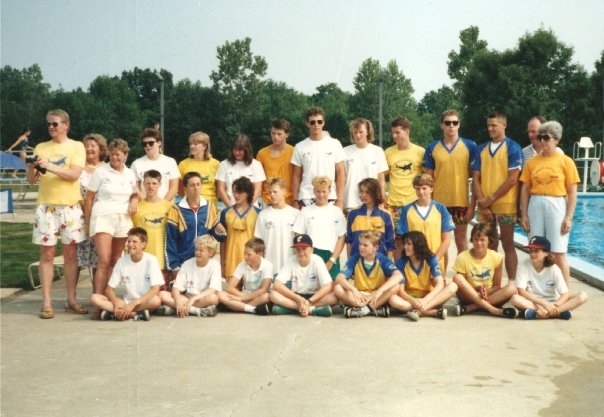
Below is the Leeds swim team on tour in Chicago in 1988. Bet you can't spot where I am in the line up.
1. Accept the simple truth, you are alone in this
You will tailgate others in training to pull you along. You can banter with your team mates. You can lean on the coach for advice and a kick up the arse. You can turn to family and friends for support. But eventually, there will always come a time when you are utterly alone. It will happen in the training pool when your body cries for mercy and you have to go on. You have to try and lock away the negative thoughts in your brain and pretend the agony in your muscles is not there.
This is doubly so in a race of any notable distance.
But the real loneliness is when you're on the starting blocks.
It's just you, your nerves, your courage and the clock. Waiting for the starting gun. The other other people on the blocks hardly matter. You'll hardly see them in the race. You won't hear the crowds cheering. It's just you.
It's ultimately the same as a planner. You work in a team, a team where most, at best, tolerate you getting in the way.
Nevertheless, while you rely on the creatives to execute something in a way that can't be missed, you have suits and production folks to make sure stuff gets made, if your in media there's a whole host of specialists and buyers to flesh out the plan and get a decent rate (and media owners to add loads of value) there are suits to get things through Clearcast and make sure there is a vet for a mouse on the shoot (legal requirement in the UK) – you can't get away from having having to do a clear strategy you can express in a sentence.
You. No one else. A sentence others will question, pull apart and try and ignore. It's lonely.
There will be moments, with a first stage internal meeting, a pitch date getting closer and closer when you feel you have nothing.
All you can do is grit your teeth, keep working, keep looking at as much stimulus as you can and keep writing things down.
Flashes on strategic insight rarely come on their own in the shower. Nice when it happens but you can't plan for it. They come from hard work. The pressure to get there can be immense and no one is going to do it for you.
Assess and listen to your body, always be patient
In training, you have to listen to your muscles as they flush out any stiffness or residual lactic acid. Don't go too hard at first. At the end, your body will acquiesce to your determination and begin to respond to more challenging demands. They will collaborate more willingly on some occasions than they will on others, but eventually they will play ball.
It's the same with your mind. Many don't appreciate the challenge of having to think for a living. Most days, there are big chunks that require concentration. Some days, you're tired.
The brain is a muscle too.
But deadlines and general workload, like essential training days in sport, will not go away.
You have to get on with it – and get into that prized 'flow state' when everything gets fluid and easy.
Which, like with sport, means starting gently, stirring the soup a little, but generally keep going. Eventually the brain will play ball like the other muscles do.
Find a rhythm
When you're training and doing long distances, you need to find the right cadence that suits your lung capacity and strength. Start too hard, and you crack and the rest of the distance you have to swim is murder.
You've lost a race or wasted a training session.
Leave too much until to late and you won't make up the time distance with the leaders, or you won't have put your body through enough in a training session to build your body up.
In planning, it's hard work. The days can be long, the work intense.
Find out how you work best and stick to it.
Some folks are on it in the morning and come in early. Some work late and do naff all in the morning.
If you're like me, and find it's amazing what you can achieve between 9 and 5.30 if you don't prevaricate, as long as the tea is good, you'll go full pelt from the get-go.
Of course, with practice you can change your ways, but, like making your weak legs get stronger, it won't happen overnight.
I also know that, as a shy person in meetings, it takes a while to get going. I start off quiet and build confidence as the small talk stops and the work talk begins.
Even then, I let others talk and weigh in when others have exhausted their vocal cords. I make sure what I say is short and to the point, i may not get another chance. Then, as I relax, my cadence builds and I get more chatty. Eventually, I need to make myself shut up.
But that's just me.
But change it up when you can
In our training schedule, there was always planned shocks to the system.We used to do hell weeks, where over seven days you would be close to tears, throwing up or both. The only objective was survival.
Because of the law of diminishing returns. The more the body gets used to a routine, the less it benefits. You need to introduce surprises and variation to keep in on its toes.
That's why every training session has a variety of strokes, distances, rest periods etc. And why we never did the same session in a fortnight.
It's also why interval training is so good. Not only does it raise the metabolism for hours after the session, it makes you train way beyond your threshold for limited periods – and as you do more and more, you find you can go for longer and longer.
If you only train at a 'training pace' you only get good at swimming at a training pace.
Variation is essential as a planner.
Media, creative, whatever -if you go through each project in the same proprietary process, you'll always do similar work. Innovation comes from doing something different.
By all means, create a benign conspiracy where you sell your thinking conforming to a the stages of a process, post rationalise it I mean, but if you want new stuff, do new stuff.
But don't forget the basics. That's where processes and agree standards are good, just as with swimming, where there is a basic correlation with the amount of training kilometres you've done and how race fit you are.
That goes for reading. If you just read marketing, planning and reading books, you'll just do the same as everyone else who reads the same stuff.
Soak up as much interesting stuff from as many sources as you can.
And for God's sake. Don't just be a planner 24 seven. Don't live at the office. The more real life you live, the more you can draw on.
There's a trick of psychology too, where couples that do new things together tend to be happier. So do new things as a team, try new stuff. It just makes it more fun.
Just as there is nothing more monotonous as swimming up and down a pool if you can't find a way to make it more interesting. Like I said, you're on your own in the pool, it's boring unless you jazz it up.
I'm sure you have lots of stuff to draw on from your own interests, this is just some stuff which is of relevant to and how I have gone about stuff in a variety of species of agency.

 NORTHERN PLANNER
Leave a reply to Vincent Cancel reply