• Late night, early mornings, other people (clients) in charge of your career, no stratospheric pay, childish trade press.

    Why would anyone in their right mind want to join agency? Here’s why I have, and will stick around for a little while longer.  The passion that bleeds from every pore.

    100_1708

    I’ve shared the agony, the ecstasy, I’ve shed blood, sweat, tears and other bodily fluids too. Along the way I’ve shared the passion too. I love the way this industry fiercely cares about what it does. Of course it should pay attention to it’s place in the grand scheme of things a little more – but I love the way this game passionately goes about it’s work, the way it likes to argue with itself over this theory, that process, that ad, that idea.

    We all know there isn’t one answer, but that just makes it more interesting. There’s stuff to really believe in, get inspired by, or voilenently fall out with.

    And that’s pretty great isn’t it?

  • So I’ve been given this new mobile phone from work. It’s this long slim Nokia. I didn’t want it, but there you go….

    Now the first thing I don’t like is the operating system, I’d grown used to Sony, this feels strange. If the manufacturers want you to switch, I wonder how they could ease this transition.

    But what I really don’t like is the way it FEELS. It’s too thin, too insipid, to insubstantial. I wonder how useful marketing phones could focus on how they feel rather than how they look.  A bit like the way you pick up and feel lots of pebbles for skimming before you decide on one that feels OK.

    And while I’m at it, I always drop mine, rubber to help me grip it would be nice.

  • Okay, after looking things to work on BEFORE the presentation, time to consider what might happen DURING.

    It does get a bit mixed up though, since most of how it will go on the day depends on what happens before it.

    100_2823

    To start with, it’s paid off when I’ve found out as much about the people I’ll be front of as possible. If it’s a pitch, do everything you can to meet them prior to the big meeting. Like we said, you need to tailor your agenda to that of the people you’ll be talking to. That goes for the style of the slides you’ll put together, the props you might use, the way you dress and even the way you think you might behave in the meeting. You can’t change who you are, but you naturally show different bits of yourself to different groups of people all the time.

    100_2825

    Like the way I speak in virtual code with my oldest friends, who will never take me seriously since they know me best….but for some reason the odd person at work thinks I’m grown up sometimes, and even listens to some of the things I say.

    I made a fatal error around a year ago in a pitch. We ‘d only seen the marketing director, not her board who would be there. She was bursting with ideas, full of oomph. So I put together something that was set at that frequency. Only to find it totally rubbed up her starched collar bosses who took in nothing we say since we hadn’t done any ‘powerpoint’ – lots of words on lots of slides.

    I have a completely different relationship with the Chief Exec of my biggest client next to the marketing director – and behave accordingly.

    And you cannot get out of doing the work.

    100_2822Some people are lucky enough to have bags of confidence and wing it…..but they always risk looking a little ‘slick’. Most of us have to work really hard to have any hope of looking any good up there. Here’s some things to always try and do:

    1. Know what you’re going to say inside out. I find writing a leave behind – or writing the actual speech forces me to know it all back to front. That gets me out of doing slides that act as prompts for me, they add to what I’m saying, dramatize it in some way.
    2. That’s really important since it allows me to flexible, judge how the meeting’s going, allow for questions, leave stuff out, emphasizes different things. Working harder beforehand makes me more human in the meeting in other words. And that’s really important since no one wants to talked at, they want to interact. The more the whole thing ends up as conversation, the better. There are exceptions of course, some people will sit in silence until the end. But in most cases. the more you can allow for THEM wanting to talk too, the better.
    3. Another trick to use is presenting to other people. Poor Mrs NP gets it in the neck with this. She knows more about some of my projects than the rest of the team, since she has to listen to every presentation. If she gets it, since she’s totally fresh, I know I’m on to something. AND, there’s a weird part of out psychology that makes us incredibly empathetic. You may have noticed that sometimes you force people to listen to a really great song – but they don’t like, and it sounds different to you. That’s because you’re listening to it through THEIR ears. A similar thing happens in presentation. You suddenly know if something is too long, if a picture is lame etc. best to know that before the day!!
    4. And think hard about any props you might want to use. Just like the slides should complement what you say – can anything else help you drive it home? What stimulus? Film works great of course. I love the story of the Dove pitch, when they convinced the board that women wanted realistic models by showing interviews with their own daughters. When AMV convinced Sainsburys that people ‘sleepshop’ they filmed people totally oblivious to a man stalking the aisles in a gorilla suit. When I wanted to convince a bed retailer that their customers relationships with their bed was actually moments they were AWAKE in it, i showed them their customer’s own sketches of a perfect bed – in every case it was things that happened before you dropped, or after you woke up.

    Now all that BEFORE stuff will help make DURING go as well as possible. When you plan that well, you know you’re ready, you naturally become more confident. But there are things you can physically do during too:

    :

    1. Like we said, be a flexible as possible. The more open you are, the better.

    2. Be yourself. While you modify your behaviour for different people, you should never be something you’re not. I’m naturally shy, which plays into my favour as I come across as quite genuine. if I fake confidence, I look pompous and stupid.

    100_0835

    3. Be passionate. Get interested in what you’re talking about, if people see you really care about what you’re seeing, if you like you believe in it, that’s half the battle.

    4. Be curious – the more you’re interested in what THEY think, the better. Always look for feedback, what their side of the story is. Sometimes people ate bursting to talk to you, rather than hear anything you say. Let them – they’ll love you for it. This works for nervous people like me, since I don’t have to say too much. Speaking last is a useful trick – you have some argument, some opinion to work against.

    5. Be grateful. Sometimes arrogance works – if you’re that good, you can pull off an attitude that’s about them being lucky to have you there. I’m not, and most are not either. If you look like you’re happy for the chance to be there, you show some humility and deference, the better.

    And there are some physical things you can do – largely around removing barriers between you and them. The more you form a unit with them, the better.

    • Break the ice. How you do that is up to you- I’m useless at small talk, and I’m not very funny, but if you are you’re lucky. So I start taking the piss out myself as soon as possible – or show something entertaining from popular culture they’ll like that sets up what I’ll talk about.
    • Use your eyes. The more eye contact you make, the more you’ll get them to trust you.

    100_2531

    • Include everyone. Don’t just talk to people who you consider important – you don’t always get it right. And in some cases, the chief exec’s PA can be the most important person in the room.
    • Mirror body language. Invaluable for pulling, so they tell me, but also for this stuff. It puts people at ease. They won’t know why they like you, but they do.
    • Talk slow……you always talk faster than it sounds in your head. Slow it down. And speaking slightly slower gives an illusion of gravitas.

    Now all this level of preparation should help confidence, and being nervous isn’t all that bad anyway. The rest will come with experience. So every chance you get to practice, I suggest you use it. The most unimportant thing you can find is a good start, or a little chunk of a bigger presentation. The more yo do, the better you get.

    I really hope this helps. Good luck!

  • You would expect me to support Ben’s plea for a decent cup of tea when he visits other people’s offices. And if course I do. But not just because a decent cuppa makes my world go around (which is does – simple I am).

    100_2520

    You can tell a hell of a lot about a place by the way it makes tea for visitors. From the massive corporate company that serves drinks from the machine in those plastic cups, to another behemoth that still has the tea lady. Not to mention the nice little place that warms the pot and always has Jammy Dodgers.

    These things really worry people when they start a new job too. is the money good? Fine. Will the work be interesting? Fine. Now, what’s it like to work there?

    Theofficeuk1

    Those little un-thought of things that shape the true fabric of your working day, like how do you get a good cuppa,  really  matter on the first day Of course you want your job description, your objectives and the background to the clients and all that, but what you really want is your bearings.

    It_crowd

    Where is ITdepartment? Are they human? What buttons do you press to get them to fix your frozen screen?  When do people tend to leave the office – is a presenteeism type place? Where do people go for lunch (do they take one?), where are the gossip hotspots? Who are the people in traffic it’s best to make friends with? Is there a sandwich van in the morning? Who knows all the gossip? What are the little cliques?

    And so on. These are the kind of things you forget about in a place you’re used to – you only appreciate their worth when you have to learn them all over again.

    Speaking of office gossip…………

    You don’t want any needless nastiness, but as long as it’s relatively good natured, gossip forms a kind of corporate glue, allowing pockets of people to bond. It also lets people give off steam in  more benign way, instead of bottling it up and exploding all over your career.

    it does make me wonder if excessive emailing rather than chatting is eroding how gossip acts as a pressure valve. Any thoughts?

    Anyway, any job interview that involved stewed tea from  machine would see me leg it out of there as fast as my short shins could carry me.

  • Lost

    One of my many shortcomings is a chronic sense of direction (Which didn’t really help back in the days of working on a supermarket – desperately searching for the new store sites that were not even on the map).

    But it’s turned into a funny kind of strength. Everybody gets lost from time to time, and when that happens I’m the man you want in the car. I’m so used to it now that, when everyone else is panicking, there’s me with this zen like calm….cool as cucumber.

    100_2880

    (I knew I’d get to use this picture eventually)

    These days I just get to the general area and, somehow if I drive around enough, the destination appears. Like magic, or using The Force (or even chicken sexing?).

  • Went to a farmers market in Leeds last week. I didn’t intend to go wild, but the stuff on offer was far too exciting. No need to feel faintly smug or moral, just very hungry.

    100_2935

    You can go to one these things to support local suppliers, be organic etc if you like. And I think that’s important these days. But to be honest, the food is so good and it’s so wildly interesting, simply loving food is a good enough reason.

    100_2936

    I ended up with:

    6 buffalo sausages

    Salami

    1 pheasant

    2 partridges

    2 ostrich steaks

    1 box of feta stuffed olives

    2 calzone pizzas

    2 pancetta pizzas

    100_2937

    And I just resisted wild boar, a steaming sandwich from the hog roast and every cut of meat you can imagine.

    Oh, and an ostrich egg that takes 1 hour to hard boil.

  • There’s so much great advice out there on this subject, I wondered if it was really worth doing anything on this. If I were you, I’d look at Russell’s bits here and here if you haven’t already.

    So yes, there’s lots of brilliant stuff about how to go about making a presentation GREAT – but there are not many basic guidelines on how to get started. And the more you put into working hard upfront, the easier it gets.
    100_2911

    That’s what I want to talk about. Don’t expect any pearls about how to work with video, or wow the room (I wish I knew). Do expect some commonsensical starts. I think that’ll be helpful for two reasons:

    1. When you you start doing them you need to know where the hell to start. There are some easy ways to get you into flow of creating them.

    2.I’m selfish. I’ve slowly died in too many bad, boring presentations to not do this. And some of these are made by very confident people who have reveled in their own magnificence and not taken to time to write, and say, a whole lot less.

    First off, we’ll have a look at how to go about creating one. Another time we’ll look at some pointers on how to physically present – and how to put your slides together to help this.

    So you know you have to do one. It’s your first, you’re a bit nervous and you don’t know where to start. What you don’t want to do is make the mistake I made first time. I’d seen enough to have a good idea that it’s best to be succinct and not have tons of slides. So I thought it wouldn’t take too long to do and left it until the last minute. Very stupid. I presented an ill thought out mess.
    100_2824

    You really need to give yourself time. But that doesn’t mean start off willy nilly either. It’s not like  a creative brief where it’s maybe best to start and then improve as you go along. You need to be really sure of what you’re going to say before you say it. The more effort you put into PLANNING what you’ll write before you write it, the better.

    I’ll explain in a sec, but before I do, a word on design. I’ll assume you’ll be using powerpoint. If so, don’t spend ages working on the style of the deck, finding the best pictures and generally making it look amazing…..at least not until you’ve decided what you want to say. You’ll end up a Baywatch presentation –  something lovely looking that has no interesting content whatsoever.
    100_1830

    And don’t start just bashing out lots of slides either – you’ll end up with something far too complicated to have any hope of reducing it down again. It will be a mess, to quote Morecambe and Wise, "Singing all the right notes, not necessarily in the right order".

    I do it another way. No presentation is merely a report. You want something out of it…the people you’re presenting to do come out thinking something, and then doing something as a result. There will be some specific things you want to communicate to get this done. IN OTHER WORDS YOU WILL HAVE SOME OBJECTIVES.

    There will be some key things about these people that mean you’ll have to deliver in a certain way. Maybe they have some in built prejudices, a strong opinion, a way of thinking – there will be something. But they are a the barrier to you getting what you want out of your meeting.

    Write down what you’re objectives are. Write down what specific barriers the audience represent. It’s turning into a creative brief isn’t it? In fact, there is even a tone and manner. Of course you must be yourself, but the more you know about the kind of people you’re talking to, the more you can tailor to them.

    Then start putting down what you think you’ll need to say to remove those barriers and achieve your objective. Suddenly you have an agenda to you’re presentation, and the beginnings of a mind map.
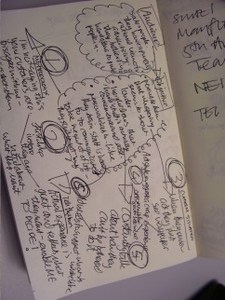
    100_2959

    Start looking at what links the chunks on the agenda together, what subject logically flows from one chunk to another. Magically you’re running order starts to emerge. You nearly have a plan for writing your presentation.

    But hold on. There are other things to consider. You need to start well and ending better.

    For the end……Psychologists have shown that people remember the end more than any other bit of an experience.
    100_2801

    So write the end first – the ultimate point you want them to leave with.

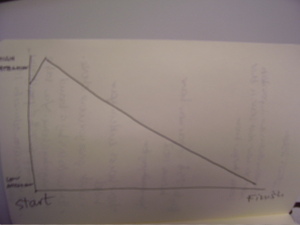
    Now think about attention spans.  It’s really important to manipulate them, since they usually go like this:
    100_2960

    Everyone’s up for it at the start, they’re listening, interested  -primed. Then they slowly fade away.

    So you need to get that vital info in the start, when you know they’ll take it in. Make it engaging, start really well – with that big point, the interesting bit that will grab them by the balls.
    100_2946 

    Take them up a notch while you’ve got them- they’ll take longer to come down. This is why I’m sometimes nervous about spending ages going over thinking before clients see the work – show the work when they’re really up for it!

    And look at you’re agenda…..how you can throw in things that will keep their attention pricking back up? Hopefully people in your presentation will feel like the dotted line, rather than standard behavior:
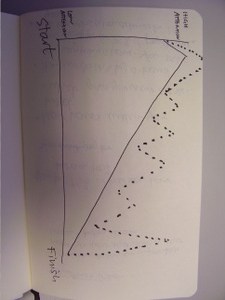
    100_2961

    Tell them what you’re going to tell them

    Tell them (interestingly)

    Tell them what you’ve told them

    Does that make sense?

    Now, when you go about writing it, you’ll have a specific blue-print to follow. It will make putting it together easy, and trust me, by holding off bashing out slides, you’ll save loads of time and effort.

    Which gives you more time make it look as good as possible, and know it inside out. And the more you know, the less slides you need, and the more spontaneous you’;; look.

    As we’ll see next time, the trick of confidence isn’t being a born orator, it’s doing the work.

    As far as the actual content goes, if you can write less do so. When you have a first draft it will be too long, condense, edit, precis. And if you can say it with a picture rather than words, do it. But we’ll be tripping over into how to actually present if we go much further, so I’ll leave it there for now.

    Hope it’s helpful.

  • It’s here. The legendary Paul Colman has posted his second project here. Great project, great prize too. Good luck!

  • There hasn’t been much movement on that ‘to do list’ recently. This will be remedied very shortly.

    In the meantime, those people who want to know what’s happening with the Account Planning School of the web will be pleased know that the famous Paul Colman, now of Weiden and Kennedy, will be doing the next project very soon.

    And in the meantime, here’s a killer quote from Fred on the dangers of specialising: "To a man with  hammer everything looks like a nail". Genius!

  • "Sufficiently advanced technology is indistinguishable from magic"

    Arthur C Clarke

    That’s a proposition in need of brief if there ever was one……….