Well, it finally happened. I’m not quite sure what to say about it all just yet, except it was a wonderful day.
-
This book is very interesting. The main argument is that it’s worth considering that what we’ve lost, what we’ve forgotten is hugely important to who we are and how we got here.
There are some things about my life I deeply miss, Grandparents, John Mcenroe in his prime, watching Pebble Mill with Mum, new episodes of Frasier, the shock of knowing Darth Vader was Luke’s father.
I never think about these things much, but they make ME as much as new stuff I’ve picked up along the way. Not to mention the things I wish I was born in time for – that are lost forever.
Maybe progress is as much about what we discard as what we gain. I’m not sure where to go with this, but I’m sure it will pop up in relation to something soon.
-
So it’s Interesting on Saturday. I’m getting more excited than is normal, and I want to enjoy the day as much as I can. This means I don’t want to miss out on meeting anyone – too many times I’ve rolled into a building and shyly hidden in a corner – only to find out after that it was full of people I read everyday.
So, I’m wearing THIS t-shirt (that way you’ll get my name right too).
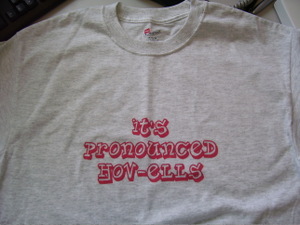
See you there, and be patient if I appear more bumbling than usual, I’m getting the 7.40am train from Leeds.
-
Right second post. Niku Banaie from Naked is up to talk about how understanding basic human needs can keep your customers and employees happy and fresh. Since this is something I think is fundamentally missing from loads of thinking at the moment, I know I’m going to like this, and I do.
(Incidentally, I spent this entire talk sitting next to Faris, not knowing who he was. There was also this foot next to my chair that turned out to be Russell’s).
He thinks that if you continually look at how people are fulfilling (or not) they’re basic human needs, you see new opportunities for fresh ideas, you can anticipate what people want. They are; love, learning, giving back, simplicity and play.
Love – there’s strong evidence that Web 2.0 is making us connected, but lonelier than ever. Social aptitude is suffering as a result. Apparently we need to be touched 3 times a day to feel healthy, no wonder the Guardian Online’s Soulmates is there most successful new media venture. And then there’s this.
Learning – the way Web 2.0 links is together means we can learn from each other.Like Crowdstorm and Instructables. I’m getting very interested in bottom up systems at the moment and the way we all follow the herd’s recommendations. Like Amazons ‘people that bought this, also bought this’. Another bit clicks into place.
Giving back – We all know that sustainability is becoming more important anyway. I liked the way Patagonia wants people to have fun but respect what we live in. I really like the idea that when their staff are banged up for ethical protects, it’s company policy to bail them out. Kiva is a peer to peer loan site, and you probably don’t need me to tell you about Freecyle.
Simplicity – We’ve just too much stuff to deal with, new and improved is simply viewed as more complication! Google makes more appear less, so does Craigslist. The Ipod is a model of technical brilliance that ‘hides’ the technology and complication, like the 100 dollar laptop that HAS to be devastatingly simple.
Three rules – SHRINK (easy to use) HIDE (looks simple) EMBODY (give off signals of quality and value)
Finally, Play. It’s boring to think like adults all the time, sometimes we want to cut loose. Gymns are dull, why can’t they be more fun? Like the Nintendo Wii that simply looks like an antidote to hard core gaming to me, especially when you can great your own Wii Mii and get them do loads of stuff for no other reason than it’s a great laugh.
Then is was the turn of Mike Butcher to talk about the effect of digital media on traditional media. Here’s a transcript of his speech, but there are some salient points that struck home with me. A new media turning things upside down is nothing new. The onset of print allowed insurgents to distribute information and organise in ways they never had before. Information of power – the greater its distribution, the greater the sharing of power and authority.
Press simply has a smaller, cheaper and quicker competitor to deal with now – online. Like the way Craigslist totally undermines paid for classified advertising (so does Ebay). Now old media may be dealing well in parts, like Guardian Online, but it isn’t leading the way, at best it’s part of it.
We’re going to see the old media continually squeezed by the new technical behemoths like Google, and the little niche start ups from the other side. It suggests a new model for media – take part and we’ll give you the space. Maybe the new model is less power at the top and more stuff coming up from the people on the ground. That bottom up theme again.
Then is was Simon Sinek, Beeker, Faris and Steve Overman to discuss how to turn trends into insights, and how then to use them. Now, this conversation went on for a while, it even got a little heated. Here are the main points:
There are way too many trends at any given time for you to try using. You need to understand who you are and what you do best in order to select what’s relevant and credible for you to tap into.
In the end, trends are useless, and insight is something that makes them useFUL. The audience is really the creative team and the client – can you give them something which as a) genuinely happening or about to b) can them show them how they can use this to lead to fresh ideas, and new, useful, distinctive connections with their audience? In essence, does it shed new USABLE light on the subject?
Beeker made a great point that you shouldn’t do something just because it’s fresh and new. Do what yo should, not what you can.
Steve Overman made a point that insights can be uncomfortable for clients – new stuff usually is. It’s massive to be able to put yourself in the client shoes. I also think this stands for creatives too. Tools to use are finding a way to take the sting out of it, make it come from someone else (voxpops?) or maybe just have the balls to tell it like it is!
Some good points about making it inspiring – Faris reminds us of the weakness of words v images and associations, Beeker talks of rich hooks – useful stimulus that makes it real for people. Simon Sinek makes a good point that much of marketing is manipulation – promotions and such, while the stuff that works in the long term is inspiration.
In the end, I think they’re just saying is that an insight something new that resonates in a new way with the client culture and consumer culture (and agency!).
And that will do for now. Third and last bit soon.
-

Lauren tagged me ages ago, so it’s about time I got around to putting down five blogs that make me think. Now there are far more than five, and you all know who you are, so I’m going to choose some that give me a slightly different perspective on stuff…..
- Fake it until you make it. These are the observations of One Woman Running, an aspiring creative. I love the way she writes, I like her observations on The Work, but what I really enjoy is the way talks about her life. She makes me remember what it was like struggling to get that first job and how brave temps and people doing something they don’t love are – every single day.
- Regine Debatty (we make money not art). This is a new one for me, but I love it. It sits at the intersection between technology and art. She shows how artists are using their medium to expose the ethical questions we should be asking about what’s going in in labs right now. As a science geek I love it, as a planner who wants to know what the conversations about the future are, well ditto.
- Ray Kurzweil’s blog about emerging trends and technology can be quite scary sometimes, but always useful. The silliest thing I can do as a planner is just read stuff about planning. I think it’s important to hoard all sorts of interesting stuff. This is a great place to do just that.
- I have to put Lauren and her She Sees Red Blog. I don’t know enough about art, something I want to remedy. Lauren’s reporting on her gallery visits, and how she does her own work is really helpful and a joy to read. Lauren’s one of these people that doesn’t just talk, she does.
- So is James Boardwell. He’s someone I was lucky enough to meet at those Northern Planning summits. Now he helps me with most of my Web 2.0 stuff, and social research. His blog doesn’t get updated very much, which is a good job since lots of his stuff needs time for proper reflection. There’s lots of meaty posts about, well, everything. Every time I meet him he makes me think, for as long as I can keep up with him that is. He’s living proof that it’s essential to know people who are far cleverer than you are.
- And I’m going to be cheeky and add a sixth. Marcus Brown is an interesting, generous man. He’s on the third version of his own blog, which is beginning to sire some posts that are incredibly profound, honest, personal and beautifully written. Then there are his alter egos, The Dead Artist and Sacrum. Sacrum is very funny, but he’s also an intelligent comment on the way planning models are used to look clever while doing nothing useful whatsoever.
By the way, Sacrum seems to have packed his bags and vanished into hiding at a secret destination. Do you think he was responsible for the Olympic logo?
-
Ray Kurzweil’s ideas sound daft at first – but before you dismiss him, consider the following:
In the the 1970’s he invented programmes to analyze patterns in composers music and make new scores in their own style.
In 1984 he made the first electronic gizmo that could perfectly mimic acoustic instruments (Stevie Wonder suggested it).
He’s one those technical doers that believes something will be useful and possible and – does it.
Right now he thinks we’re only decades away from clever, conscious computers. Ones that will be able to demand rights and will probably be more intelligent than us. Now of course the problem with futurology is that it’s usually wrong, but look at Honda’s Asimo…machines and computers are already changing our lives, and the process is speeding up all the time. Think of the way mobile phones have truly revolutionised our social lives, or the way the internet has transformed information culture (and social lives too).

You might be worried that with all these machines doing everything for us, we’ll get bored without the trials and tribulations of the daily grind, but just maybe culture is ready…
Consider the emerging behavior of Baby Boomers – over 55’s have all that energy, all that time and all that money. Some (mostly male) try and replace the lost corporate status and usefulness – they try and hold on. But others are beginning to embrace this time of life as a new beginning, a chance to do all the things they wanted to try but never had the chance – in essence an experience culture based on self actualisation. They don’t want to be defined by age, but by attitude.

Anyway, imagine you were a mediaeval serf transported to 2007. Even a poor homeless person would be existing in the lap of luxury to them. Worrying about a home being repossessed isn’t quite the same as fleeing rape and pillage, or avoiding the Inquisition.

So maybe an answer to the question, "How will we stay interested?", would be, "Are you interested now?".
Of course we know that in the 1960’s they were predicting that by now we’d all be enjoying unlimited leisure by by now. But it never happened. Economists have shown that consumerism and our booming living standards are not making us happier – we’re more glum than we were in 1950. That’s thanks to us working our socks off so we can get the latest stuff we don’t need, and then find we get bored with it quickly, so we need to work harder to get more. Maybe the Baby Boomers chasing experiences are showing us the way.There’s plenty of evidence around that we’re ALL craving more time now, with loved ones, but also for ourselves.
And maybe more people will be able to do the kind of jobs that interest them, maybe we’ll have jobs that allow us to have flow – like the way you lose yourself in gardening, or a good game of chess.
That said, after a 200 years decline of working hours, the 80’s saw a reverse – largely thanks to lack of job security. But we still spend more time on leisure too. For the first time, in 1999 we spent more on leisure than clothing, housing food or transport.
So where do we get the time? You could argue that we spend less time with friends, but we also toil less over household chores. Technology has reduced drudgery, which we’ve filled with more work and more fun. But there’s a sting in that tail. Any more technology has a danger of being seen as drudgery too – another booklet to read, more settings to learn. More so than ever, innovations have to be useful and easy to use – take the work AND the thinking away from us. Think about it, our houses are already run by stupid robots – central heating, oven timers, answering machines, Sky Plus…….
That serf looking at us now would think we’ve gone mad. There’s an intense pressure on us to make the most of our down time now. We watch crap reality shows guiltily, we lounge around in pools worried that we should be seeing an art gallery, or wandering through an old cathedral. We eat prepared meals guiltily thinking of unopened cook books.
Maybe we’ll welcome these new machines with open arms, maybe we’re ready to enjoy our time, but you just wonder if leisure will turn into so much hard work…….
-
Progress is usually considered a good thing. Mostly it is, but sometimes it can be a double edged sword. Of course there’s the usual examples, like nuclear power, or the combustion engine, but maybe there’s other, less obvious implications we don’t consider.
Sometimes we can get caught up in the thrill of a new innovation without thinking the consequences through.
Take cars for instance. We’re all waiting for the day when we have decent electric cars without emissions, or maybe they’ll be running on hydrogen cells emitting only water. But electric cars will almost certainly be quieter, how will this affect road safety? Will more pedestrians be run over since they can’t hear a car coming?
And as for cars that emit water vapour – that’s actually THE most efficient global warming agent. Do we know for sure we won’t just make too many clouds?
Then there’s the internet. We’re already wondering if the ‘connected’ western world isn’t in danger of becoming a culture of lonely, socially inept individuals. Still, most would agree that getting the Third World connected will be a force for good. Not only will dictatorships find it harder to maintain control when they lose the monopoly on information, in theory it should be great for people in isolated areas to feel more connected to the rest of the world.
BUT, I read about some disquieting research on Nigerians who were using the web for the first time. Many actually felt more negative and helpless about their lives. Imagine a blind person who has no concept that there is anything wrong with them being told that other people can see….
Many felt poorer than ever after seeing all the riches elsewhere. And the richness of experiences elsewhere made some feel lonelier and more isolated than ever.
Then there’s getting to exited about what you’ve developed, without considering if anyone actually wants it. Videphones have been possible for a long time, but people simply did not want them. They were just too invasive. It took mobile phones and the feeling of control we have over them before we got comfortable with it.
I bet someone somwhere is intent on holographic phones. Imagine always being on show, people who phone first thing seeing you in you’re PJ’s, seeing that spot, or your bedhead. Will we be even less inclined to actually go out and see people when we’re ‘with them’ artificially? Will anyone want that?
Who knows, but this is part of the reason behind me, as a planner, wanting to get more involved in product development, maybe that’s where I can be most useful. Or maybe it’s developing those added value services that help people avoid any negative effects of what we’re selling them. I don’t know.
But I do know that progress for progress’ sake can be more subtly complicated than we often acknowledge.
-
So, I was lucky enough to go to the PSFK conference. In return for a free ticket, they asked me to blog about about it, so I am. I reckon you should look at Will and Charles’ reports too.
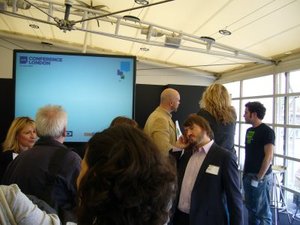
First off, the venue was great. This is Will’s picture (hope he doesn’t mind), I’ll post my own next time. As you can see, we were under a canopy, with a series of french doors at the side. All that natural light really made a difference.
What follows is largely a report, I’ll try and keep myself out of it. I’ll post some thoughts on the themes later, but for now one strong opinion is that it was very well organised, ran on schedule and the attendees really helped to make it as much as the speakers.
By the way, I’m embarrassed to note that I was sat next to Faris for an hour and didn’t even realise until he got up to speak.
I was annoyed to be late, blame GNER, but I caught the end of Timo Veikkola (Nokia) talking about how shifts in society shape design. Interesting stuff on how culturally we’re in a pretty optimistic mood – we’re worried about the environment and the Middle East, but we think that things will be OK and we’re beginning to act. Doing things for yourself and self expression is becoming important. In answering the questions at the end, he talked about ‘3rd’ life. The idea that we’ll be combining virtual and physical worlds. I wish I’d caught more – it seemed useful for anyone who works on multi national brands (that’s not me though).
Next up was Regine Debatty (we make money, not art). She blogs about the intersection of art and technology – so as a science geek I’m bound to like this. And I do.
She starts with biotechnology. We’ve always manipulated the body – from corsets to prosthetic limbs, but we’re moving to a stage where we can manipulate life how we want. But will this make life perfect?
She talks about the ‘Victimless leather jacket’ – basically a tiny jacket grown from mice cells. Strangely people who see it are disgusted at the thought of wearing one – more than the skin of a dead animal. This says a lot about what we’re ready for and what we’re not.
There is the probability that stem cells will allow us to grow bits of bodies on ourselves to then sell to other people. Funny to think about class, how rich people will have their bodies grown by the poor.
Then there’s disembodied cuisine – a piece of art where the took live frog cells and grew them into tiny steaks. They served them, they tasted awful, and people reacted strongly against the idea of it too. But in France, in the 70’s, they said they’d never buy pre-packed meat……
One final thing was the possibility of creating superhumans. This has profound implications for equality. On one hand we have the idea of the ‘natural’ humans who sired them being inferior, but on the other we have all humans being equally perfect. Is this good?
I really liked her approach. She argued that what’s happening in the labs is mysterious and when we know about it, it’s too late (who has the most imagination by the way, scientists or artists?). She was showing how art can expose and discuss this.
Then it was Tamara Giltsoff, John Grant and Diana Verde Nieto to debate The Marketing Gap in Green.
I’ll have to apologise now for not noting who said what:
Public opinion will be forcing aviation to revise it’s approach – aviation is becoming the new 4×4.
It’s going mainstream. It’s about money, not philanthropy. Business cannot escape it’s impact – while we decide what to buy, they decide what the choice is in the first place.
Maybe the opportunity is at the front end – how to help people alter behavior. It’s people NEEDING to be at a meeting at the other end of the world that’s more the issue that how they get there. How can we address this?
A good point about CSR departments not able to communicate well – and the need for them to work with marketing more.
Are we talking about ‘marketing green’ or are we talking about sustainable business practice? We need to square selling with sustainability. The way to add value will be letting people look behind a product, at how it was made. That’s what will add value.
Good point that we’re right at the start of this, like doing websites in 1995. We need to work out what we’re doing – but at least we’re starting. We made it up as we went along with new media – will this be the same?
A lot of what we need to do is take the pain out of green behavior for people. How can we collaborate with them? Like helping Americans to see that big isn’t better? Or car companies sponsoring car sharing, or sharing school runs.
Consumers will give their time and attention in return for wellbeing and purpose. We’re not happier having more ‘things’ anyway, purpose can help instead.
As for agencies, it was suggested that we need a new department, just like when new media took off. We need to avoid thinking of it as special interest, but increasingly the cultural norm. And don’t think you’re an expert, no one is yet.
So there was a lot to think about. I didn’t expect any answers – it’s too early. And I didn’t get any.
I’ll stop there for a bit. I think I’ll do this in three chunks. I promise to finish this week.
-
I’m a bit dazed and confused after a week of sleeping, eating, reading and drinking, but I’m here.
I’m most confused by learning that Rob Campbell has a pair of pert breasts, but let’s set that aside for now.
I need to blog about the PSFK conference and I need to get myself sorted for this too. But I’ve got tons of other stuff just aching to be posted about. Not least working up to more advice, this time about research. And there will be some news on swimming along with some crumbly stuff about, well, this and that.
Good to be back.
-
I’m supposed to be on holiday, but…
I had a good day at PSFK yesterday. I’m supposed to be blogging about it (they let me in for free), and I promise to do so when I get back next week.
For now though, it was well run, the venue was ace, and the speakers were superb. BUT it struck me that the people who were the most interesting were not the ones talking about advertising, or really ‘planning’. The best stuff was from people who are doing something a bit different. Ian Tate was easilly the best for me though. Conclusion of the day? The most interesting stuff isn’t coming from the established big agencies (or clients). Small seems to be better. I’ll report fully in a week or so.
It was great seeing people though. Will and Charles were there, I met Helen for the first time and we had lunch. She’s a lovely and Comfortably Disorientated in person as she is online. I also had met Beeker for the first time. We both had coffee with Russell. She was very patient with the Star Wars geekery.
I was very thankful they were there. I always feel out of place at these things. I’m far too shy to go up to people I don’t know and usually end up shrinking into a corner hoping no one will notice me.
It was a shame I missed the evening – and Lauren. But Friday night was the first night of my holiday. I wanted to get home to Mrs NP.
That’s really it now. ‘Bye.



 NORTHERN PLANNER