So it’s getting on for 9pm and I’m waiting patiently for talk to someone about tomorrow morning’s pitch. The chinese takeaway is on the way, which helps the situation. So joy of joy’s I’ve got time to start the next planning basics post.
And it’s on strategy. As with the other stuff, big chunks of this are from a luminary, Andy Edwards this time. But not all. There’s a good reason for that too, namely, when we did the APG Network, it was brilliant, but planning directors were a bit too keen to indoctrinate us into their particular school of planning. It was confusing at times when we just wanted a good start.
By the way, I think that leads to THE best advice I could ever give. I’m sure you’ve met a creative team that’s hellbent on copying something they really love from the D&AD annual, but this can be a planning affliction too. It’s very tempting to look at some genius from the APG Awards or something and copy it. DON’T. Every client is different – so the strategy needs to be too. That doesn’t mean you shouldn’t be inspired by what’s worked in other markets though.
So, strategy. I’m not going to dwell on the various planning models. Like I said about branding, at the basic level, the approach should really be the same – whatever the media. We’ll do being media neutral another time, but at the end of the day, an idea should be good enough for wherever you want to put it. Richard Huntington talks about generous ideas, meaning any discipline specialist can use it.
This isn’t specifically about brand strategy or campaign strategy, or any other task. It’s about how to go about getting a good idea for whatever you’ve been tasked to do. We’ll cover the difference between brand positioning, vision and essence another time (but to be honest, like we said in brands, it’s always dangerous to get caught up in planning models. Rigorous thinking does not mean ticking boxes.
So……..
This my cat. She’s called Kato and she’s a genius strategist. 
Like most moggies, she’s imperiously aloof most of the time. But just you wait until she gets hungry. Then she rubs herself against my ankles, or if she’s really desperate, she’ll roll on her back and stare up with the most loving experession a cat can muster. She knows I fall for a bit of affection every time. In other words, she knows what she has to do to make me do what she wants.Strategy is as simple as that.
Look at this girl, sulking to get her way.

Simplistic but bloody effective. We’re all stategists you see, it’s instinctive.

A rose can be a strategy to inject a bit of romance, it can encourage someone to love you, it can say you’re sorry, it can even be a way to cheer yourself up. We know which one is right for the occasion without thinking.
But information is not strategy. Just telling people something isn’t enough (but the right information helps). Your strategy uses the information in the most powerful way possible. Consider:
Sale this weekend v Get in the wife’s good books
Reduced by 50% v Look richer than you are
Very safe car v You can be more aggresive
New and improved v The original updated
Longer opening hours v More time with the kids
I think it all boils down to two simple things. Define what you need to do, then define what you need to do to get there. AND NEVER FORGET, your objective is NOT to ‘drive footfall’ or ‘increase sales’. It’s to understand what’s STOPPING people doing what you want and finding a way to change that – ultimately you’re looking for a response in someone’s head, then the physical end result will take care of itself.
So as a definition, strategy is this:
"How you’ll get to where you want to be". And for us, it’s a means to influence perception, so that people will THEN (AND ONLY THEN) buy, sell, visit more.
So, to objectives. If you get this right, the rest becomes easy. You really have to work hard to understand the right question before you can solve it. Usually that means some form of research (we”l cover methodologies and stuff another time), it certainly means understanding everything you can about ALL the issues.
For example, all that lovely Honda work only worked because they knew the problem wasn’t the quality of the cars, it was the dullness of the brand.
Skoda had to get on a consideration list by stopping people taking the piss out people that might want to buy one. But they were not converting enough sales. It was only when they realised they needed to tell people more about the car that they turned things around. Or consider something I worked on this year. Selling beds. Dull I know and that’s the problem.
We did some TV (and a sale ad to boot!) that got people to re-appraise the opinion that beds are dull – we forget how brilliant they are, and it’s not to do with sleep. It’s how much we look forward to little bed moments – a sleep in, reading in bed, a late night film, and it had an immediate effect with a sales uplift of 20%. No big sale flashes, no massive price points. Just creating a new connection between two things we aleady knew.
Look at this objective by Henry Ford:
"We plan to build a motor car for the great multitude. Everybody will be able to afford one and everyone will have one. The horse will have disappeared from our highways and the automobile will be taken for granted"
He didn’t say, "Sell more cars".
Now for a brief interlude. DO NOT expect it all to work like clockwork. It’s really annoying when someone has a great idea and they tell you, "It just came to me". But there’s a big truth in there. You’ll thrash things around, you’ll think so hard it makes your brain bleed. But it won’t come. Then you’ll sit in the bath, and BANG! it comes – it was so obvious wasn’t it? The moral? You have to give yourself time to get ALL the information, and to think hard. But it doesn’t stop there. You need to have the time to think about other stuff. That’s usually when it comes to you.
And start, quickly. When I write creative briefs I don’t spend too long considering how to do, I just start writing. The first one is pretty hopeless, but then you start improving it. I think I’m saying that it’s not just a linear process, it’s pretty messy and it will get better as it goes along. That means hard work – it’s not lots of coffee, a bit of blogging and then EUREKA! It just isn’t, or not for me anyway. I find ideas hard unfortunately, but at least I’m in good company. When Einstein was asked why he didn’t have a notebook for his ideas he replied, " I don’t have many good ideas".
So back to what I was talking about (is this my Ronnie Corbett post?). On yes, define the competitive context. By the way, that doesn’t just mean the competition in the category, it means the competition in life. Russell’s done a good video on how small brands really are in people’s lives. It’s bloody useful to remind cleints how insignificant what they’re selling really is to people, and what the REAL competition is.
Take flowers. Nikki Crumpton did some genius work for the Flowers and Plants association where in one campaign, they found the competition was women waiting for someone to buy flowers for them, and in another, the competition was our cultural belief that flowers are for romance – when they are actually good for our health and wellbeing.
But you do have to be different to your competitors too. There are so many markets where everyone looks and says the same stuff. I worked on a betting company once where weekly, I knew what the brief would be by looking at what their competitors had done in press – "Do that!". Find a gap in the market, find a market within the gap.
And understand the context of what you’re doing. Is it a long term brand thought you’re after? Is it an evolution of something already in place? Or is it purely tactical? This will come from understanding the objective of course. And are you after a gradual shift in perceptions? Or are you after a an immediate great leap?
What I’m saying is that the perfect strategy identifies the most compelling thing you can say, it locks down and owns that thought and it’s not just different to the competition, it undermines it. You’re winning a battle for the mind. These days when we have to earn attention, not buy, this is not an option.
Before we move on to some pointers about how to go about this, I want to make a point about tone of voice. This doesn not get the attention is deserves. While some argue you need a single minded, brutally simple idea, and others go for complex ideas, you can’t get away from the fact that, just like body language v speech, it’s not the information, it’s how you deliver it. The casting, the images, the way the language is delivered, it all has to be true to the brand. Find it’s voice first. Then it’s easy (or easyER!). You just have to ask, "How can I use my brand to solve this problem". Get a conceptual person in your head, ask yourself what they would do to solve this problem, and how. Tone MUST be part of your strategy. Otherwise it’s just information.
So – how do we go about it?
- The law of sacrifice – you cannot be everything to all the people all the time. Do only what you need to do for the people you really need to influence.You need to cover- 1. The market 2. The consumer 3. The brand. Start with what you know the least about, but be thinking about the others while you think about a specific, they can, and should, overlap.
- When you think about the competion, it helps to do market mapping. Actually do it on piece of paper. Put the brand in the clusters that suit them best. It gets you clear where you are and where you need to be. Is there new cluster that could be filled? How can you disrupt the current order? And remember, me-too is nothing. Best practice is the devil. Orange totally disrupted the technology market years ago with emotion – "The future’s bright". Nike did it by turning sports stars into rock stars. The Spice Girls did it by not being impossibly beautiful. Prince did it by being neither black or white.
- And you need to find the audience Bulls Eye. It doesn’t have to be a market shifting insight, but it does have to be something that sheds new light on what’s possible within the market. At all costs, find a problem in their lives you can solve that no one else can. And avoid falling into the trap of just replaying back what they already know. Conversely, it’s hard (but not impossible) to tell them something earth shattering. Because a) They won’t believe it and b) It usually won’t be true. It’s great to draw a new connection between two things they already know – but never linked before. Like linking the convenience of phones with self-organisation, or sofas and not having enough time with loved ones. And define them properly. I don’t mean just with demographics, although there’s not much point persuading the unemployed to shop at Waitrose, I mean how what you know about them will help you solve the problem. Compare this:
Working class people on a budget.
to
People with more sense than money
Or
People looking for a hatchback car v People who don’t need a car to prove their success
4. And as for the brand, the company or product…leaders defend, or lead. 2s attack number one. But 3s and challengers outflank the main battleground and carve whole new niches.
Consider the relative strengths of the brand and it’s product and service – and weaknesses. Do you need to defend a weakness or focus on strengths? If you’re lucky enough to see the WK reel, you’ll notice it’s very strategic and process driven – because everyone knows they’re creative and they understand there’s a question mark (unfairly) in their rigour. I’d argue Alfa Romeo needs to find a balance between proving reliabilty and keeping it’s core strengths as a creator of objects of desire that defy common sense.
5. And beware of logic. It has to make sense, but you’re in the business of communication. It needs to bring humans into the mix.
6. Mind mapping is a useful trick to help you organise your thinking, draw new connections and see things a little bit differently.
And a great way to frame your thinking is this:
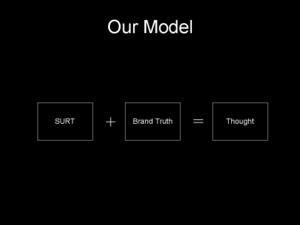
Happy with a truth about the way you want to fit into people’s lives – a simple, universal truth. Then identify how the brand helps this happen. The thought is the summation of both. Like this:
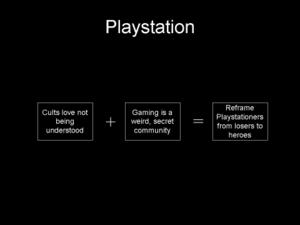
Or this mine, don’t laugh:
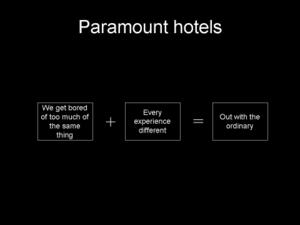
PLEEEEEEEEAAAAAAAAAASE don’t think of this as some rigid model, it’s just useful start to how to frame your thinking. It gives you something to work on. Do not take it as a vote for brutal single-mindedness. You’re strategy needs a lot going on. That doesn’t mean it needs to be complicated, I think it needs to be a compression of lots of things a creative, media planner or anyone can then pull out and develop. You need to be able to see a lot of outcomes, not just one.
But that brings me to my very last point (promise). How do you know if it’s great? Well, maybe great strategy is like great music, or a film. It feels right straight away and it’s too instinctive to define. I think there’s a lot in that, but my instincts will be different to yours, and also to the end consumer.
I think it needs to be: differentiating, relevant, involving, credible and impactful.
But also:
- Water tight. I explain most stuff stuff to Mrs NP. If I can’t explain it to someone I talk to everyday, who knows what I’m thinking most of the time, how the hell will it work for anyone else?
- Works in a sentence – but don’t be satisfied by just that, it needs to feel expandable. Do you think it will work in a poster? What about a website? What PR would result from this. Can you think of at least five great ideas that would result from your strategy? Can you write a short film script from it (trust me this is very useful).
- The competition will be surprised and scarabble to react.
- It will impress your collegues. If you get, "Bastard, wish I’d thought of that", you’re on to something.
- Do the overnight test. Things look very different in the morning. Does it stand up to a fresh eye – espescially yours?
So there you go. Please take it as just some basic starts. Nothing more nothing less. I hope it shows you how you can organise your thinking at least.
I hope it makes sense, sorry it’s so long. There will be some howling literals and typos, but I’m too tired to care. I promise to check later. It will give you a laugh at least.


 NORTHERN PLANNER