• A while back, Helen posted on Coffee Shop dreams. It’s a lovely post about giving up what you’re doing now for ‘a simpler life like running a coffee shop’. Firstly, I need to publicly thank her for inspiring me on a brief about, well, coffee shops.

    Secondly, I’d like to share my own coffee shop fantasy. Now I’m happy with what I’m doing, I know I’m very lucky, but sometimes………

    Sometimes I wonder what it would be like to jack it all in and move to St. Ives, my favourite place in the world. I imagine learning to surf properly and running down the hill every morning towards the beach. I fantasize about wearing sandals all year round and being able to smell the sea every single day. But how would I pay for all this?

    August_2006_090

    There are plenty of places to eat there, and some are amazing, but they either fall into the expensive and complicated camp (you know, pan fried this and that drizzled with a balsamic reduction) or into the fast food camp. Don’t get me wrong, both are great, but I’d love to do something different.

    I wonder what would happen if I opened up my own little place. It wouldn’t have a theme as such, but it would be reasonably priced. Everyone would be welcome and it would serve simple, delicious food. The kind of stuff I cook every day. Really good meatballs, my wife’s lasagna, my cassoulet that’s lovingly evolved over ten years, my sisters chocolate cake,  my signature curry and fish pie, my brother in law’s amazing roast potatoes and genius paella. Not to mention mushroom risotto and stuffed peppers. 

    Lovely home cooked food that wasn’t on the menu because it was fashionable, traditional or anything like that. Just honest, delicious food that we know people really love to eat because friends and family always ask for seconds (and maybe we’d offer that in our little place too).

    A place that turns a decent profit, but really exists for the joy of cooking and watching people loving your food. That’s what I would do if I ever took leave of my senses.

    It will never happen, but at those times when it’s 7am, and you’re struggling to make a creative brief sing, it’s a lovely little dream.

    So while I’ll still post the simple half hour recipes, I’m going to throw in some harder stuff I’ve picked up along the way. Until I’ve got my fantasy little place it will have to do.

  • The next bit of planning basics will be about how to go about formulating strategy, but in the meantime, here’s two things I’ve been thinking about recently.

    First off, have a go at Rob’s Account Planning School of the Web project, it’s quite, quite brilliant. Russell’s chosen well. I’m slightly nervous about my stint next month.

    The other thing is about telling the truth – or avoiding BEAUTIFUL LIES. Let me explain.

    At work, we have this healthy habit of doing creative reviews every month or so. Not our own stuff, but work out there that’s interesting (by the way, this is bloody useful practice for working on strategy. If you get in the habit of working back from others’ work, starting you’re own becomes second nature).

    100_1796

    Trouble is, while there’s a certain amount of great creative ideas, so few seemed to be based on any discernable, genuine product, service or brand truth.

    Quite a few seem to blur, bend, or wilfully lie about what they’re selling to fit a particular consumer insight, or gap in the market. The wonderfully constructed edifices seemed to crumble as soon as you applied any sort of common sense or ask the simplest question. These days, that’s simply not good enough.

    Once upon a time you could get away with this. The Nescafe Gold blend couple told you nothing about Nescafe except position them where they wanted to be. And the old Lurpak trumpet fellow was pure invention.

    Lurpak

    That was OK when we were all less marketing savvy, now you can destroy any artifice or overclaim with a single blog post.

    And just to make it even tougher, now people can largely shut out brands they don’t like, you have to seduce, entertain and be interesting like never before. So you need a strong TRUTH to wrap all this interesting stuff around – about what you’re selling, or how and why who’s selling it goes about things.

    This is nothing new – Truth Well Told may well be THE most famous agency mantra. But it’s not on option now, it’s a must. Consumer insight is great, market insight is too. But until you’ve sonething TRUE to say about the thing you’re promoting, your just telling BEAUTIFUL LIES.

  • It was inevitable that the Wurst would rear it’s beautifully, meaty head at some point in the recipe series. Today is that day.

    Since it’s a Monday, we’re going to do something that’s dead easy; Quick Sausage Cassoulet. Do not confuse this delight with the complex version that takes an age to prepare – but make no mistake either, this wonderful, hearty, garlicky delight is an easy substitute.

    You will need (to serve two hungry souls):

    4 good quality sausages (Toulouse ones if you can)

    4 rashers of smoked bacon – chopped

    1 clove of garlic, finely chopped

    1 large onion, finely chopped (optional, if you’re in a rush)

    1 tin of chopped tomatoes (best quality ones you can find)

    1 tin of baked beans.

    In a big pan, chuck in a tblsp of olive oil and bring to a decent heat on the hob. Throw in the onions, bacon and sausages and move them all around the pan until the sausages are browned on all sides and the onions are translucent and beginning to brown around the edges.

    Add the tin of chopped tomatoes and stir in. Reduce the heat to a minimum. With a slotted spoon, add the baked beans spoonful by spoonful – this should mean you’ve only added about half the sauce to the pan. Stir it all well and bring to the boil.

    Then reduce it to a vigorous simmer and leave uncovered for twenty minutes. Then serve in bowls, preferably with crusty bread, but a side salad is good too.

    The only washing up is one pan and the bowls you eat from. Brilliant.

    Simon has asked for some soups – they’re next.

  • Right, back to some planning basics stuff. Last time it was on what planning was for, now it’s on brands. Or how and why a company need to be unique in it’s market, not just through what it sells, but how it behaves.
    100_0977

    This is the bones of a talk Malcom White did on the APG Training Network. While lots of the content was great, he talked for too long and seemed to have an axe to grind. Since he’s left Euro RSCG under a cloud that week, maybe he was in a bad mood. Like I said though, lots of the content was useful.

    First off, brands are important.They build a direct, unobstructed path of communication between the manufacturer and the consumer’s deepest needs. They allow customers to form relationships with companies, they breed loyalty. (I would also add that they’re plain useful. Life is very complex, there’s too much choice. Brands help you choose).

    Brands also add value. Between 1982 and 1987 the most heavily branded companies on the stock market out -performed the rest of the FTSE 350 by 15-20%.

    (They’re also bloody useful for planners too. Without some sort of brand ‘voice’ to start with, creating strategy is twice as hard. Every time you do a new campaign, it’s far easier to ask, "How do we apply our brand to this problem?", instead of, "Right, what shall we do?". That doesn’t leave out understanding what problem you’re solving and all those other hard bits, but that’s for another time)

    Now I’ll have a quick moan at brand consultancies. Yes, they are very clever, yes, they provide beautiful process and wonderful charts and frameworks. But it’s pretty useless if you cannot execute it. A brand is like good glue. It unites the marketing mix, and it also unites the company behind a vision to work towards.

    Brands affect product experience. When they did the Pepsi challenge all those years back, they didn’t show anyone comparing Pepsi and Coke with the labels on. Because then Coke wins hands down:

    Which do you prefer?                Diet Pepsi                 Diet Coke

    Blind                                          51%                         44%

    Branded                                    23%                           65%

    Brands are like a peach. At the heart of every peach is a stone. the functional part. Now the stone is important of course, but every stone is pretty much the same. Peaches are chosen on basis of it’s flesh and skin. The ripest, sweetest, juiciest looking peaches get picked the most.

    Survivial of the juiciest.

    That’s just like brands. There’s a product or service at the heart, which MUST meet some sort of need, but it’s the extra stuff on the outer layer that differentiates it from the competition. The feelings, images and associations. The brand.

    (Now I’m quickly going to add some bits of my own here. Do not be fooled into thinking this just means ads and design. What representsd a brand are all the experiences wrapped around what you’re selling. That includes the store, the people, the packaging, even the voice in the call centre. All these things help to create some sort of brand image. In other words, it’s as much about how you do things as it is about how you say it. )

    A successful brand is:

    • Sustainable
    • Not easilly copied
    • Motivating to its customers

    And it’s borne out of an understanding about what a customer really needs. Like Nescafe focusing on being a little personal pick me up, not just a hot drink.

    And it must be based on a product truth or service truth. That may be what you make, how you make it or why you want to make it. But it’s not a mere communication of fact, it needs to wrapped in emotion. And brands that do this tend to stand out more:

    Apple v Microsoft

    Tango V Coke

    Honda v Ford

    In essence – MANUFACTURERS MAKE PRODUCTS; PEOPLE BUY BRANDS.

    Brands have four characteristics:

    Difference – They simply deliver what they do ina way that no one else does.

    Clarity – Good brands are instantly recognisable.Take Boddingtons and it’s ‘No nonsense with a Mancunian twist’ or ‘Welcome to Optimism’.

    Consistency – That doesn’t means predictabilty. That means having something interesting to talk about -a lot.

    Leadership – This doesn’t mean being number 1. Rather that it should open new territories and new ways of thinking.

    How you do it is the hard bit.It would be quite easy to dismiss brand frameworks, but not only do lots of clients insists on them, so do many agencies. The easy way around this is to not focus on the framework itself, the more you stare at a box, the harder it is to fill. Here’s a more useful approach:

    1. Define the rational core – what the product/service/company is at it’s best.
    2. Define how this best fits in to your audiences lives.
    3. Describe the marriage of these two.
    4. You now have your start. Whatever framwork you’re stuck with, you now have stuff to begin to put in.

    …….and that was largely that. It barely scratches the surface, but it’s a useful start. What I don’t think it covers is tone and manner, and how to make sure the brand get’s executed in the right way. Most of that will be covered in later bits about strategy and the creative process, but I do want to help with tone of voice.

    That’s because it’s missing from too much communication if my view – like body language v spoken words, it’s largely what consumers react to. Casting, imagery, sounds, smell even – those are the real associations people have with brands. So you need to get it right.

    Firstly, when you start a project, be sure you know what you have to do. Most jobs are not ‘brand’ jobs, most are about communications. It’s a shame that lots of perfectly good brands lose all consistency by putting their account up for pitch every two years, and let agencies do a shiny new brand framework instead of a communications idea.

    Sometimes though, you do need to find the brand’s voice for them. If you’re lucky, you won’t have to look far. If you make the effort to spend time with the company and the people that work there – not just the marketing team, I mean the owners, the factory tour – the lot, you often find there’s a clear personality pervading every corner of the company. It was like that working on Morrisons, and this is perhaps the best example ever – Russell’s Honda APG paper ( Download 02_honda1.pdf ). It’s useful to look at the the people who founded the company, What principles did they found the company on? Are they still true today? If there’s an authentic voice already there, all you need to is bring it out.

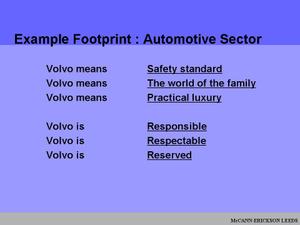
    That’s not always the case though. Big companies can be too amorphous, or even too dull. This is where you can not only create something new, you can begin to create a vision they can unite around too. I find it useful to define three things the company does at it’s best – in the mind of the consumer. They need to be true, but the trick is marry the product truth with people’s lives. Once you have them, these three things will naturally result on three disctinct personality traits – that’s the beginning of your tone of voice. Three is useful because anything more is just a list, and anything less is too one or two dimensional.

    Like this:
    Volvo

    Hope this is useful. It’s only a start. There’s a lot of far more interesting stuff on this subject out there, but you have to start with some basics.

    You’ll notice I’ve thieved Mcann’s brand footprint. There’s no other reason except it’s easy to use and very helpful when you’re working on integrated stuff. Other people will have favourites. And don’t forget, it’s not the framework, it’s the thinking.

    And, in the remote chance you missed it, Russell’s Schtik is fundamentally useful as well – and a far better description of the use of tone and manner than I could ever hope to deliver.

    (I’m rushed, the spelling and grammar will be even worse than usual, sorry ’bout that)

  • Firstly, please help the Dead Artist and endevour to raise the value of the The Mountain Rescue Painting by linking to him.

    Secondly, it’s a bit busy Up North, but there will be more recipes and planning basics shortly.

    By the way, I came accross this in the Guardian – unconventional household tips. Might come in handy for something or other.

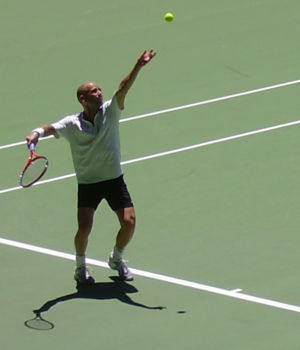
  • A voice from the afterlife made me think about the drawbacks of youth very recently. Which brings me to another hero to go with Rutherford and Matt Biondi. It’s Andre Agassi, but not necessarily for reasons you may expect.

    I played team tennis as a teenager – nothing special, just good enough to enjoy playing. But I hated my club for reasons that probably handcuff the British game to it’s present day. Namely, you must wear white, children are to be seen and not heard and. most damning of all, it’s not about the game, it’s about meeting people and being social. I do think that sport is a great way to make friends, but in the end, people who love their sport just want to play.

    Now imagine what an impact Agassi would have on headstrong fourteen year old faced with all that. The rebel with that hair, awful clothes and loud mouthed, crass objections to any authority at all. Brilliant. Not to mention scintillating tennis. Problem was he never won anything.

    Airtechchallengeretro2

    French Open final twice, US Open final once, he kept on losing at the final hurdle. Redemption came at Wimbledon in 1992 when he beat Goran Ivanesivic in 5 sets. True redemption would come later, but this moment was pivotal in proving to the world, and himself that he wasn’t a choker.

    They’d played four hard sets, Goran had blown him away in the last one and everyone thought he was about to choke again. Except for the man himself. He talked afterwords about feeling it was different this time, being able to tap into his ability, overflowing with it. He could feel his own strength, he knew what he could do and what it was for. Suddenly he wasn’t afriad anymore.

    The best server in the game kept thundering these bombs down, powerful enough to obliterate the hated Serbian army. Agassi kept with him and then pounced. Goran had no answer and that was when Agassi became a man. All the ‘image is everything’ stuff was pushed to one side, he had gone right out to the edges and found he could not only live there, he could push further. He started to grow up.

    We all go through callow youth, thinking we can take on the world, knowing without a doubt that experience is nothing, we need to turn things upside down. Then comes the slow realisation that we’re only at the beginning, there’s so much we need to learn. It’s quite a shock to realise you’re not infallible, but in the end that only makes you stronger.

    Agassi went on to win all the big tournaments, but even better, he grew old gracefully, with dignity and became the game’s best loved player. He was still exciting, but working with Brad Gilbert in later years, and simply growing up, made him one of the most mature, human and kind people in sport. Agassi_2

    Now a happy husband and father, he enjoyed his last years as a much loved veteran. He learned that you can overcome lengthening years with ferociously hard work, dedication and pure experience.

    Few would have thought that loud mouthed lout would have become such a role model for all. For me that was his real victory. Maybe it’s something the young cannot be taught, maybe you have to learn the hard way. But Agassi showed that the true beginning of knowledge is understanding how little you know.

    He is also a famous, successful bald man – so double points for that.

  • Dead 

    Everyone I need your help. I’m helping out on a charity do for ChildLine this Autumn – it’s for kids, it matters – and part of of that will be an auction.

    By ghostly chance, The Dead Artist seems to have started some rather good paintings in a past life. Since the theme of the do is Pirates, this one seems especially appropriate.

    Img_0840

    I thought I’d ask him if he’d like to donate it, but it’s not easy to get in touch with the dead. The only way around this is to post, since he seems to haunt one or two blogs. Maybe if everyone concentrates hard enough, he’ll get the message through the ether or something. Hopefully there won’t be some sort of Faustian pact involved (and corporeality doesn’t preclude being able to hold a brush). You never know with apparitions……

  • Just to confirm, it’s in Arts Cafe in Leeds, this Thursday 7.30pm. That isn’t to say we won’t move on to somewhere else, but it seems to be down to me and I’m too lazy to think of anywhere else. Hope to see you there.

    I’ll be loitering around WH Smiths in Leeds train station at 7.20ish if anyone’s unsure of how to find it.

  • Lauren pointed out, and rightly so, that there are vegetarians out there. So number three in the recipe list is mushroom risotto.

    Comfort food doesn’t have to take hours to prepare. This is a culinary hug in less than 30 minutes. Summery too. Great outside with a glass of something cool and dry. This a filling, addictive meal. Mushrooms are packed with ‘unami’ the elusive flavour that adds incredible depth and flavour to stuff. Parmesan has it too (it’s those littlem grainy bits). Wonderful

    You will need:

    A litre of vegatable stock  – it’s fine from cubes but try organic ones.

    Big chunk of butter

    olive oil

    1 onion, finely chopped

    200g sliced mushrooms- open cup is best

    300g rice. Purists will say arborio, long grain is fine

    Wine glass of white wine or white vermouth

    125g grated parmesan

    2 teaspoons dried tarragon, or 2 handfuls fresh

    A big handful of frozen peas

    Bring the stock to a gentle simmer. In a pan, melt half the butter with 1 tblsp of olive oil. Add the garlic and onion and fry over a low heat for 3 minutes. Add the mushroom and cook for three more.

    Add the rice and stir well, coating each grain with the oil. Pour in the wine and simmer gently until it’s absorbed.

    Add enough stock to just cover the rice and simmer gently until the stock is absorbed.

    Continue stirring and adding the hot stock, waiting until until each batch is absorbed before adding the next. It’s done when all the stock is absorbed and the rice is tender. If you run out of stock before before the rice is cooked, it doesn’t take 2 minutes to make more from a cube – or just continue with boiling water instead.

    Now be quick – add the parmesan, herbs, frozen peas and quickly stir in. Turn the heat off and put a lid on the pan. It will all go outrageously creamy.

    While you waiting, you could chop up a fresh salad to go with it – or toast some pittas that are great stuffed with risotto.

    This meal just begs to be accompanied by really dry white wine. As you play with this one, you may prefer chives to tarragon, or even parsley. Works well throwing in mange toute or sugarsnap peas, or even asparagus instead of peas (or as well).

    Washing up is a doddle – two pans and a chopping board.

  • The last Northern Planning get together in Manchester was so good we needed an extra month to recover. So after the April blip we’re re-entering the fray this Thursday.100_1738

    We know it’s in Leeds, we know we’re meeting at 7.30pm. We’re in the midst of deciding where , but there may well be a guerilla gardening excursion. All welcome, planners, instalation artists, whatever. Maybe we could get someone to do some guerilla art. Be nice to see you.