• My Mum died 14 months ago very suddenly. I remember the moment I found out vividly.

    I was driving to the tip to get rid of some accumulated crap and, just as turned off the main road onto the trading estate it was situated in, my sister called to let me know. 

    It was like a kick in the heart.

    Then I calmly finished the journey, unloaded the rubbish and drove home. 

    From that moment until last week I never understood why I never felt as much as I thought I was supposed to feel. I got though the planning for the funeral, the day itself, the aftermath, the pain of untangling my life with my ex-wife that was happening at the same time, without any out-pouring of much emotion.

    What on earth was wrong with me? I wasn't prepared to try and feel how others maybe thought I should, but it was weird. People who know me understand I'm not afraid to show my feelings, I'm lucky to have friends, who share, who talk.

    Not a thing.

    Then a few weeks ago, my nephew had his first child and a picture of my Dad, with the tiny bundle of joy, without my mother, made me feel something different.

    For a week I didn't know why, then I realised the absence of my Mum in that picture had finally hit home, because it made me think of my time with her as a little boy.

    Then, like some mental pinyatta split open, visceral memories tumbled out. 

    My way of dealing with the death of my mother was to block out all those wonderful memories. 

    How we used to cuddle on the sofa watching finger bobs after playgroup.

    Her teaching me know to make lasagne.

    The way her curly hair felt on my cheek when we hugged. 

    Her over competitive spirit playing cards.

    Her kindness yet frustrating lack of filter. 

    So many memories forcing their way out.

    She was so worried about me being alone.

    I wished she could have met the new person in my life.

    Seen my son transitioning into a teenager.

    I wish I could have shared the pride and terror of my younger daughter becoming a young women.

    Retaining her innocence and joy, yet sharp as a razor. 

    Finally I am grieving for her properly. Honouring her memory by remembering her. 

    Pain is a part of being alive.

    Death is a part of being alive.

    Avoidance of pain is dumb.

    I miss you Mum. 

  • I discussed here the challenges with simply following best practise and precision, beginning to suggest you might do better to focus on being a brand people actually existed. 

    I must be clear and honest here, I'm not dismissing the splendid insight we have from years of data. Certainly, I wouldn't tell you to ignore Byron Sharpe. As with most things, you really must become familiar with the rules before you break them. 

    Advertising is famously unpredictable, so the luxury of some level of certainty is welcome one. 

    But that's the kind of strategy that can be, and increasingly is, done in house. Best practise is there to help you not do anything stupid. In fact, that's not real strategy, the point of which is reaching goals in the most efficient way, hacking the system.

    No, that's not good enough.

    In a world where people are savvier, harder to reach and numb to the overload of EVERYTHING, let alone marketing, we need to create stuff that connects. Indifference is the real enemy.

    Markets have never been more competitive, it's naive to imagine many companies can just sit back and wait for long-term, brand  building effects.

    Markets and culture just move too fast, we need to work with its pace, not against it. 

    However, they need not endure the hand to mouth treadmill of short-term tactics that never really break through. 

    That's why I think it's our obligation to create stuff people actually wish existed.

    That doesn't 'disrupt' or make them think hard. No one has the time. 

    Do the short term well and the long term will take care of itself.

    By working with the pace and direction of real life.

    Creating ideas that stand out, yet feel instantly familiar.

    That make you react and actually want to buy something, yet remain in your heart for a lot longer. 

    That cut through the landfill of pointless, pre-tested crap because they make you feel something.

    That you want to have in your life, because they feel part of it.

    Yes, build distinctive assets – in other words, consistent look and feel that doesn't constrict ideas.

    Yes, build the brand over time – in other words, have a point of view on the world, have a story that every piece of activity builds towards. 

    Yes, reach the whole market – in other words, whatever money you have make it go further by making stuff people want to share.

    Yes, be make people feel stuff and be creative, but creativity to impress your audience, not awards judges. What they enjoy tends to be vastly different. 

    The fact I'm going to share some rules of thumb is risky, you don't want to make advertising (it use that word in the broadest sense) that looks like advertising. 

    But here goes..

    First COLLIDE things together. Most ideas are re-combinations of things that don't obviously go together, the trick is making them fit. 

    A pure example is the Cadbury Gorilla. Ignore the case studies that try and make it look it was about Joy. It was an ad that made no sense – a gorilla drumming and chocolate don't go together. This also shows why you need a real point of view or story – they never pulled it off again because really it was just a stunt. 

    Whereas Snoop Dog and Klarna worked well, because the whole thing was about smooth transactions. Yes it's celeb endorsement, but it's a wrong fit made right. 


    Then there is AGITATION. Tap into an issue in the lives of your audience, just make sure you have a credible reason to do it, that you have the right. 

    This example where a supermarket removed foreign goods to show the dumbness of rampant nationalism is just great


    Love or hate Brewdog, you can't deny they have a voice, something close to anti-establishment. 


    Of course, it's not right for all, some brands want to be felt more reliable and negativity can backfire.

    A safer option is simply 'closeness'. Show a deeper understanding of what's really going in in the daily lives of your audience, involve them, celebrate them, make it a shared story – get into the REAL emotional truth of what you're selling.

    I'd love a UK supermarket in the cost of living crisis to go beyond PR and really expose the courage, bravery and kindness with which so many get through scary times right now. Like this plumber who will only charge what people could afford. 

    Imagine if ASDA had gone beyond paying top dollar for this Elf Xmas ad, which I imagine will have cut through, and built greater resonance sending out real 'elves' to reward people making something good happen this Christmas. 

    Or shooting the Elf out there in the real world with real struggling people. 

    Anyway. I have always loved the replay campaign where Gatorade connected with over 30 year old athletes by settling old scores (every one wished they had second chance)


    This is one of the best shopper activations ever – simply built on the fact we all love the sound of our own names – and probably some data about the need to remind lapsed users they love Coke .

    Spotify Wrapped shows us our own data and taps into the tension between respective musical tastes and the slight fear of people knowing what you really listen to. 

    798487E0-59D6-4E91-8E1F-11C9FCFA1571

    I hate that Spotify recommends me Queen because I listen to Under Pressure sometimes but there you go.

    Of course, there is pure creativity and magic. However, entertaining people was much easier when, in the UK at least, there was one commercial TV channel, no internet and shops were shut on Sunday. There is too much entertainment for us to consume nowadays. 

    So instead, you can build short-term value and long term memory if you create things people wish existed in their lives because they're relevant.

    They share a brand point of view, they are relevant to what is holding the brand back today.

    While building the brand for tomorrow.

    Because they work with the pace and direction of life.

    They add to it, not interrupting. 

    They stand out from all the dross because they touch something deeper.

    Make you feel something so you buy something today and want to tomorrow. 

    It doesn't take masses of budget, just masses of thought and enthusiasm for people, not 'segments'.

    So yes, best practice is fine, but if you can do more why on earth wouldn't you? 


  • I'm sure you're familiar with the phrase 'give man a hammer and all he'll see is nails'. I think it was Mark Twain. 

    So this data should be approached with caution. The claim is that if 80% of brands disappeared at night, no one would care. 

    The authors have an agenda to promote 'meaningful' brands (whatever that is supposed to mean). 

    Of course, Bryon Sharpe would say light buyers don't care about brands, just make sure you're easy to buy.

    But, come on, it makes sense if you think of your own life surely.  We're making too much stuff. No person has the bandwidth to be bothered with it all.

    Too much good entertainment, endless stuff on the Netflix list that never gets watched.

    To much choice on the grocery store shelf.

    Too much stuff from each other on social media.

    So that 80% figure makes perfect sense. You'd think people promoting brands would be upping their game to win attention and be one of the 20% wouldn't you?

    Sadly not.

    On TGI, people who say the ads are better than the programs goes down every year.

    This same survey suggest most of us think brand content is poor and irrelevant. 

    Coming back to hammers, nails and agendas, that's why the IPA agenda on long and short term is so unhelpful – it fails to consider if any of the output is actually any good. 

    You could wring your hands and just say to yourself, ah well, the data says I just need to spend loads of money reaching people and building 'distinctive brand assets'. But not only is that a bit defeatist, when it's getting harder to reach people, even if you HAVE a big budget, surely it makes more sense to actually create content people actually wish existed.

    How do you do that? It starts with ideas over precision but there's a lot more to it than that – but that's for another day.

  • I was ten when Purple Rain came out, so it's fairly natural I've always loved Prince. Prince
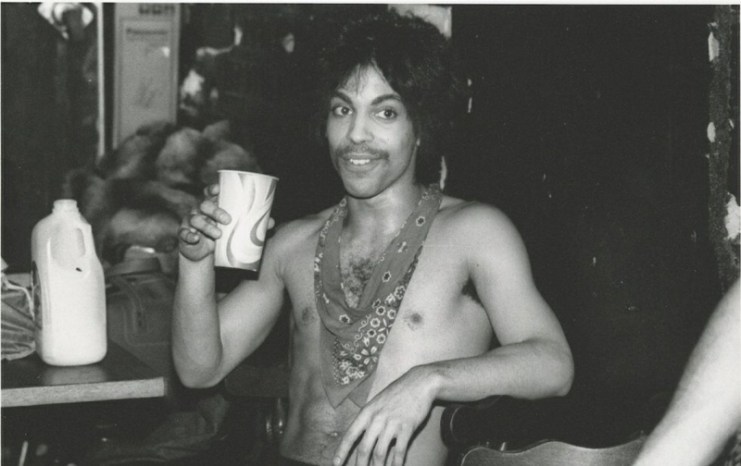
    Between 1983 and '88 he created a body of work that was unlike anything that had come before, bursting with new ideas. However, that was only around 10% of his total output – it's just that we got to hear the very best. In fact, some was years old, honed, refined and in some cases, just ready for its time. 

    Ideas just poured out of him, he never stopped making music, it's just that his strike rate of greatness as opposed to OK, or even simply forgettable was around one in ten. 

    There's a lesson there for all of us when it comes to great ideas. They don't come from sudden flashes of brilliance, it's constant hard work, relentless improvement and the acceptance you have go through guff to get to great. 

    This matters to strategy and planning types, especially in a world of in-housing and the way basically everybody thinks they can your job. 

    Yes, logic and evidence are essential – otherwise you're just a bundle of opinions. However anyone can follow a process and spend lots of time and money justifying the obvious (it's how consultancies make profit yes?). Our work requires a leap of imagination, a new way of looking something…..an idea. It's creative act those without the right kind of brain or years of learning their craft, or the right attitude, simply can't do. What divides a real planner from those that just carry the title is the ability to have ideas. Not just follow a process.

    'A previously unsuspected connection between concepts that leads to non-obvious consequences' – Josh Bernoff.

    That's the opportunity in strategy world spending too much recourse overcomplicating the obvious. 

    It's obvious to say that lots of men like football. It's less obvious to say that without football, many people would be insufferable to the people around them. 

    Ideas are not limited to strategy, creative, tactics or whatever though.

    A company is actually an idea, not a real thing. An intangible thing bringing together people. things and thoughts.

    Money is an idea, is doesn't exist, it represents a shared value of what something is worth.

    A nation state is an idea, an arbitrary border and shares culture, systems and traditions.

    Very few things are concrete, we all swim in a sea of ideas everyday.

    They are not some flouncy luxury, they are fundamental. 

    So it doesn't help having things like concepts, thought starters, territories- they are all over complex names for ideas.

    When it comes to strategy, there are really three species of idea: 

    Why Ideas

    How Ideas

    What Ideas


    Why ideas are leaps that electrify what the opportunity is, what the real problem is. I tend to think this is most important, now only does great strategy get to the crux of an issue, great problems unleash creativity. They frame a challenge in a way that also an opportunity. They show what a business problem looks like in the real world. Strategy is about change in the real world, Why ideas illuminates what that change could be. 

    Make the reliability of Honda Desirable instead of dull.

    The problem isn't what Skoda buyers think, it's the people around them. 

    The beauty industry should make women feel great, but instead it makes them feel inadequate


    How Ideas clearly solve the problem – closest to a classic 'proposition' or simple task that, if executed properly, they will unlock gold. 

    Polaroid is social lubrication

    Make Lurpak the Champion of good food

    With ghd, beauty can be made, not born

    The Times is history's first draft

    Make beards uncool (for a shaving brand)

    Make Axe part of the morning routine

    Kindness is a strength not weakness (for a natural deodorant)


    What Ideas are more around tactics and execution. Some would tell you to stay away from these, I say let them pour out of you and challenge others to so better. So many ideas these days need to be around media or PR, they are not the sole remit of a 'creative'. 

    Ad funded documentary of real Christmas moments

    One off TV ad celebrating Commonwealth Games supporters

    Use programatic digital to weave Ikea products into the moments they matter the most

    What if we got Snoop Dog to change his name for Smooth Dog for Klarna?

    Staff as Stars


    Getting involved in 'what' is essential, just as IDEAS about how and why are so important. The data fluctuates, but the IPA data bank shows that great creative ideas boost payback by a factor of, as much as, 11. Econometrics from a media group (can't share who) show that innovation destroys 'precision' when it comes to ROI. 

    That said, don't let creative types tell you that an execution by itself is an idea, be that a line, a visual or even a 60 second film. Sadly,  they many just have tactics, or something that just looks or sounds nice.

    There are few lines like 'Just Do It' that just transcend. 

    This Cadbury Gorilla was really a big fat stunt that worked to drive impulse. The case study will try and tell you it's about conveying 'joy' – but in truth, it's a one trick pony delivering the element of surprise. When they try to do more 'joy' ads, they mostly failed, because the idea wasn't really about that.

    In a creative review, sometimes the best thing you can do is ask 'what is the idea in a sentence'? You'd be amazed how many times they don't kn0w.


    When it comes to your ideas, like Prince, there isn't a flash of insight, I'm afraid it's all hard work.

    James Dyson didn't invent the bagless vacuum, he worked harder than everyone else to get it to market.

    A sculpture is the removal of rock to reveal the beauty inside. 

    In other words, make a start, get something down, then continually improve it.

    Great ideas do not appear, they emerge. 

    Ideas are re-combinations of what is already out there.

    So fill your brain with as much raw material as you can.

    Read more non-marketing books.

    Don't just sit there waiting for inspiration that won't come.

    When it comes to a project, read stuff that isn't totally about the product or service – but has a tenuous link.  If you're selling coffee, read about commuting, the original coffee salons, how people get together socially these days (let's go for coffee), which leads to stuff about shyness, public speaking, making time for non-screen stuff, the new rhythms of hybrid work, for example. 

    It also means injecting newness into your process. Get a change of scenery, take purposeful breaks, do the process in a different way, talk to a stranger.

    As long as you've done lots of hard work already, this is where a lightbulb moment actually happens, Stimulating change in the brain and letting the subconscious work while you do something else creates moments of revelation – but not without those first hard yards. 

    Most importantly, find your flow. Diarise time without distractions – phone, email, Slack, Teams -wrench free from the web of brain fog -  focus.

    Now, of course, it's also your job to help others have ideas.

    To be even clearer, I think it's your job to help EVERYONE have a voice. The more experienced people are, the more their ego and fear of losing authority, mean they won't listen to other thoughts, they are more slavish to the process and in general, ideas get less input.

    They feel they have they have more to lose by being open. 

    It's the challenge in creative reviews where the CD's word is law.

    Yet Pixar has daily crit sessions. Their best films are the result of a tortuous process of incremental gains – their films are a result of continuous improvement and collaboration. It doesn't sound very romantic, yet it's what works.

    Coming back to Prince, he needed editors – his worse output came when he didn't have a recording contract and put out what the hell he liked.

    So, with your own work, forget your ego and talk to as many people as you can about your thinking. Try and get to a First Pass and invite the world and his wife to crit it. Think of every interaction as a chisel getting to the sculpture within.

    Listen to what others say, spot the idea in it. 

    We all know workshops are trojan horses for bad ideas mostly. However, you should embrace them as ways to blunt the auth0rity of senior people and bring in new thinking. Just don't look for NEW ideas, look for input on thinking already in play – including your own. 

    If you really need to do an ideas workshop though- make it so concepts and unrelated areas collide. A quick foolproof agenda:

    Lay out the task

    Clear out the closet – flush out first ideas

    Do a brain game to get the subconscious going

    More ideas

    What would your target audience do – a day quick day in the life and then GO!

    Opposites – what is the very opposite of what everyone else is doing?

    Wrongness – what is the wrong thing to do, how do you make it right?

    Objects – what's the connection between, say, some animals – what ideas come?

    Simple.


    So yes, ideas. Your lifeblood, not logic.

    Be more Energizer Bunny, it's actually about quantity before quality.

    Don't be an island, get as much input as you can.

    Challenge experience and authority – bigger egos lead to worse ideas.

    Be fast, be prolific, embrace imperfection and wrongness – you want others trying to slow you down, not the other way around.

    In other words, be a radiator, not a drain. 
     

  • Client services is a tough job. Never ending in-tray, no one doing what you need on time, being at the sharp end of client moans. I did it for a bit and failed, so, well, respect.

    Having seen both sides, the most successful client services folk are great planners in their own right, especially today, where clients can take things in house. What they really buy into is impartial advice about their business,

    Being More Strategic

    Strategy isn’t something only people with planning or strategy in their job title do. We can, and do, strategy every day because it’s simply:

    Achieving your goals with minimal effort

    My strategy to get to the office in Manchester, from Leeds is to save parking/train money and traffic rage by driving most of the way and cycling some of the way

    My daughter’s strategy to get around me is to be perpetually cute

    You’ll find that impact with clients comes from the advice you give, how you can help them reach THEIR goals with minimum effort

    Client services are well placed to do this, because with the closest relationship, you can continually talk to them about their goals and the headaches they must reach them

    On a business level

    And a personal level

    It simplifies every client conversation to always frame it around what we’re trying to achieve and what will it make it easier to get there

    It cuts through politics

    Subjective opinion

    Busy people with too much on their minds

    It’s always that simple – what do we need to achieve? How do we get there with the least effort?

    Don’t let your strategy team overcomplicate it, push for brutal simplicity of thought

    Which brings me to how you can better partner with the strategy folks

    Working with The Strategy Team

    The goal of the strategy people is brutal simplicity of thought. Cutting through all the clutter to find the simplest and easiest way for clients to reach their commercial goals.

    We want to be able to cut through the crap to what really matters and, as we tend to be short of time, needing to do it fast!!!

    We also tend to be a little shy and sometimes find it hard to say what we really want, especially in busy meetings with lots of people with the gift of the gab.

    That can mean we struggle with client and internal meetings sometimes.

    Finally, we’re not a factory. We don’t want to ‘churn out’ strategy. We want to be your partner with the client relationship – give them the EVIDENCE BASED RECOMMENDATIONS they need to use marketing and creativity to reach their commercial goals

    So how can you help?

    1. Involves us in the client relationship. Let us attend meetings more, not just the ‘strategy ones’ the more we get a feel for clients, the more we can really help
    2. But you’ll always have a better understanding of their world and what matters to them – don’t just talk to us about their business needs, talk to us about their relationships in the business, what pushes their buttons, what keeps them awake at night. Like any target audience, the more we know about what makes them tick, the more we can develop recommendations they are likely to buy into
    3. Deal us in. Make sure in any meeting we have a clear role and space in the agenda for that role. Look for us struggling to get a word in and help us get into the conversation
    4. Involve us early. Most of the real strategic work is defining the issue. The worst thing you can do is give us a brief the client has signed off, that we can’t talk with them about. Involve us as soon as possible, let the client talk us through the brief, give us the chance to ask questions. Client briefs are always too long, and they rarely get to the heart of what is really needed. Too often, the first presentation is when the client tells us the REAL brief
    5. If can’t involve us, put the effort into briefing us. Especially how our work will be judged, who is judging it and what you are expecting. Make sure EVERYONE who will approve our work is involved in briefing it where you can. We want to get it right first time
    6. Be brutal. Great strategy is about simplicity – be hard on yourself, ask yourself what is relevant, keep conversations about THE GOAL and THE EASIEST WAY to get there. Be brutal about what is a medical job v a strategy job. Be brutal with us, ask us WHAT IS THE GOAL what is the EASIEST WAY TO GET there. If we can’t answer simply, we haven’t done our job
    7. But overload us with information and reference- at our best, we spot things and make connections others do not. Give us EVERYTHING you have to read in our own time. Just don’t talk us through it all!!!
    8. Be kind. Sometimes we need to talk through things to figure it out as we go. Every good planner has a trusted confidante they can chat to as they work things out. This is important, we love AND hate the start of project when we don’t have the answer, it takes time to work it out and chatting it through really helps
    9. Be concise. We do what we can to keep our work simple. In return, we need feedback clear and concise. Where you can, don’t let people feedback in comments, make them join a meeting to talk it through – comments are often contradictory and confusing. It’s ALWAYS quicker to chat, conclude and move on
    10. Judge our thinking before our formatting or spelling. It saves time if we share early thinking, it also means we can collaborate better if we share a work in progress. That means you need to not judge how it looks, or typos etc. Let us talk through where we’re going, and you feedback on that. It will save time and make our recommendations better. We can make it client friendly later, first it needs to be good
    11. Keep us involved. It’s common to get us to write briefs, but then just attend the odd creative review or development meeting. We like seeing good work happen. We also have a skill to not talk about creative work being good, but how it is working. It saves time in the long run to keep in the development process, the work isn’t just right, it works
    12. Make time. Creative reviews and such are CRITICAL. It’s very common for creative reviews to be quick and not allow time for feedback. We need time in these sessions to talk through the work. Please respect our role in the process – quite rightly, our briefs are scrutinised to be watertight, so the work that comes out should be given the same respect.
  • While our jobs have a measure of uncertainty, we tend to have decent notice periods to cushion unexpected blows

    Or give employers time to replace us if we quit

    It should go without saying that if you have resigned, you should try leave on as good terms as you can

    It's not always easy, believe me I know, yet you should try – it's a small industry and word gets around

    Yet there are still two ways people go when they resign

    Both linked to being unshackled from the fear of getting fired or at least not progressing

    There are the ones that, at best check out or, at worse, become objectionable and burn  bridges

    Then there are the ones who carry on with their responsibilities, now longer held back

    Held back from hierarchy

    'How we do things around here'

    Fear of rejection

    Making their face fit

    That will never work

    Staying in your lane

    But this isn't our process

    Or even just routine

    The good ones who can't help but care about the work and the people around them

    Who retain respect and the general approach of being a good egg

    Suddenly come to life 

    With renewed energy

    Idea pouring out of them

    Challenging those around them, making them think and re-appraise

    Getting more done, creating more change in their last weeks or months, than the last couple of years

    Which begs the question

    What it is about how agencies operate, that means many only  feel free to do their best work once they are leaving?

    When they claim to encourage critical thinking, original thinking and interesting people

    What can we all do so everyone can work like they've just quit?

  • Too much of anything isn't really that good for you.

    Even water is toxic if you drink too much.

    As introvert, I've often found myself defending the quiet ones in work. 

    The ones who need time to think. 

    Who feel exhausted by too small talk and need to retreat after too much time in big groups.

    They add value because they don't fall in love with their first idea.

    They try harder because they can't rely on charisma to persuade.

    (Actually that's not totally true, many totally fill a room, you just don't to see the struggles before and after).

    But thank god for the introverts, we need them too.

    They buy introverts time to think.

    Without them, meetings would be full of uncomfortable silences.

    Great work would be harder, because no one stuck their neck out to give everyone something to build in.

    (Because most great work comes from iteration, not insight).

    They keep flagging projects energised.

    So here's to the loudmouths.

    Just open your ears from time to time please. 

  • When I was little I played tennis,  always watching the best players, trying to copy their styles. 

    When I was starting out as a planner, I had slightly less of a clue what I was doing than I do now.

    So I was grateful for bloggers who would share how they worked and I'd copy their  approach. 

    (word of warning, in today's world of LinkedIn and Twitter, quality isn't quantity)

    You know what? In both cases it kind of worked.

    My serve was better when I tried to do it like Boris Becker.

    My fledgling strategy was better when I tried to copy some APG paper or example brief someone shared. 

    My first stumbling presentations were less catastrophic when I copied the structure of a TED talk, or the style of the speaker. 

    In other words, if you have no experience or craft skills, copy those who have, while you develop some.

    I always liked the story of an actor who played Roger Bannister, the first person to break the 4 minute mile barrier (running obviously). He was a below average runner, yet when he adopted Bannister's style, he actually ran faster. Not because the technique was any smoother, it's just his brain thought it was faster, so the body followed.

    The placebo effect is everywhere, way beyond medicine, and copying those you want to emulate, tricks your mind into going beyond what it thinks it can do. 

    So if you're starting out, or even if you've been doing the job a while and can't crack a problem, or don't know where to start, it doesn't hurt to read a case study you admire and copy what they did, or adopt some approaches someone has shared on a APG talk. Get some examples of briefs or plans and steal. 

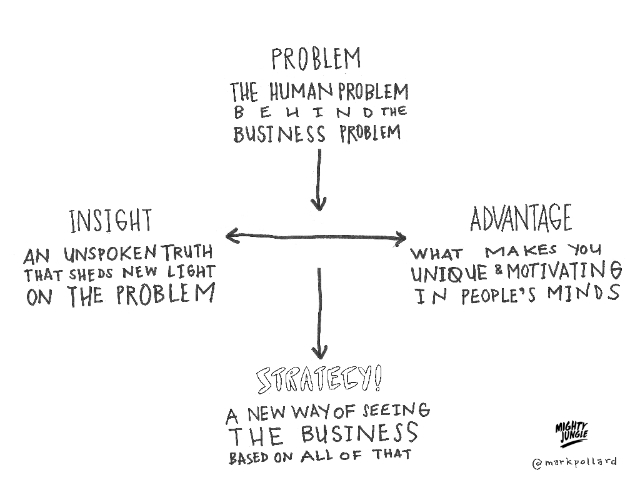
    I like Mark Pollard's framework for example. 

    Strategy-framework-mark-pollard (1)

    He's very generous sharing all sorts of hooks to hang your thinking on, with lots of examples. There are others, it doesn't matter which one, just try and do it like someone you think is good, until you find your own voice.

    Obviously, these approaches will help you START. Once you're away, make the work your own, but it's a great short-cut to actually beginning and that's usually the hardest part.

    Just don't forget the framework or style isn't the point, it's just a hack to get somewhere good. 

    Controversially, I think therefore, it's OK to fetishise creative brief templates. They don't make thinking better, apart from forcing compression, but if the author believes they do, who cares?

  • I haven't posted much around here for a while, let's be honest.

    Mostly because, like with so much else in life, once you lose momentum, it's very hard to regain it. 

    Then again, the trick so writing and posting stuff is to just start and not overthink it.

    It's the same for me with writing a creative brief. Of course you ACTUALLY need a strategy first, many forget this (seriously). 

    But then the only way I know is to start writing something bad, then figure out how to make it good.

    Anyway, there is one thing I thought about while I was away, which is why the break did me good.

    It's the need for more breaks, for it to actually be okay to do nothing much.

    If you're job is somewhat creative, there's a subtle new pressure to bleed for it.

    Meanwhile, every aspect of life is about self improvement.

    Meditate first thing, then do some HIIT training. Change your habits in 66 days.

    Never just BE, you always have to do.

    Yet psychologists have long known the subconscious works wonders when you're having down time.

    If you want to have great thoughts, try not having any for a while.

    What's more, despite what bubbles on Instagram and Twitter may suggest, real people don't live like this. 

    They may do more yoga and log into Headspace, they may be cutting out more meat.

    But they still trudge through jobs they don't love that much (more virtually) and relax on an evening with some telly.

    They're busy worrying about fuel bills and making ends meet.

    I do wonder, in advertising at least (yes I think we should still call it that), we should try to live less like shaman and more like normal human beings. 

    Because the very best work immediately connects, no matter how great the creative work is or isn't. 

    Real life has never had more drama, fear, hope everyday grace and heroism.

    So live it, rather than bothering with the latest debate on LinkedIn about the Metaverse. 

    It's hard to listen while you preach.

    So I  don't think it's right that a famous agency in London makes a song and dance of going 'on safari' to see muggles in real life.

    Just get the bus now and again. Switch your phone off and just soak up real life.

    And LIVE real life. Take breaks, do stuff that doesn't matter. 

    What some telly that you don't have to think too hard about.

    Eat a bag of chips. 

    Just sit and do nothing.

    In an industry that insists on DO, take some time to BE. 


  • My sister is an amazing cook. She can turn any mixture of ingredients into a great meal, she just has that knack.

    Just as in the wrong hands, the most expensive steak in the world can be inedible.

    Just as the finest red wine in the world is wasted in a plastic cup.

    Execution and treatment are everything.

    Basic ingredients can become things of wonder.

    The most wonderful raw material can be destroyed without the experience, car and attention to treat them properly. 

    I really love this track. Much of it has to do with the context of the final scene of Sex Education where I first heard it.


    Some of it is to do with the fact I was going through one of two things at that time.

    But mostly, it's because the song has the rare power of a deceptive cadence that builds without you realising it, the song is quiet and dreamy and it's only when it ends that you realise that. 

    Put another way, the execution – the quiet whispery voice, the gentle strings and couple of deft changes of pace really work for me.

    After, I discovered this version. I guess it's the original.


    Totally different and I can't stand it. Same song, same lyrics, yet one (to me at least) is amazing and the other is meh. 

    Which goes a long way to reinforce the point that you really don't have a good creative idea until you start to execute it. 

    So it delivers more than a message, or builds on a so called insight.

    It connects. 

    Just as Sex Education, the truly excellent Netflix show is about much more than the shock value of lots of sex in high school, it's about the confusion of being young (and being old), the thin line between friendship and love, love and lust and tension between being who people expect and who you really are – even though you're still working out who that actually is. 

    Here are two ads broadly based on the same message – our cars are reliable.


    The first, the classic VW ad isn't just about reliability, it's designed to resonate with something specific about the culture of the UK in the 80s. Roughly something to do with female independence, while still connecting with the materialistic aspirations of the time. It's also a story. 

    The second, less recent, but still a classic Honda, is pure theatre and showmanship.

    Both got people talking and generated talk value, with loads of free PR. In very different ways.

    Both could have started with same brief – make the car's reliability desirable rather than dull.

    The trick is in the execution.

    One taps into culture. One tries to create an event.

    Just as both these are about dramatising feeling great about saving money.


    The first (in my opinion) rewards the viewer, builds theatre and has deft little executional fairy dust (like the Skeletor laugh at the end).

    The second is devoid of any flare whatsoever, sorry. It even proves that even a great track can't save a bad ad.

    But the same track can transform a good one into a great one…


    Our industry still spends millions pre-testing propositions, messages positionings and other abstract concepts that matter far less to the success of marketing communications than the texture of the stuff that actually get's made. Of course, precision in solving the right problems helps, as does delivering the appropriate message, but when you're really competing against Netflix, YouTube, Tick Tock or someone's favourite soap opera, the message is the easiest part.