One of the most hallowed pieces of recieved wisdom in brand thinking is the iron rule of differentiation.
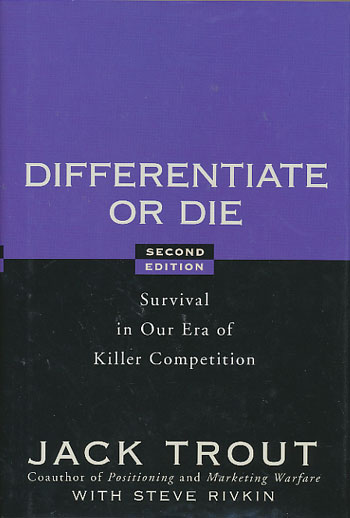
Nearly every marketing textbook tells is that brands need to differentiate or die. Kotler, Riess and Trout, they're all at it.
So it's surprising then, that most brand communication in any category looks and feels exactly the same. Then again, when one takes into account the influence of snake oil salesmen, also known as brand consultants, it's a foregone conclusion.
They get paid thousands, sometimes hundreds of thousands, to come up with a 'differentiated' brand – a new 'position', 'proposition', 'essence' or promise, plus the squillion other boxes in their brand pyramids, onions, wheels and God knows what other wierd and wonderful shapes.
Basically, they come up with a new 'strapline', mess around with colours and create constricting rules and guidelines over tone of voice, values and stuff that squeeze out any chance of a good idea for the poor bastards that have to execute any brand communication.
The only 'differentiation' is a strapline that, in the real world, normal human beings don't care about that much, with some sort if tiny variation in 'positioning' and product benefit, that escapes everyone apart from deluded marketing departments that have signed all this stuff off.
Worse, it gives them the comfort of 'being different' within the category, while actually perpetuating the creation of 'risk free' brand assetts- packaging, websites, Facebook pages, ads, POS etc - that look and feel just like everybody else. Expensive clones with beautifully pointless little phrases no one really pays any attention to.
In their heads, their brands are different, but in the hearts and minds of customers, they're all the same, when attention is actually the only battleground that matters, which we'll come to in a minute.
But what about 'Just Do It'? you ask. What about 'Vorsprung Durch Technique'? What about 'The Future's Bright? You have a point, but that point isn't about 'differenentiation' it's about distinctiveness. Which makes the battle for differentiation an even more evil crime against marketing- customers don't really care.
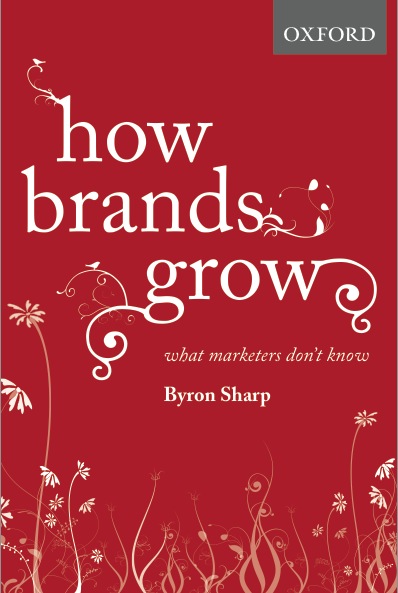
Once again, I return to Byron Sharp's 'How Brands Grow' (with reams of data to prove it) to find that while differentiation does exist in mind customers, it's weak and, amazingly doesn't vary that much between different brands (a minority of Coke buyers think it's different in the same way that a minority of Pepsi buyers think Pepsi is different)
Even worse (and a poke in the eye for most brand tracking) if you ask the same sample, rather than the all too common, new sample, the same questions about a brand three months later, they're likely to say something different. Because they neither care, nor think about brands very much. Certainly not enough to pick up the subtlety of a strapline or a different Pantone version of red.
So then, differentiation doesn't actually matter all that much anyway to customers. It is marketing people talking to themselves. It's brand gurus getting very rich for doing not much, validated by bad research that asks the wrong questions.
As is often forgotten, real people don't want to think about choices in categories that much, they just want quick and easy signposts for what to buy.
To not have to think.
When the source of brand growth is light buyers, who don't care about brands, brands need to get noticed. As mentioned before, the battle is getting noticed at all.
As Sharp says, "Brands should build distinctive assets that build the visibility of the brand…make it easier for consumers to notice, recognise, recall and (most importantly) buy the brand".
So then, we come to the paradox of 'differentiation', it's most common outcome is making brands look the same. When the only battle worth fighting for is the struggle for attention amongt people who don't really care. Creating legions of marketers comfortably numb the much harder, but only sure route to growth.
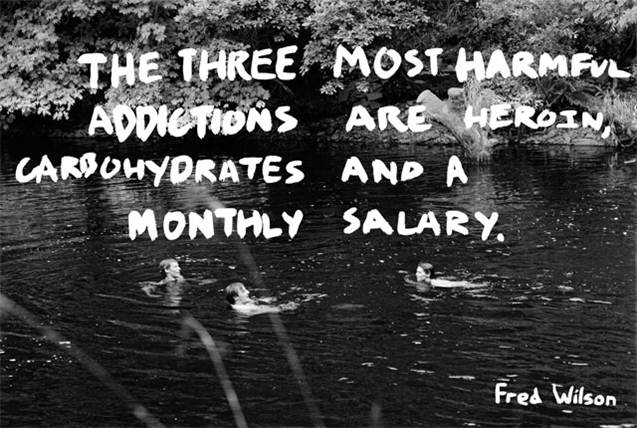
To mangle Karl Marx, "Differentiation is the opiom of the marketing professional".
So coming back to the straplines that have mattered.
We don't remember and respond to them because they clearly state out the 'brand vision' or anything like that.
We remember them because they're utterly distinctive. Not just within the category, but within wider culture.
Because they're powerful, provacative invitations.
Because they're powerful engines for communications ideas, not barriers, or even worse, vampires that suck the lifeblood out of them.
Because they're a launchpad for startling, distinctive brand communcations, that are coherent, not the endlessly repeated proposition constantly hurled at people who care less and less.
They empower marketers and their suppliers to deal with business issues, rather than tying one hand behind their back.
Just Do It was simply totally distinctive in the sports market, and was the canvas for even more unique advertising and stuff.
Orange was a name utterly unlike anything else at the time, as was 'The Future's Bright'. You didn't have to get it was about, I bet few did., It was noticed and made us feel different.
Whereas with, Vorsprung Durch Technique, no one even knew what it meant! Which is sort if the point.
So, if you're lucky enough to get a genuine brand development brief, or unfortunate enough to be stuck with the useless brand consultancy output you have to execute somehow. Your job is to convince conservative individuals, living by old and, frankly wrong rules of differentation, that they can 'tick the different box'. Whereas, in reality, you're striving for distinctivenes.
A strapline that's a provacative invitation, or statement of intent- if you even bother with one.
Brand imagery, tone, colours sounds and and concepts that are at once ownable and incogruous to the rest of the category. That once add to and stand out from culture.
In other words, less 'Oh that's clear'. More, "My word!"
A final word.
A new brand idea is not the same as a new brand.
If you're dealing with a brand with some any level of familiarity, it's commercial madness to throw it all out try to start a new story in their heads. It's so hard to build up any sort of profile in the heads of customers, that once you have it, it will short circuit long term growth rather thab hinder it.
Rather, you should be looking for a 'reboot'. Work with what you have. Find out what in the heads of customers you have and those you want, and repurpose it for what is right for business aims.
The truth of Old Spice is neither this.
Nor this.
It's both.
What is often overlooked that the new stuff doesn't work against the deeply ingrained impression of slightly old fashioned masculinity. It brilliantly repurposes it.
Just as Sainsburys is built out of 'foodiness'.
Then.
Now.
That's the point of brands, long term, loose memory structures that are constantly refeshed and updated, in line with shifting market conditions, organisational objectives and culture and customers at large.
Not 'lines' not 'propositions'. A loose smudge of an impression in customers minds that's more about feeling and character, not a defined, ring fenced 'position'.
That is enriched and refreshed over time.
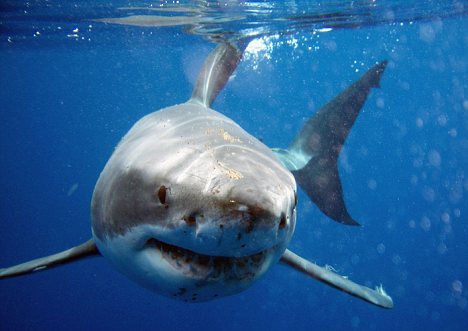
That, like a shark, constantly moves forward or die, but is never anything but a shark.
To finish, the obession with brand differentiation - and the false prophets who have got rich peddling it - at best, makes little contribution to brand growth, or manages to create it by luck, through accidental distinctiveness that gets noticed.
At worse, and all too commonly, it does more harm than good.
Because the obession with being different just makes everyone look the same.
In sharp contrast to the dumb trailers that followed. GI Joe, Abraham Lincoln The Vampire Slayer (!!), another Underworld film etc. It all smacked of a desperate industry relying on special effects and endless re-boots of old ideas, rather than anything resembling ideas.
The shining beacon within this was the trailer for the third Batman film (I hope). One of the most successful films ever, yes, high spectacle, but dark and takes no prisoners with intricate plotting etc.
Proof, alongwith the numbers Prometheus seems to be doing, not to mention Midnight in Paris doing over $100 million that you don't have to treat people like idiots to be successful.
Sad then, that when it comes to brand communication which is, of course, both part of and competing with popular culture, tends to take the GI Joe route.
So I went to see Prometheus last night (the prequel thingy for Alien if you didn't know). I enjoyed it a lot and it made me think.
I can't seperate the stand alone film from the original Alien, which I was just old enough to watch while it was still relatively new and hadn't dated (it still stands up).
I loved that film, and accept that much of why I enjoyed Prometheus is the adding to that original story. The thrill of the Space Jockey imagery, the prototype face-huggers, the exomorph on the mural and THAt ending with THAt creature. That film and those iconic moments mattered to me, and enriching that is pretty special.
Just like I how grew up with Star Wars and suspect my generation loved that more than any pre-teen generation has loved any form of enertainment before or since.
The prequels that eventually followed were disappointing of course, doomed to never live up to expectations, but to be honest, I still went a little misty eyed when Yoda pulled out his lightsabre, when he rumbled with the Emperor and, most of all, the silence when Vader's mask went on for the first time and then he started THAT breathing thing. I just cared too much about this world to not feel something.
So it's funny when agencies and brand managers alike talk about making brands 'stop interrupting what people are interested in and BECOME what people are interested in'.
How many ads can you remember that really did this? Left you gasping to have the story enriched by more content? And don't get me started on banner ads and 'social stuff'.
Think about the THOUSANDS of communications campaigns hurled at us every year. You can count on one hand those with any sort of genuine cultural resonance, and even then - The Old Spice Guy, The Meerkat, Papa and Nicole, the Nescafe Gold Blend couple - how much do you really think people care when these things are killed off? Maybe a little sad, but begging for more?
Doubtful. Brands are useful, we might have affection for some, even love one or two, but if anyone is crying out for more Old Spice stuff, rather the Dark Knight or even Transformers 4 (yes, it's planned), they're a little wierd.
If you start every brief with the objective, 'Be culturally significant' or, heaven forfend, create a Lovemark, your rate of success is going to be pretty dire. Even the experts at making culturally significant stuff make plenty of duds. The amazing success of Harry Potter is outnumbered by failures like Eragon and The Golden Compass. Geeorge Lucas may have done Star Wars and Raiders, but he also did Howard the Duck and Willow.
Failure is built into the business models of film studios and record companies.
It isn't part of the business plans of clients.
Being realistic, its should never be about love, it should be about getting noticed at all.
These days, kids and stuff mean I go swimming a lot less and go the gym a lot more, on a lunchtime to be precise. Next to swimming or being out on the bike, the gym comes distant third, but when can't do without either the endorphine rush, the sense of Flow and the release from being anything but me from time to time, it's still special.
It happens to be the same place where Jessica Ennis trains (no photo proof of course, you don't take photos half naked women in gyms. Not even the famous ones).
When you get that close to someone, you realise just how extraordinary world class athletes really are. What they do week in, week out is beyond the realms of what is possible for most of us.
Let me correct that, it's possible for nearly anyone, champions are made, not born, but the levels of practise, commitment and sheer hard work to get there are just too much for most of us.
When you face that level of focused, brilliance, it's pretty inspiring.
I was lucky to play a few games with a pro-tennis player once. I asked him to hit a few proper 1st serves against me, I barely saw them, let alone got a racket on them.
You don't really see that on TV, not even in a big stadium.
Like it or not, it's the bit of the brief creative's read first (debatable if some read anything else to be honest).
It's also the hardest to write. Some lucky folks are natural born proposition writers, but the majority of us have to slave over honing a finely crafted sentence.
So what do you do it you're stuck, or, most likely, the suits are screaming for the brief to get creatives going?
You could take option 1 and make sure your entire brief is littered with gold and so well written creatives just have to read it. So laden with little bombs that any could detonate in a creative brain. Which means developing the skill of making the same point in a number of different ways. This works with the species of crreative who ignores the proposition as a matter of principle.
The proposition for this was 'beautifully made cars' but the brief was stuffed with different gems that bascially said, we need to make Skoda considerers believe they won't get laughed at by others.
You could take option 2 and write a 'task based' proposition. Basically frame a juicy creative task instead- because what get's good creatives really going is having a great problem to solve. Particularly useful when we're increasingly realising we're changing how people feel, not 'saying at them'. Also useful for proper intergration and digital which is much more about 'doing' and creating systems for people to play in."Make the Compare in Compare the Market Famous"
Or if you're really stuck, use the 'liberating not'. Whatever is opposite to what the product/brand is about use that. Somehow is makes a one two three word proposition stand out and get's creatives thinking. You could say your coffee is strong., but you could also say "Not weak". You say your fast car is 'not slow', or even 'Not boring and complacent"
Or your beer can be 'Not girlie'
Your lolly can be 'not serious'
Every brief needs a well honed 'idea' for creatives to leap off, but there are dark arts to creating that leap. I won't tell if you won't.
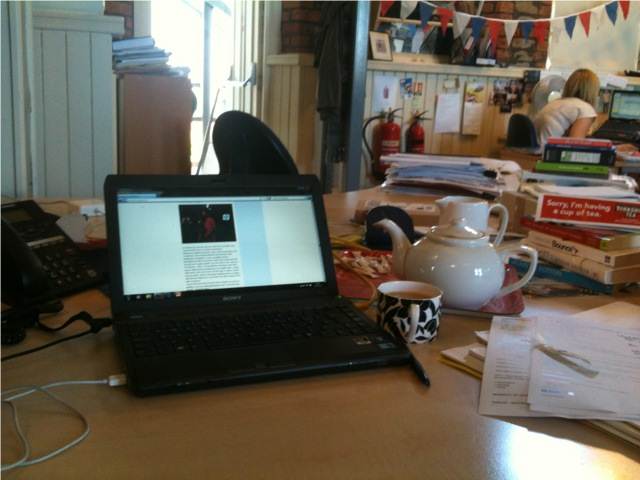
Naturally, it is replete with proper tea making equipment, including the trusty pot, even trustier Yorkshire Tea and china mug. Just out of shot is some Fortnum and Mason Earl Grey leaf tea that is actually quite amazing and that I'm not an inverted snob enough to hate myself enjoying
You can see the telephone that hasn't been used for about 6 months – it's all mobile these days isn't it?
In the absence of the Head of Planning – who usually sits opposite, for passive aggressive discussions on the minutia of modern music and an ongoing competition for who can build the bigggest mountain of unopened Amazon books - you can enjoy the spectacular view of the fire exit and the tips of a leafy tree. Apparently green makes you more creative. Tick.
Peer past the desk and you'll spy the most fashionable social media PR type peering over her laptop, pretending to do some sort if 'listening exercise' (whatever that is) while actually abusing me through the medium of Twitter. Just out of sight is her sidekick, part witch, part hippy, part French philospher who insists on drinking tea with honey. That's right, honey. Different strokes etc, but sometimes I weep for the future.
Above the Twitter Twattering, honey drinking Witches of Eastwick, you'll see some bunting. Not for the jubilee, on no, we're too louche and ironic for that. For something French that happened months ago.
Back to the desk and, predictably, there's the little pile of pretentious books, ostensibly reference for some projects while actually ornaments to make passers by think, "Ooh he's clever!".
If you could peer down, you would see feet sporting sandals, since the chief exec is back and doesn't like people wandering around the agency in bare feet. She hasn't been around for over a week, allowing my 5 toed friends to breathe the free air. Quite the rebel me.
Look around and you see a listed building that used to be a school and was then transformed into 'Players Bar' a drinking establishment owned by the world famous soft rock Gods, Def Leppard.
You too could enjoy the delights of this working environment for a couple of weeks even longer. All you have to do is endure doing work experience (or poisoning young minds as I like to call it) with me. Obviously, work experience based around planning and stuff, but also the chance to learn how to make the perfect cup of tea, correct my spelling, learn about fashion from the aforementioned Witches of Eastwick and do your own Account Planning School of the Web project on a one to one basis.
Any takers email me at your leisure.
One addition, added after original post. I'm not suggesting there will be people clamouring at the door, but there are some criteria to get in. You need to be enthusiastic about planning. To that end, in no more than a thousand words, you need to email me why you want to get into planning and describe your favourite ever campaign and why it's so good (clue, I'm more interested in the strategy than the casting).


 NORTHERN PLANNER