• Agency review – we haven't the balls to fire our agency

    369 degree thinking – we can't afford TV

    Aligned – big agency speak for 'we agree' or, more precisely, we don't agree but we want you to think we do

    All agency workshop – lots of suits and planners doing passive aggressive and achieving nothing

    Amplification – Can we have a bigger media budget?

    Best practise – copy everyone else

    Brainstorm – useless, half baked ideas

    Cultural strategy – strategy

    Chemistry meeting – free ideas

    Challenger strategy  -strategy

    Content led -we can't afford strategy

    Consumer led – written by  a focus group

    Digital strategy – strategy

    Disruption strategy – strategy

    Hard working – tactical retail ads given to a junior team because no one else wants to do them

    Intuitive – trust us. This is brilliant. Versus counter intuitive, trust us, this is even more brilliant, even though it makes no sense, not even to your target

    Lateral thinking – the brief's bollocks so we ignored it

    Learnings – cock ups

    Media Arts strategy – strategy

    Media neutral – we can't afford TV

    Populist – written for the lowest common denominator

    Provacative (person) – bad manners

    Provacative (campaign) – brand manager will get fired if it doesn't work

    Resign the account – fired

    Strategist – planner

    Safe pair of hands – useless

    Scope it out – get someone (not me) to actually make this unworkable idea work

    Soft launch – NPD have given us a dog and we haven't the clout to tell them no one will buy it. Or no one got their act together in time (see All Agency Workshop)

    Tissue session – presentation of weak, half baked ideas

    Thought leadership – market share losership

    Think of us as partners, not suppliers – we want to renegotiate the fee

    Work in progress – work not started but we had to show you something


  • All I want to do is drop everything and go do something makes me feel alive, that works by body so hard I can hardly breathe or stand. The mind is at once clear and totally present in the moment.

    No internet. No Ipod. No Twitter. No TV. No orders. No duty. No one.

    Just me. Mostly swimming, sometimes riding my bike like there's no tomorrow (hopefully in the rain).

    Then putting on something warm and making a proper cup of tea. There's nothing quite like the feeling of 'good tired'.

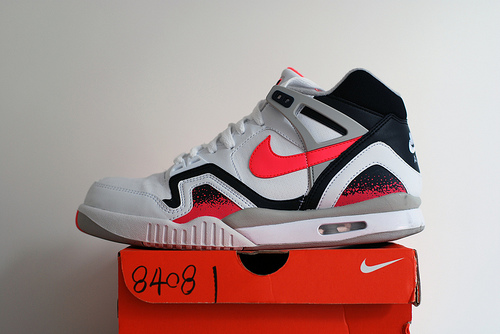
  • So the latest in My History through 100 Objects are trainers bought in around 1990, sadly long demised.

    Hot lava 
     

    Apart from a, now sorted,  wobble over sweat shops etc I have an irrational love for this brand. Not as a strategist mind, but as an emotionally driven human being. In fact, locically, all planners should be immune to brands, since we're supposed to know how they work, but we fall their irrational lure because we're still people with a deep need to construct and share our identity like everybody else.

    Walk into any boutique agency and look at the sea of check shirts and thick rimmed glasses if you don't believe me.

    Anyway.

    I remember at school,it must have been around 1988, everyone had Nike Air Pegasus, but I can't say I was particularly interested until I saw this ad.

    http://www.youtube.com/e/S93b-FL-VJw
     

    I loved playing tennis but hated the culture that went with it in the UK.

    Juniors should be seen and not heard.

    We encourage you to wear white.

    Does your face fit?

    It's not polite to want to win.

    Rules. Conformity. A bastion of middle class. I was brought up in a 'well to do' market town. Naturally I hated it.

    That ad was everything I wanted in tennis. So I saved the money I earned from working in our local sports shop on weekends and bought a pair of 'Hot Lava' trainers.

    Horrifically gharish and ugly. That was the point. And yes, I know how quaint it sounds, little middle class boy thinks he's a rebel buying trainers. It is silly, but brands are silly, they're irrational.

    Somewhere in my subconscious, I've never forgotten how that felt and it's only been enforced by over 20 years of other ads and stuff. Despite demonstrating a rebelious streak by opening my mouth these days, rather than uniform, I still only buy Nike, anything else just wouldn't feel right.

    By the way, if you know where I can get a pair of these trainers again, let me know, I'm going through some sort of grasping at youth retro thing (that's an invite for spam comments if there ever was one).


  • I_M_WITH_STUPID 

    When I started out as a planner I didn't really have a clue what I was doing. No planning director mentor type person, little time spent with planners as a distinctly average suite none of that. All I got was a a few (useful) APG courses, the generosity of planner blogs and the suspicion I'd never really been a suit, but a sort of planner who always always lost, forgot to invoices and far too shy.

    And that is why I'm convinced I've survived out here where planners are both rare and, largely unwanted. Much of 'being a planner' has involved figuring out what a planner actually is. And that has largely been a good thing.

    Viewpic 

     When you're a little scared because you don't know something you really should, you work bloody hard to make up for it and, here's the good bit, the lack of constraints from 'rules' provides all sorts of possibilitily that's absent from 'doing it properly' .

    Contrast that with knowing it all -  you stop trying, you stop developing and just like a shark, when you stop moving forward, you die. When you're no longer an idiot, you're fishfood.

    That's why I still love it when I'm nervous, when I don't think I quite know what I'm doing. It's those times, when you're Using the Force, when all you've got is your instincts, when you're the most likely to do something great, that no one else will because you won't be doing it like them; for Gods sake, you don't KNOW how to do it like them. I like it when I'm making it up as I go along.

    3928654089_af7ffd4fd7_m

    Which is why I like stuff, people and situations that shock me to death, make me uncomfortable, have no respect for me at all (yes I know that's everyone) and make me mad, angry and even scared. That's why I like digital stuff, lets be honest, no one really knows how to 'do it', come to think of, no one knows how to 'do' old school advertising either, they just try and bring in 'sciency' rubbish that makes it look that way – sometimes they even believe the sciency rubbish.

    There's another by product of not knowing anything. It doesn't have much respect for authority and experience it doesn't have any time to kiss someone arse for what they did 10 years ago or even 10 minutes ago. 

    The problem with tried and tested people with all that experience and knowledge is that they tend to do things the same way every time and, according to Einstein, doing the same thing over and over, with the expectation of a different result is the very definition of insanity (I'm presuming this was before anyone was getting to grips with quantum mechanics by the way) which is what 'The Disruption Agency' is such a contradiction in terms. As soon as you have a process for Disruption (and believe me they have. In triplicate) guess what happens? Dead right.

    So if you're in am agency that 'doesn't do it right', if you haven't got a world famous, genius mentor, if you've been asked to do something right out of your comfort zone, your head feels like it's going to explode, you don't know what you're doing or how the hell you'll figure it out…good. That's right where you want to be as far as I'm concerned. Figure it out, make it work, you're probably about to do the best work of your life. 

    Don't accept what someone else tells you just because they're older, more important, more famous or whatever. Be a pain in the arse, question everything; authority, the process, the ideas, the research. Everything.

    Forget all that 'you can't break the rules until you know what they are' claptrap. You're at your most lethal when you don't even know what they are.

  • 2010 061 

    I got an email from someone asking for some advice the other day, wanting a viewpoint on how to be a really useful planner in a small place, without all the data and information resources you might be used to at a big leviathan agency network, the time or budget for primary research …and being able to add something to a department where there are already some great intuitive brains.

    Two points here. First, I'm always amazed when someone asks for advice, as if I know what I'm talking about, but more pertinently, people do actually read this silly blog and take some of the things said here with a measure of seriousness. That's a responsibility that should be treated with respect.

    Secondly, I like trying to give out useful advice. Not because I have delusions of grandeur I hasten to add, but because sharing some useful (?) tips forces you to think about you own working habits and how realistically you live up to what you're advising. It's rare you're completely whiter and white and it's a useful reminder to never get lazy or cut corners. There's no way you can avoid doing the work.

    It struck me I might actually have some stuff of use, not if you're a fancy pants hotshot who's worked in big hubs like London or New York, for big fancy pants agencies, however, if you're finding your feet, trying to learn without any great mentoring, or trying to do your job in a placed not that used to planning and it's value, well, I really don't mind helping out. Seriously.

    Anyway, this is what I wrote (edited for confidentility and general public consumption).  

    Hi there

    It’s a bugger when you don’t have the tools. I used to love TGI and struggled for a bit without it, until I realized that all it did, and this goes for most quant in my view, nothing more than validate what I already knew.

    Now, how can you do stuff already great 'intuitive' planners don't do already without that kind of stuff?

    My first point is about intuition, using your guts. Your guts have shit for brains because you will base everything on your own experiences. We all do. We’re all biased. There is a way around this, which will make you better than them though.

    Do thought experiments, find a point of connection between your own experience and something you know about your audience’s experience. For example, if you want to know how to sell running shoes to men who fetishise them as pieces of design (that’s most of us) you can relate it to how a woman thinks about shoes. I did some work on women’s hair straighteners and didn’t get under the skin of how women felt about how it transformed their looks until I remembered what it was like to wear my first decent suit…helped me anyway.

    You can do that sitting at your desk and, if you work hard at thinking about genuinely similar experiences you won’t go far wrong because we all behave the same – you just need to find that connective experience in the first place.

    On the same note, become specialist in something they’re not….I suggest become the in house behavioural economics and social anthropoligist expert – read Dan Ariely, read Thaler Sunstein’s Nudge, read Daniel Gilbert's Stumbling on Happiness, read Grant McCrackens books and everything you can on ‘choice architecture’. These are universals on how people behave and can be applied to anything. It's not new, but not enough are using proper behavioural psychology well.

    Now for trend suppliers. They are a waste of money. You can find trends just by reading a newspaper – spend more time absorbing as much popular culture as you can, what are the patterns? What do they mean? What could they mean? Look at the culture around the category, the conventions etc – how does that conflict or not capture the relevance of what’s going on in their real lives? Collect a scrapbook of interesting stuff that might be relevant now, but more likely will be relevant for something you’re not doing yet.  

    Have a read of Douglas Holt’s two books on cultural strategy – especially the second. There’s a way of going about things, a process that’s great, unique and delivers proper commercial results. Have a go at that process.

    Finally, be truly great at qual. I don’t mean focus groups and depths etc. I mean going out and meeting your audience in their own environment. There’s so much that’s wrong with groups – group think, people not being able to articulate how they feel etc they are not that reliable. Get confident and talk to people at ‘the scene of the crime’. Just observing how they behave, the atmosphere etc is more useful than groups. I understood more about the role of biscuits in a UK mum’s life when I attended one of my mother in law’s coffee mornings than masses of available data. I got under the skin of men and their motorbikes by spending a morning at two motorbike retailers and talking to a few staff and customers (they see themselves as the last wolves in world of sheep if you’re interested). This kind of research is quick, cheap and more useful than more formal ‘primary’ research.

    Finally, read all the academic, pop cultural books you can around the category, and wierder stuff around that, you’ll quickly get to the stuff that’s really driving it. I got some good stuff for a UK frozen burger brand through an quick look at the category conventions – on a product level, it was all about health, on a brand level, it was all about making Mum’s feel guilty about not playing with their kids enough…but we remembered that our own experiences of burgers as kids was as the food our Mum’s gave us when we had our friend’s around – fuel for good old fashioned playing. This was getting us somewhere, but it was only when I read a relativeley heavy weight book on parenting and the state of kids in the UK that we found one of the biggest issues for a UK Mum these days - culture forces her overprotect her little darlings, which is actually harming kids happiness by stopping making the firm friendships kids need, that only come when parents leave them alone to play together.  On a product level, the burgers were something you could leave kids to eat without worry – all kids love burgers, on a brand level, we encourage them to lighten up, get some ‘me time’ and let their kids play without interferance , which flew in the face of the category culture that, to be honest makes them feel guilty and bad and has the same kind of cultural codes – the have it all Mum and the close knit middle class family. Kids need to be left alone to make proper friends, let them.

    Hope this helps

    Take care and good luck
     

  • How many hours have you spent in brainstorms, workshops, idea generation sessions or, God forbid, Disruption Days or Media Arts workshops? It must be hundreds and that's not counting the time spent painstakingly preparing stimulus, dressing the room etc.

    Meetthydoom1 

    I'll bet though, you can't think of a single, genuinely good idea that came out of nay of them. All that eye wateringly expensive, stage managed time wasted.

    Naturally, agencies will claim that all sorts of Damascene moments have been created in these monumental wastes of time – and I'm sure there have been rare miracle moments when something good has emerged – but the reality is there is little good that comes out of brainstorms. 

    4190007083_b9671e144d_m 

    Mostly you're left with a series of half baked ideas that aren't any good, or some stupid 'out there' stuff that are just unworkable. The master moderator therefore plans the session with the guile and cunning of Wile E Coyote and steers everything towards a pre-planned Eureka moment, or post rationalises a genuinely good idea to death, to show how it was born straight of the crap brainstorm output, when of course if wasn't anything of the sort.

    Academic research has shown again and again that brainstorms produce idea that are much poorer in quality than working alone or in a focused team. You're much more likely to have a good idea making the tea (mostly down to working like this).

    In case you're wondering why these sessions stifle creativity, there's 'social loafing'..where the group dynamic lets individuals doss around, a natural nervousness of being judges for ideas and holding back, the agenda and 'one person at a time' getting in the way of spontaneity and ideas never getting voiced because you're waiting for someone else to finish. There's the dangers of groups think where we conform to the prevailing mood  – usually polarised as ultra conservatism or rampant wackiness, both of which are useless. Then there's the simple fact that the pressure to have ideas usually means you can't have any – a little like trying to force yourself to sleep.

    So why on God's earth do agencies persist with these wasteful drain on time and resources? Fine ifthey don't know the academic evidence that proves they're useless, but surely the only evidence they need is the sheer lack of decent ideas. To be honest, it lies in underlying crime of selling the process rather than the ideas, that also leads to wrong-headedness about the value of creativity itself.

    The ugly truth is that they're pretty good for client bonding and a great day out of the office for them. They like being at the agency and pretending to be creative etc, for a little while it's nice to pretend to be an innovator rather than a box ticker.

    It cements the proprietary processes agencies are so delighted to sell. From Disruption Days to mind numbing exercises built on Millward Brown's Brand Equity Pyramid – a wasteful process built on a wasteful process you could say.

    Even more disturbing is the nagging feeling that agencies like these sessions because they mask either a lack of creativity or a lack of faith in it. It's much 'easier' to do a workshop and then develop the mediocre ideas, rubber stamped by all and sundry, than actually have to think, not to mention have to persuade clients to buy into properly good work.

    There are probably some very mediocre planners who have risen quickly by being great moderators and process managers, not mention quite brilliant planners who haven't because they're better at thinking than being a performing seal.

  • In the space of just one week, I've heard the following in conversations:

    "That VW Force thingy was lovely but I bet it's got nothing to do with the product"

    "Did that Gorilla actually sell any chocolate?"

    "I bet Fallon lost Sony when the client got sick of lovely ads that didn't sell any TV's"

    http://www.youtube.com/e/ql-N3F1FhW4
     

    "What's the point of that Swagger Wagon thing? How on earth will that sell MPV's to parents?" Read this if you're wondering.

    You get the gist. Whenever something original, that tends to enter public consciousness emerges you get the same old yah, boo, hissers. Clever, funny, beautiful etc but will it actually sell anything?

    (Please don't pelt me with specifics on the above stuff, of course there are issues and viewpoints on all, just indulge me with the general picture)

    Basically, there's an inbuilt assumption that genuine creativity and proper commercial payback are diametrically opposed. Sure, creativity brings awards and kudos but does nothing for the bottom line.

    You even get inside agencies. It wasn't long ago when someone told me that burgers we're never going to change society – which is right of course, but misses the point about getting people talking about the brand. Which brings me to my main point.

    You can take Millward Brown's Brand Pyramid, Hall and Partners persuasion and consideration measures and shove them where the sun don't shine. The IPA Databank shows that work that wins creative awards are more effective than the ones that don't. In fact, the more awards they win, the mor effective they are. Even more telling, creative award winning work is 11 times more efficient at selling stuff than other work.

    Have a look at this bloke from Brainjuicer's talk:


    And there's two major reasons why:

    1. Very creative campaigns get talked about – which increases the effect. In other words, they create fame, they make people see the brand as the one making waves in the category, which in turn raises quality perceptions, price premium and all that other stuff without actually 'ratioanally' justifying any of it. Which brings us to point 2.

    2. This kind of work is high on emotion and low on rational messaging, in fact, the rational stuff probably gets in the WAY of selling.

    That's right, emotions have far more effect on buying behaviour than rational product messaging.

    Of course it does, our instinctive side is far more highly developed than our rational side – and has the greater influence, we just convince ourselves it's not like that. That's why research, and testing work' is so tricky, we don't really know what influences our behaviour.

    Throw in the fact that most people are light buyers in any given category and you soon work out it's more important to create the right feeling than the right message – it lodges itself in the subconcious for much longer.

    That Gorilla thing that said nothing about Cadburys chocolate? 60% higher ROI than previous campaigns for chocolate.

    So why do these myths pervade the corridors of our clients and, lets be honest, where we work? Because it challenges the fundamentals of everything they're taught in their marketing degrees and MBA's. It flies in the face of the awareness, familiarity, advantage and bonding brand metrics they tie their budgets and futures to. It questions the very way they work.

    And since they pay the bills, agencies join in myth 100%, it's easier, we sell processes rather than ideas. Which is suicide. What we have that they don't is creativity, lets use it. And planning has a massive responsibility in this. I'm not suggesting rampant creativity per se, the work still needs relevance and credibility etc, that needs planning to create the correct space for the creative department to let rip.

    It also means planning needs to help clients feel confident in what they're buying. I don't mean a shrill for the work, I mean when you get the right work, you provide compelling evidence it's the right thing to do.

    Go forth.

  • ..the Strokes new song is a corker.

    http://www.youtube.com/e/OwxcQvB_vcQ
     

    This will mean nothing to you unless you were around when this came out,

    http://www.youtube.com/e/jrmtySpO3Fs
     

    amidst the glut of bubblegum pop, irrelevant hip hop and shoegazing stadium rock that seemed to so dominate back then.

  • Some days are better than others, some days are worse. Most days are pretty much ordinary and slip by unnoticed.

    The first cup of tea is always the best, naturally made a little more special using a properly warmed pot

    Pot and mug 

    Porridge for breakfast

    Porridge 
    But jazzed up with some rhubard compote. Yes, it looks revolting but it tastes like heaven. Porridge is, of course, the breakfast of champions, complex carbs with all that slow release energy, which was much much required for:Work

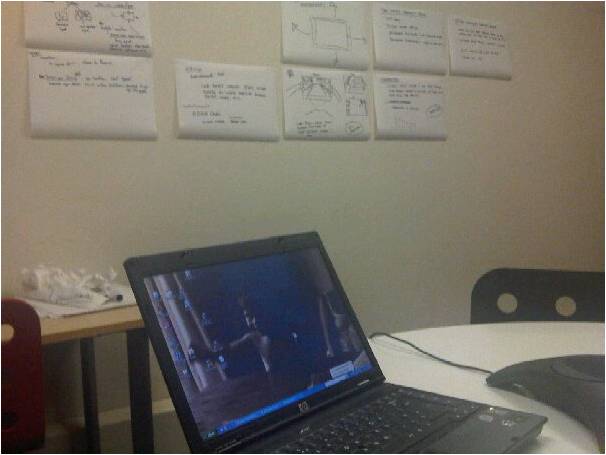
    Sitting in a room, putting things on a wall and tapping away on a quaintly out of date laptopBum

    Producing nothing worthwhile in the first hour or so apart from some wall magnet art, thankfully making some sort of progress eventually, to be celebrated by more tea

     And that is an average morning in the achingly, dynamically hip life I lead. Bet you Soho, Shoreditch and Madison Avenue lot don't feel so pleased with yourselves now eh?

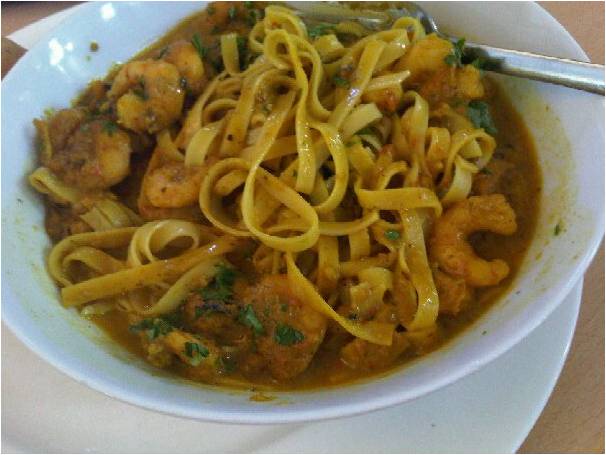
    In updated news, work's very own chef made Prawn Laksa for lunch. Nothing ordinary about that. Like I've said, ordinary moments can be made special with a little effort.

    Laksa 

  • Good:

    The utterly brilliant Boardwalk Empire is only three episodes in

    Possible Singapore trip in March

    A week by the sea with wife and child just booked

    The inaugural 'Dad club' even happens this month (Dad's escape families for a night, drink beer)

    Someone else at work likes Prince


    Bad:

    I need a cup of tea and I've run out of Yorkshire Gold

    It's Valentines Day soon, a great way to make lots of lonely people feel worse


    On the whole, good