Are you organised? If so I salute you. I am nothing of the sort.
There's many reasons why I wasn't a very good suit (Crippling honesty and low boredom threshold immediately spring to mind), however, the ability to get oneself from a to b without mishap, let alone others, is a particular character flaw that sticks out like the proverbial sore thumb.
And let's face it, an account handler that gets lost, has poor timekeeping and loses things is as useful as a Prime Minister who can't smile in front a camera….oh maybe not.
Just in case you're considering a job in planning though, don't think it's all blogging, coffee and workshops. It's bloody hard work and there's no excuse to behave like a baby. You can't escape being organised, it's just it doesn't have to be a superpower like it does for a suit.
Spidey gets to stick to things, but the Johnny Hornbys of this world can charm the pants of Anne Widdecombe (I imagine) etc, while convincing creatives to make the logo bigger AND juggle a million things at once, while babysitting/ cajoling/bullying everyone else to be on time, sign things off, do up their flies etc.
Some would say that suits are bag carriers, they don't appreciate creativity, they style their hair to cover up the three sixes on their scalp etc, that's not even totally fair or true; the best suits have the annoying skill or being great at everything – being a suits, talking strategy, creativity, the lot. Bastards.
But still, there's a whole vanguard coming behind. But so what? Hurrah! We need them, thanks the inevitable fallout of agencies squeezing profits out by working their staff ever harder for less money – we can't do without them.
In other words, suits are like like Mums, but we'd fall apart if they ever left us alone and stopped interfering like we wish they would. And we love them, we just need to grow up to realise how much.
You can't avoid the fact that advertising in all its forms is part of, and competes with, popular culture. Now more so than ever, thanks to the web enabled, marketing savvy consumer we're dealing with these days (don't you hate the word consumer).
So it makes sense to create campaigns that are relevant to that culture, to real people's lives, not 'the category'. It's not enough to work out where you want to fit in your market, where do you fit in life?
That means cultural relevance as a minimum, but to be honest, cultural significance. Actively setting out to influence culture, get talked about.
Here's some evidence
The IPA Databank has assessed 20 years of Effectiveness Papers and concluded that, not only do campaigns that aim to deliver fame and talkability achieve their business objectives more than any other kind of advertising, with a 72% success rate. They deliver increased penetration AND frequency.
A fame campaign can take different forms, and much of that will depend on the kind of work your agency does.
Develop a brand voice, based on delving into consumer culture and brand culture, do everything from the brand out:
So Lurpak wants to have a conversation with foodies by championing quality ingredients.
This leads to all sorts of stuff, championing proper breakfasts on Saturday, being proud of homemade even if it doesn't look perfect etc.
Nike believes if you have a body, you're an athlete, and wants to create a forum for urban runners to play in.
Then there's the model that cares a little less about a consistent voice and just does what it right for right now, building a loose baggage of feelings and associations. It strives to be more entertaining and populist and overtly focuses on finding out what people are interested in and working back from there. This can be in terms of a playing with a cultural problem or using cultural cues for maximum entertainment and standout. It takes the'fame' argument and pushes it. There's a saying in the beer market, "People drink th advertising". That's kind of the point.
So Oasis has two very different campaigns aimed at young 20 something peoplee, based on the same ideas that it's for 'people who don't like water. Multi-platform storytelling etc. One borrows from japanese manga, one from US teen dramas.
But then the next takes a different tack, from 'entertainment' to pure cultural resonance by championing a decent lunch rather than a limp sandwich at your desk…campaigning on people's behalf.
Crispin Porter's Coke Zero are pure entertainment, built on the truth that it tastes just as good as the real stuff. Taps into cringeworthy, sharp comedy like The Office.
While in the UK Mr Sleep creates fame for Travel Inn by simply being something you find funny, loosely connecting to the obvious truth about hotels, you want a decent nights sleep first and foremost, all else is luxury.
I won't go on.
What I want to say is that you can't escape rigour and best practice. Business objective, correct audience, all that. But when it's always been more commercially effective to create fame and talkability, and it's got harder to do, it makes sense to start with culture and what people are actually interested in and work back from there.
How you then bring that to life will depend on where you work, the clients you have and your own view on how brands work best, but when it gets increasingly difficult to bore people into buying your product, it pays to get very good at delighting.
Agencies can get very self important about their role, but their job isn't to coerce people into buying stuff, it's making them feel great about doing it.
I'll leave you with one of the best examples of this. This ad 'gets' women and the culture around looking great, the joy in feeling beautiful, the confidence and the indefinable sassiness that makes Girls Aloud so brilliant (that the Saturdays don't have making them crap)…the brilliance of sisterhood and the drama of getting ready. All in just under two minutes.
There isn't one of course, it depends on your mood, your preferences etc, but for me, last night seemed as if was at the time.
I got home at 6.45pm, which is pretty good for me and dived in to play with my 6 month old boy who can't stop smiling and generally wants to play all the time.
So while Mrs Northern got ready, we did the usual demented pantomime that consists of silly dancing, a bit of talking, bad singing, tickling , throwing around and general buffoonery that makes us both laugh like loons.
That's the amazing bit that's happening now, he's not just the helpless little thing that just wants looking after, we have a relationship, we're friends. And we really like being around each other.
Nothing makes me happier than coming in at the end of the day and him giving a little yelp of joy.
By 8pm he was getting tired, so it was time to give him his last feed an haul into his sleeping bag. This is always Will and Daddy time. We get settles on the sofa and cuddle while he slowly drifts off.
It was a little different this time, he stayed awake for another hour. So while watched a bit of telly, we kept staring and smiling at each other. He kept on putting his hands out, wanting to explore my face, he seems to like feeling th texture of stubble (he seems to get very excited exploring my bald head). I can't tell you how happy I felt, just smiling at my little boy and him smiling back. His eyes seemed to be saying, "I liked the rough and tumble, but I love just being together like this too". I quietly talked to him, nothing special, just thoughts and stuff and eventually he dropped off.
Finally, it was time for a bit of late night cooking and eating alone. I had no idea what to have, hadn't thought about, but making it up as you go along is sometimes half the fun.
It was, roughly, spaghetti with roasted tomato and chicken.
What you need to do is:
Roast a punnet of ripe tomatoes until they're squishy and a little black around th edges. Glug some olive oil on them before they go in the oven- set it at about 180 degrees c.
What you like for 10 minutes, then put a handful of spaghetti in a pan of boiling water. I also put in a handful of dried sun dried tomatoes.Not only does this rehydrate them quickly, the juices that come out flavour the spaghetti.
Leave it to boil for 12 minutes.
When the tomatoes are done, pour in a glug of white wine, put it back in the oven,
Drain the pasta and sun dried tomatoes, throw them it back in the pan with a handful of chopped, roast chicken, a teaspoon of basil and a teaspoon of dried chillies.
Tip in the roast tomato mixture, along with a handful of rocket and toss it all together. Eat straight away.
It's absolutely magic, really juicy, and the sweetness of the tomato contrasts with the bitter rocket and basil, the kick from the chilli and the dry wine. It tastes of summer.
That was one version of a perfect evening. There are others of course.
As part of the process of moving here, I did a small talk on why a digitally flavoured agency needs planning.
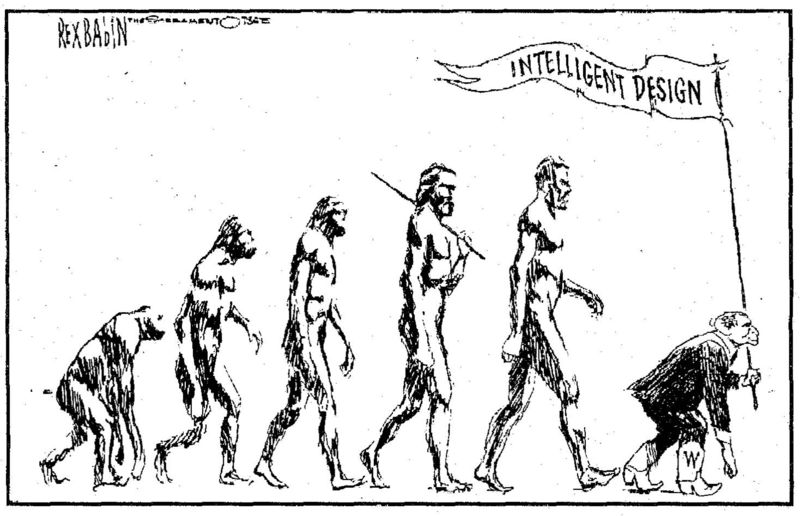
How, for a more vociferous point of view, look at this. What I said was based around two slides.
While this is what I think of idiots who believe in intelligent design, I was making another point about Darwinism.
Advertising agencies got found out around 15 years ago, when clients began to look at what they were getting in return for fees that paid for Porche's, lunches at the Ivy and, even Up North, a very plush life for agency types. We've been seeing the slow decline of ad agencies ever since, amplified by the claimed decline in effectiveness of paid for, traditional above the line. If you're any good, you do okay, if you're not, you're fishfood.
A similar thing is happening with digital agencies. For a few years they had the upper hand over clients and other agencies thanks to being the only ones that 'get' the technology. A few whizzy websites, a bit of SEO and a few banner ads and yay, make lots of money!
But now they're getting found out. Clients are looking at very pretty, but very useless pieces of digital art and questioning what the return is, and unfortunately for digital, that's very easy to measure.
You wouldn't believe the amount of digital specialists I've worked with that have no clue about building ideas around people, who just want to update the website. When more people don't even bother with brand websites, they just noodle around they're own social hubs, this 'act' is wearing a little thin.
Technology is still massively important, things are moving quicker and quicker. But knowing how things work and what is possible is useless without knowing what it's for.
Then there's display advertising. Hand on heart, can you remember an ad on the web that made you sit up and really take notice? I can't, but I can still remember how I felt watching the first 'Just Do It' ads, or 'Balls'.
Just because the medium might have changed – and boy how things have changed, it doesn't mean the skills have. It's bloody complex now. Digital? I give you post digital, the Internet of Things, Transmedia Planning….multiple touchpoints, people, surprise surprise, doing what they want, not what you tell them and shutting out brands, and culture in general that doesn't earn their attention. e – interacting with brands across a series of touchpoints rather than one web portal.
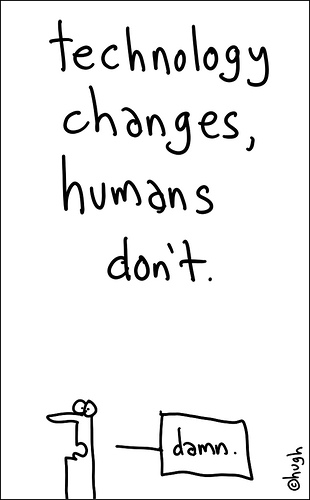
That brought me to the second slide, thieved from Gaping Void.
Digital stuff hasn't changed people, it's simply enabled them to be more human. One way, authoritarian media and culture managed to pretend otherwise for a while, but humans are social creatures and can't help responding to others around them, wanting to belong to a group and acting social. Social networking isn't new, it's just magnified how people really behave.
In other words, it's not enough to know the technology, you have to know people. You have to build ideas around how real people behave, be relevant, interesting, know when to show up, how to fit into their lives.
And that sounds familiar doesn't it? That's what people that grew up doing brand stuff and advertising learned to do as second nature (the good ones).
Thats' what planners do – as far as I'm concerned, there's no such thing as a digital planner, I'd wager there won't be as many digital agencies soon, maybe on or two specialists that are especially good, but there will be agencies that don't do advertising, they don't do 'digital' or, they just have ideas that connect people with brands in the right way – the brand, but also for the people.
That's going to need planners more than ever before. So the idea of 'digital' is a little silly as far as the future is concerned. Ad agencies are going to become good at doing stuff that isn't just advertising, the good ones already are. So called digital agencies will have to get good at proper strategy and creativity.
There are pioneers of course. Balloonacy is great, wonderful use of technology, what you need people to do and built around a brand idea.
This TV commercial was designed to let people in and share and discuss online.
This idea for Oasis is based on classic planning – increase frequency by persuading young people to have a decent lunch, of which Oasis is a critical ingredient. TV is activation, reach and engagement, but there's a campaign to join in with on Facebook.
I was in London for something or other yesterday, Shoreditch to be precise.
That meant a walk from Liverpool Street Tube, through the Square Mile to Shoreditch.
It was funny to watch how, in the space of 400 yards, I walked through a sea of pinstripe suits, shiny chrome (and disappearing taxes).
Then passing through some sort of invisible forcefield, immediately entering a world of irony, knowingly sparse and shabby streets, creative types, T4 presenters in general extras from The Mighty Boosh.
Funny how two completely opposite worlds co-exist next to each other, one the complete antithesis of the other. That amazes me about cities, the way they self organise like that. In the small of a few footsteps, everything changes.



 NORTHERN PLANNER