Gareth has shared a great presentation on the creative brief and strategy for the digital age. You should read it.
-
I've always worked on challenger brands, with one exception. Challengers are much better than number ones – more fun, more interesting, less complacency.
So naturally, I've joined Eatbigfish's Challenger Project community. You should too. And if you haven't read Eating the Big Fish by Adam Morgan yet, you should do that too, it's one of two genuine essentials for planners. As far as other books are concerned, the less they are 'planning books' the better. Fish where others do not.
Anyway, it doesn't matter if you work for number one's or not, these days, the best way to stay a number one is tothink like challenger. That's why I think Nike has stayed ahead all these years – they wouldn't do work like this otherwise. Compare that to big lumbering L'oreal,
or Gillette who need god knows how much quant to hit on the shallow observation that men like to be treated as individuals (they don't by the way, they just think they do). Or the clunky champions stuff..
By the way, I quite the 'best a man can get' stuff
– I remember it for starters and it was particular view on manhood that isn't really different to Old Spice
or Dove today…….
….a real man is experienced – it was just executed in a different time, before Americans got irony, or found out that Europeans did.
Anyway, that was the disappointment with the number one I did work on, they'd become complacent, lazy and believed their own hype.
So I suggest you join in (it's free) there's plenty to read and watch.
For starters, here's Naresh Ramchamdani's observation that digital, cheaper media is the same as expensive media and firepower – people know when you've made an effort to do something special and reward you with engagement (you'll have to join first which will take seconds)
And here's Russell's take on post digital, the internet of thingsand the general 'digitalisation' of physical objects (on another note, of you want to know about the important of 'things' in our lives I would read this first, then decide what making them part of the fabric of the web could/should mean.
-

Will is nearly 6 months old now. He's just about sitting up, moving off milk and attacking real food with gusto. Perversely, he's stopping sleeping right through at night after a few months of pretty good sleep.
He's also laughing, worrying, as soon as I start talking to him he starts to laugh at me (but then again, why should he be different to anyone else?). I still talk to him all the time, it's great for his future vocabulary and from my point of view, he doesn't talk back and he can't go and do something else, no matter how boring I'm being.
I've started to write to him too. Just thoughts around what I'm feeling, what I'm doing, what we're both up to. I hope he might want to read it someday, when he's old enough. It's hard for sons to see their parents as people, one day I want him to know what I was like and what life was like was me and his Mum. When he's our age, things will no doubt we wildly different. And it will do until we can talk to each other (although he seems to enjoy spouting gibberish at the moment, maybe I just need to understand Williamese).
It's amazing watching him, he's interested in EVERYTHING. I think children are have lots to teach us, he hasn't learned to be cynical yet or ironic yet – everything he cares about is either do do with playing, feeling safe and loved and not being hungry. Not a bad way to live your life really.
Don't you think grown ups forget to play sometimes? Not everything needs a point, sometimes it's nice to do something just because it's fun.
-
Good interview with Will Collins from Naked, pay special attention to the bit about Boots.
-
One of the difference between new work and old work is that I won't be lead agency planner all the time, which was mostly the case before. Sometimes I will, sometimes I'll be part of an inter agency team, doing mostly the digital bit.
That means two things, which, come to think of it, stand for planning full stop. It's rare that an agency and it's planners work in isolation these days – even if you're leading comms planning, you're going to have to be generous to other client agencies and work together.
That means you have to both think big and think small. Sometimes you're thinking about the whole brand and having big ideas to pull everything else along, while other times you're thinking about how to execute someone else's big idea, or co-creating it with other planners.
That means being flexible and it also means there is no such thing as totally Generalist OR Specialist. It doesn't matter what you do, you need a knowledge and appreciation of how everything works.
One of the accusations I'd level at most digital specialists is that they don't know enough about how brands work, what the brand their working on is about or what their audience is interested in, or does.
On the other hand, too many traditional, lead planners have great ideas for advertising, but fail to consider how it would work elsewhere.
How you go about all this depends on how you thinks brands work, and the brand you work on- build brands built from lots of little ideas that pull in a general direction, or you can search for the big idea. Either way, you need to be generous to others and appreciate what they do.
So, top skill for digital people, but planners in general is leave out the intellectual posturing, surrender a bit of control and just get on with working together. And that IS commercial – you may lose a little share of budget, or adapt your own work to fit the collective etc, but that's better than clients losing patience and either firing the ones who refuse to play ball, or consolidating everything to get things done quicker.
-
I'm not the only one whothinks agencies, and most specifically planners, need to engage with Behavioural Economics. Basing ideas on how people behave is supposed to be what we're good at. But…
..let's not fall into Emperor's New Clothes Syndrome. Most of it is really common sense. Like most credible stuff, it makes sense because we know it already, it just hasn't been codified. Take the concept of rewards to make people do stuff they don't want to…….
It also means proper research that looks at what people really do, going out and meeting them in their own environment, absorbing the culture. You won't get that in a focus group.
Speaking of groups, I was reading in this that groups are very bad at making decisions. They tend to polarise around very radical decisions, or very moderate ones, depending in the group dynamic. So you either go too far, or you get nowhere. Bad for focus groups and testing work, worse for workshops. Are brainstorms etc really useful for anything more than getting client buy in? Are the late nights getting stimulus ready better spent having a few people that work together well kicking some stuff around?
-
They've got scaffolding up.
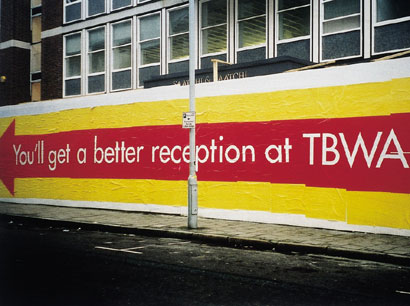
But better work?
 NORTHERN PLANNER