I did what I thought was some pretty good thinking on something or other. The people with me at the time did too.
so I wrote it up, then got lots of feedback from the people who weren't there that clearly showed they didn't get it.Which was my fault not theirs.
Because when I looked at what I'd done, it was pretty well written but I'd clearly got carried away with writing a piece of prose and not a piece of planning. It was lovely to read, it was even concise but it didn't make any point really well.
Smartness is all well and good, but when you're trying to communicate it to others, you need hooks to hang that smartness on. Memorable, pithy distilations of your thinking.
It's good for your audience but it's also good for you. Boiling down your thoughts into a series of soundbites helps re-appraise your thinking, cutting out what's unnecessary, keeping what's working and, also seeing how it can get even better.
I forgot that.
Which just shows the distict disadvantage of the indpendence that comes with a little 'seniority'.
You just don't get the constant feedback that naturally comes with a good mentor to report to.
It pays at every level to seek out as much input as you can, but I dare say that actually becomes more important with experience, not less.
One final thought. If you're working on a presentation, you really should rehearse in front of someone who isn't involved, because then the mirror neurons fire and you see your stuff from their point of view, not yours.
Suddenly all sorts of flaws – pace, delivery, ordering, clarity and, in some cases, fundamental problems with logic , structure and argument – become clear, stuff you just don't see if you're too close to it.
My one year old little girl has a cough that's keeping her awake at night. So Mrs Northern and I are taking in turns to sleep with her.
The routine seems to be putting her to bed okay, eventually stumbling up ourselves, being woken by a little coughing fit around 2am, waiting for her to either go back to sleep or give out frightened little yelps and then remembering it's your turn and stumbling into her room, or turning over and going back to sleep, secretly relieved.
If it's my turn, the little monkey might want to play, she might wriggle while she's firmly cuddled and has her fine, candy floss hair stroked, but she does eventually go to sleep.
Then I drift off, usually awoken by a little bundle has quietly rolled over and put a hand on my arm.
She's okay and sleeping fine, but she just needs to know Daddy's still there.
My little girl can't speak yet (beyond pointing and saying 'Dat'), but her little questing hand talks to me in a way that her words, when they finally come, will never do.
Sometimes the feelings evoked by being a parent are just too intense to articulate, they really are.
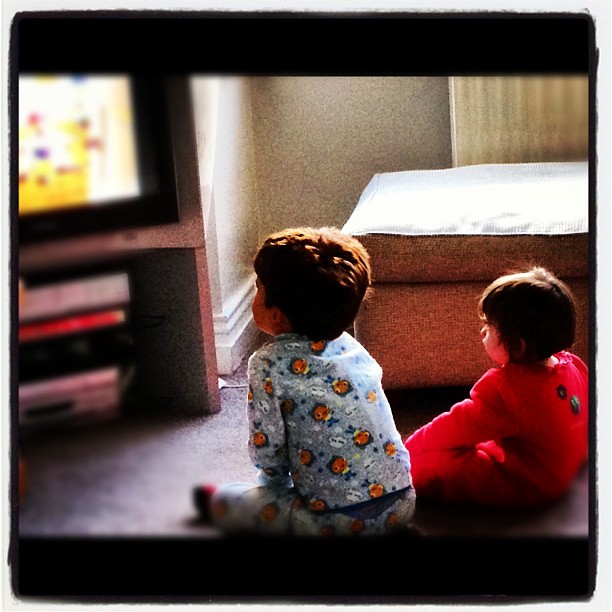
I had the children to myself on Saturday, which was lovely. Before reading, painting, trip the park and then on to see the parrots at the pet shop, there was a little bit of watching Toy Story while Daddy made breakfast.
According the the academics and psuedo experts on Mumsnet, telly is a total no no for under two's but then again, in the real world you can only do your best.
Ona another note though, one has to marvel of the genius of the makers of kid's telly and films, whom, ever since pioneering Sesame Street have, at their best, made stuff that rewards both kids and parents watching with them.
I've never understood why ads and stuff don't manage to follow the same idea. I'm sure there are some but I can't think of any off-hand.
My love for Yorskhire Tea s far from secret. So it will be no surprise that I read their IPA case study with interest.
There are many things to love about the Little Urn campaign, but what I love best about the data in this case study, is that my beloved Yorkshire Tea is a genuine exception to the iron Double Jeopardy law of brand loyalty.
Basically, brands with a higher market share get that share mostly from having lots of buyers, who are also slightly more loyal that average. But Yorkshire Tea's share comes from having a lot less buyers who are a lot more loyal and drink buckets of the stuff.
Contrary, bloody minded and opposite to conventional wisdom (actually not of course, double jeopardy is ignored or just plain unheard of amongst most 'seasoned' marketing folk) – how wonderfully Yorkshire of Yorkshire Tea.
There's a great quote about fast food, "Speed and convenience is everything, flavour is secondary".
Now one could argue that culture has followed suit beyond food; with music, films, books,telly everything- lots and lots of stuff when you want it, how you want it, with less thought about quality and more about quantity. And predictability.
Then there's the devices and media we enjoy stuff on these days.
The impact of 3D cinema in place of actual content that takes your breath away.
An IPod that's an approximation of the rich tones you get from an old school seperates system.
Watching a high quality, cinematic HBO drama on an IPhone.
Somehow we're managing to squeeze the 'occasion', full flavour and TEXTURE out of the experience.
Like fast food.
More, more more.
Now, now now.
Without bothering with flavour.
Or stopping to taste it.
On the part of the makers, creating more clones polystyrene for jaded palates to cram themselves.
On the part of the consumers, not giving content the respect it deserves.
Like drinking vintage wine from a plastic cup.
Or buying Yorkshire Tea Gold and not making it in the pot.
Yes yes, more stuff out there, more interesting, more connections for all sorts of ideas.
But more isn't always better. To make connections and mould newness out of the cacophony requires quietness and concentration. Instead of blocking out yourself and your consciousness with constant noise, remembering how to hear and feel them.
Little wonder then, that when something comes along with real texture and flavour, people respond.
They remember what it's like to feel something, to be challenged, to escape pre-programmed life for a bit and experience something real, tangible and maybe a little raw.
The unashamed joy and feelgood that was Mamma Mia. For example.
The wave of mixed up pride, hope, connection and wonder that was the Olympics.
No surprise that advertising that sets out to make us feel something these days can be commercial dynamite.
From a very complex mixture of guilt, hope, inspiration and, perhaps, even revulsion…….
To the pure, uncomplicated joy that is being around kids.
Or even a shared, intake of courage and pride and determination.
It sets out to make you feel something and tugs at the cultural mess around the need to resolve the tension between the need to still buy new stuff and appearing to be a bit more considered and 'old fashioned values' in austere more morally ambiguous times.
Little wonder when so much advertising is banal, pre-programmed, triangulated, message orientated, devoid of texture and flavour, work like this reminds us what we have become, and what we should really be aiming for.
If you're an aspiring planner, you're probably looking to do an internment.
You have a choice.
You could learn about politics and meaningless proprietary processes at places like Grey, Ogilvy and Leo Burnett.
You could learn about doing 'advertising' that shifts brand scores but not much else.
You could contribute to the 95% of marketing communications output that is largely banal, unnoticed and met with indifference.
Or
You could learn about real craft, ideas that change minds, affect culture and, more importantly, solve business problems with creativity – rather than 'brand problems'.
You could make a difference, work harder than you ever have before and end up doing the best work of your life.
You could have fun along the way, learn to surrender your ego and meet some great people who only come through the door to do great work.
Not politics.
Not to be cool.
But to make a dent in the universe (yes I'm quoting Steve Jobs).
You could start on the long road to developing the skills and track record that could lead you to working where the hell you liked – inside or outside of the agencies, or advertising.
So I was sat on a train, en-route to Heathrow and eventually the Nurburgring, Italian race cars and ridulously good Italian cuisine. You'd have liked it (it was work by the way).
I found all this exciting when the trip was first planned but, to be honest, one hour into the journey I was already missing my little boy and baby girl and the prospect of not seeing them for two days wasn't all that welcome.
Because there's a big difference between the IDEA of a thing and the reality of actually doing it. That's why it's very easy to agree, in October, to have the family around on Christmas day, when you're feeling all noble and pleased with yourself for being a good, loving family member – the idea of it sounds appealing.
It's also why you probably curse your luck mid-December as the reality of the work and expense become apparent, not to mention how excruciating your brother in law is, or how just know your cousins will outstay their welcome and Grandma will annoy everyone by telling them how to make their kids behave.
There's a big difference between what we think will make us happy and what actually does.
Just like the times, at home, when all I want is half an hour to myself. Sometimes it's perfectly understandable, in a world where one has to lurch into gear every single day at 6am to be in charge of nuclear powered offspring, to be a little whistful towards the days of no responsibilty and doing what the hell you liked.
But as soon as I get a taste of it, all I want is my family. It's always nice when it gets to 8pm and the kids are in bed and it's just the two of you for a bit. But we can't resist going to check in on both of our sleeping little children at bedtime, because we already miss them.
It's true that I'm happy and at peace when I'm in tremendous pain swimming lap after lap, but nothing compares to the simple pleasure of jumping up and down on the trampoline, or reading to Evie Suzanne.
All it takes is a brief spell of the everyday to be taken away to be reminded just how stupidly, deliriously wonderful the everyday actually is.
That goes for work too.
I once had the chance to work in the foreign city of my choice, and great brands with truly exceptional practitioners. I turned them down because we were planning a family.
Now I would have learned more than I could ever dream of, about the job but also about other cultures. There isn't a day when I don't wonder about what might have been, the work I could have done, the stuff I could have been involved with. But then I remember I plan for a living, which really isn't the same as work. I remember to really not care that it's not Nike, that it's mostly engine oil because the Nike bit is the pretentious self image bit that really doesn't matter.
Doing something every day you actually enjoy, that you don't suck at entirely (colleagues may disagree with that bit) with people that are largely OK is the bit that matters.
What I'm saying is that wanting to a famous planner that works on the coolest stuff known to man is OK, but that's not where happiness comes from. It comes from being a planner in the first place and hopefully being given a chance to flourish in your own way.The clients matter less than what you make of them.
Job satisfaction is a comfortable illusion anyway of course, all the little failures and victories at work serve a vital purpose to make us feel useful, but really, for me, work pays for family that is afforded freedoms that others, not so fortunate, don't have.
I heard on the radio about a Mum who walked 40 minutes to school with her son because they can't afford public transport. Then she walks an hour to work.
We are so lucky. People in agencies are so lucky.
Amidst all the politics, deadlines, jostling for 'profile' and whatever else, sometimes it's worth remembering to be happy, by remembering where that really comes from.
The Smiths are famous for, shall we say, not having produced the sunniest cannon of music. For fans like me, the songs are witty, thoughtful and sometimes very funny, but, it has to be said mostly, they invoke an intense feeling of melancholy.This is good, in my view, human experience is not made of happy feelings, we're designed to feel all sorts of things and sadness can be good.
Anyway, this feeling of sadness is well established as a link to creativity as we'll see.
The professor of psychiatry Kay Redfield Jamison has studied the
biographies of famous English writers and poets, and concluded that
“famous writers were eight times as likely as people in the general
population to suffer from major depressive illness”.
The neuroscientist Nancy Andreasen performed a study on the dozens of
writers of a particular writer’s club (the Iowa Writer’s Workshop) and
came up with similar results – 80 percent of the
writers met the formal diagnostic criteria for some type of depression.
These findings have even been corroborated in the lab. For example,
the social psychologist Joe Forgas has repeatedly shown that sadness
tends to increase creativity. In one experiment, he
manipulated the moods of his subjects by showing them either a film clip
about cancer and death, or a neutral film clip. He then had his
subjects compose writing samples. What Forgas found is that his saddened
subjects composed considerably better writing samples. “Downcast…
subjects compose sentences that are clearer and more compelling… they
produced more refined prose, the words polished by their misery”
Yep, feeling sad would seem to make you more creative. Why?
The thread that unites the conclusions of all these experimenters and researchers is that sadness, melancholy etc makes us more attentive, focused and persistent in our work.
Just like amphetamines have helped famous poets and writers in the past, from Graham Greene to Auden, the quietness and heightened attention from sadness helps you focus on thoughts tumbling through your short term memory and connect them into new shapes, screening out the distractions and cacophany of extraneous stuff (and in Auden and Greene's case, producing a beatiful, sparing, taught writing style).
The distracting murmers of the mind disappear, and we are able to focus and persist with the hard work of focus, edit, precis, evaluate and edit precis and distil again. Continually looking at what is wrong with something to create something really, really right.
Two things on this.
First, depression is horrible, horrible and not worth any amount of creative firepower. Let's be clear on that.
Second, persistance and continual distilation is not the only form of creativity. It's the only guaranteed form, but the startling flashed of insight, those game changing epiphanies, tend to come from positive moods.
Sadness rarely brings a Eureka moment.
That's why there's such an incredible correlation between bipolar disorder and creativity. An illness that constantly lurches between intense sadness and over the top euphoria, while incredibly painful for the individual involved, can liberate both kinds of creativity.
The psychiatrist Hagop Akiskal found that “nearly two-thirds
of a sample of influential European artists were bipolar”.
In support of this, Nancy Andreasen—the same scientist who led the study
on the Iowa Writers Workshop—discovered that nearly 40 percent of the
creative people she investigated had the disorder – about twenty times higher than it is in the general population.
Naturally, only a fool would wish mental illness on anyone. But on the other hand, if you need craft a brief, write a proposal that sings or get a presentation taught, coherent and thought provoking. Listening to this just might help…..
But if you want to give yourself a chance to get a damascene flash of insight, make sure you change the mood, listen to this in the shower for example (the relaxing, comforting nature of the shower coaxes connections from the right side of he brain)………
And yes Rob Campbell, that really is a Queen track I'm posting, but I have to say that, personally, it makes me feel far sadder than the Smiths track.
I loathe Blackberries. Not only do I loathe the 'serious busines, work ethic' shtick that is the true culture around these things (at least for spoilt middle class people like me) I hate the fact they're crap at anything apart from email. Apps and other bolt ons are just, well, crap (unless you want to organise a riot and don't want the police to find out).
I, in spite of myself, love Iphones. I love the design, I love the functionality and I love the symbolism of creativity.
Which tells you more about me than it does about the brands of course. But while Samsung and others can steal some share from Apple with a similar experience and sharper pricing, Blackberry can't. It's just too crap and just too mired in its 'tools for business' heritage.
That's why crap like this won't work.
They have a big brand problem, but you don't fix it by trying to be something you're not.
And solve the product problem first.
By using a generic point of view that could be adopted by anyone involved in mobile telephony. Is there anything more generic that positoning yourself as the brand for 'glass half full people'?
I could forgive it if it was a bit more about phones for doers as opposed to flaneurs that are all talk and more action, but I don't take that from this.
When a brand is in trouble, a useful rule of thumb is go back to what people liked about it when it was doing really well. Which brings us back to me.
I was forced to have a Blackberry for work for a year. It was a cock up with ordering accounts wouldn't change it for me. So I did everything I could to break the cursed thing, short of driving my car over it. But the plucky little bastard wouldn't break.
I had to wait for a change in company phone policy to get an Iphone that, let's face it, is as fragile you could give a hard stare and it would crack. Iphones are not hardy, they're just fun.
If I was in the scary position of being in charge of Blackberry (scarier for them) with no innovation coming through, to stop the haemorrhage of sales, I'd start with finding the connection between what's good about my product, the real culture around my brand and something in the lives of a decent amount real people.
Perhaps the Western assault on pleasure, and newfound respect for hard work over creativity might be a place to start. A phone that will not break no matter what is thrown at it, for workers that are too busy for phones that distract, that enable you to do your job well and don't want to do anything else.
Just saying.
By the way, in no way am I blaming the agency responsible, I don't know the brief, how directive the client was. Also, I'm not blaming the client, perhaps they got duff advice from their agency……..





 NORTHERN PLANNER